Maya Richardson had restored thousands of damaged photographs, but none had ever made her hands tremble. The package arrived on a cold January morning, wrapped in acid-free tissue and sent from Charleston by a woman named Grace Thompson. The letter inside was brief: “This photograph has been in my family for generations. It’s the only image we have of my great-great-grandmother’s family, but it’s badly damaged. Please help me see their faces clearly.”
Maya unwrapped the fragile artifact under her magnifying lamp. The emulsion had cracked and peeled; water stains scarred the bottom third. Seven figures stood before a wooden house with a wide porch, frozen in June 1906. On the back, faded pencil listed names—several illegible. Maya photographed the original with her high-resolution camera, then began the painstaking digital surgery.
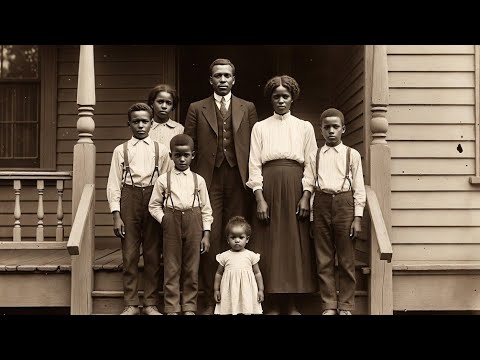
For three hours, she cloned undamaged sections, smoothed stains, and removed a crude earlier repair. By evening, the composition was clear: a man in a dark suit, a woman in a white blouse, and five children ranging from a teenager to a little girl of about four sitting on the porch steps. Maya saved her work and stretched. Tomorrow, she would restore the faces.
The next morning, with fresh eyes and strong coffee, she started with the adults. The man, mid-thirties, had a strong jaw and serious expression, his hand resting on his wife’s shoulder—a gesture of protection and partnership. The woman’s gaze was direct, intelligent, her posture upright despite what must have been the exhaustion of managing a household and five children in 1906 Charleston.
Maya moved to the children: a teenage boy nearly as tall as his father, two girls with braided hair and white ribbons, a seven-year-old boy grinning with a missing front tooth. Then she zoomed in on the youngest—the little girl on the steps, her small hands folded in her lap. The damage here was severe, a large water stain obscuring most of her face.
Layer by layer, Maya removed the discoloration. As the child’s features emerged, she paused. Something was unusual. She increased the magnification. Her breath caught. Even through the grain and imperfections of the old photograph, even accounting for 1906 camera technology, what she saw didn’t make sense—characteristics that wouldn’t be medically understood for another fifty years.
Maya sat back, her mind racing. She had seen every kind of facial feature human genetics could produce, but this was different. This was something the family in 1906 wouldn’t have had words for—something that would have made this child stand out in ways both remarkable and potentially dangerous in the segregated South. She picked up her phone and called Dr. James Wright, a colleague who taught medical history at Columbia University.
“James, I need you to look at something,” Maya said when he answered. “I’m working on a photograph from 1906, and I think I’m seeing signs of a genetic condition in a child’s face. But if I’m right, this condition wasn’t even identified until the 1950s.”
Dr. Wright arrived that afternoon, his curiosity evident. He leaned toward the monitor, studying the child’s face. Maya watched his expression shift from casual interest to focused attention, then to astonishment.
“You’re seeing what I’m seeing?” Maya asked.
James nodded slowly. “If this photograph is authentic—and I assume you’ve verified that—then yes, I’m seeing clear markers of Waardenburg syndrome. Look at the distance between the inner corners of the eyes, what we call dystopia canthorum. And here, this lighter patch in her hair—that would be the characteristic white forelock.”
He pointed to the child’s eyes. Even through the limitations of the old photograph, the difference was visible. One eye appeared deep brown, common in African-Americans. The other was distinctly lighter—a pale blue or gray that created a startling contrast.
“Heterochromia,” James said quietly. “Complete heterochromia—different colored eyes. Combined with these other features, it’s almost certainly Waardenburg syndrome type one.”
Maya felt a chill. “But Waardenburg syndrome wasn’t identified until 1951. This photograph is from 1906.”
“The condition has always existed,” James explained. “Petrus Johannes Waardenburg was simply the first to recognize it as a distinct genetic syndrome and publish research about it. Before that, people with these characteristics were just considered unusual—or in some cultures, marked by God or cursed. For a black child in the segregated South in 1906, looking this different from other members of her community…” He trailed off, the implications clear.
Maya thought about what life must have been like for this little girl. The heterochromia alone would have been startling—light eyes in a black child, one light and one dark, creating an appearance that would have seemed impossible to people who didn’t understand genetics. Add the white forelock and the distinctive facial spacing, and this child would have been unmistakably different.
“In 1906, how would people have understood this?” Maya asked.
James shook his head. “They wouldn’t have. They might have thought she was partially albino or that she had some white ancestry that manifested in unusual ways. Some might have viewed her with suspicion or fear. Others might have considered her special—blessed or cursed, depending on their beliefs. And in Charleston, with its rigid racial hierarchies and segregation laws, a black child who looked different in this particular way…” He paused. “It would have been complicated. Potentially dangerous.”
Maya returned to her computer and pulled up Grace Thompson’s letter. “The woman who sent me this photograph said it’s of her great-great-grandmother’s family. She’s trying to learn more about them. Should I tell her what we found?”
“Absolutely,” James said firmly. “This is part of her family’s story. But more than that, this could be historically significant.”
Maya spent the rest of the afternoon completing the restoration, working with new understanding and care. She enhanced the details of the child’s face carefully, making the distinctive features visible without exaggeration. When she finished, the little girl’s face was clear: the wide-set eyes with their striking difference in color, the white streak in her dark hair, the small, serious expression that suggested a child who had already learned she was different.
Maya printed two copies—one for Grace, one for her own files—then sat down to write an email, choosing her words carefully. She explained the discovery of Waardenburg syndrome, that it wasn’t medically identified until 1951, and that the family in 1906 wouldn’t have had a name for what made this child different. She offered to help research what the child’s life might have been like. Then she hesitated before clicking send. She was about to tell a stranger that their ancestor had a genetic condition—information that might be surprising or even distressing. But Grace had asked her to help see the faces clearly, and this was part of that truth.
Three days later, her phone rang. The caller ID showed a Charleston area code.
“Miss Richardson, this is Grace Thompson. I received your email about my great-great-grandmother’s family photograph.” Grace’s voice was warm but emotional. “I’ve been staring at the restored image for two days. The little girl with the different colored eyes—that’s my great-great-grandmother. Her name was Sarah.”
Maya’s heart skipped. The child in the photograph had grown up. “Do you know anything about her life?”
“That’s why I’m calling,” Grace said. “After I read your email, I went through all the family papers I have—old letters, Bible records, newspaper clippings my grandmother saved. I’ve been trying to piece together Sarah’s story for years, but there are so many gaps. My grandmother never talked much about her own grandmother, and when she did, she was vague. I always wondered why. Now I think I’m starting to understand.”
“What did you find?” Maya asked.
Grace took a deep breath. “I found a letter from 1924 written by Sarah to her daughter, my great-grandmother. In it, she talks about being different all her life—about people treating her with fear or fascination. She mentions a woman named Clara who protected her as a child and taught her everything. I never understood what that meant before, but now…”
“Now you know Sarah had Waardenburg syndrome,” Maya finished. “And in 1906 Charleston, that would have made her very vulnerable.”
“Ms. Richardson, would you be willing to help me find out more about Sarah? About this Clara who protected her? About what Sarah’s life was really like? I have so many pieces, but I can’t fit them together on my own.”
Maya didn’t hesitate. “I’ll come to Charleston.”
Two weeks later, Maya stood in the arrivals area of Charleston International Airport holding a sign with Grace Thompson’s name. Grace emerged from the crowd—a woman in her early fifties with warm eyes and Sarah’s high cheekbones. They recognized each other immediately, and Grace pulled Maya into a hug.
“Thank you for coming,” Grace said. “I know you didn’t have to do this. Restoring the photograph was your job. This is something more.”
“This is history,” Maya replied. “And I want to help you find it.”
They drove into Charleston as the afternoon light turned golden, past elegant historic homes and live oaks draped with Spanish moss. Grace pointed out landmarks—the Old Slave Mart Museum, Mother Emanuel AME Church, the neighborhoods that had been the heart of Black Charleston in the early twentieth century.
“The house in the photograph doesn’t exist anymore,” Grace explained. “It was torn down in the 1950s during urban renewal. But I know the street it was on, and I’ve been researching what the neighborhood was like in Sarah’s time.”
Grace’s home was a modest bungalow in North Charleston filled with family photographs spanning five generations. She had converted her dining room into a research center: a large table covered in organized stacks of documents, a computer, and a whiteboard crowded with notes and a hand-drawn family tree.
“I’ve been working on this for three years,” Grace said, gesturing at the organized chaos. “Ever since my mother died and I inherited all the family papers she’d been keeping. I always knew our family had interesting stories, but I didn’t realize how much history was hidden in these documents.”
She pulled out a cardboard box and carefully lifted a stack of letters wrapped in ribbon. “These are from Sarah. She wrote them to my great-grandmother, her daughter, between 1924 and 1948. Sarah died in 1952, when my grandmother was just a teenager. By then, she wasn’t talking much about the past anymore. My grandmother said Sarah became quiet in her later years—like she was tired of remembering.”
Maya took the letters carefully, aware she was holding pieces of Sarah’s voice from across the decades. The handwriting was clear and educated, each letter dated and addressed with care.
Grace pulled out another document: a small leather-bound book with a broken clasp. “This is what made me reach out to you in the first place. I found it in my mother’s things after she passed. It’s some kind of journal written by someone named Clara Bennett. It covers the years 1902 to 1928, and Sarah is mentioned throughout. But it’s not just a diary—it’s full of medical observations, descriptions of treatments, records of births and deaths in the community. I think Clara must have been a midwife or healer.”
Maya opened the journal. The pages were filled with neat, precise handwriting, each entry dated and detailed. She flipped through randomly and found an entry from August 1906.
Sarah continues to thrive despite the talk among some families. Her eyes and hair make her a curiosity, but she is bright and quick to learn. I have convinced her mother to keep her close to home until she is older and stronger. The world is not always kind to those who are different.
Maya and Grace spent that evening going through Clara Bennett’s journal systematically, reading entries aloud and taking notes. The picture that emerged was of a remarkable woman who had served Charleston’s Black community as a healer, midwife, and informal physician for nearly three decades.
Clara had been born in 1870, the daughter of formerly enslaved people who had learned herbal medicine and midwifery during slavery and passed that knowledge to their daughter. By 1902, when the journal began, Clara was thirty-two and had established herself as someone the community trusted with their most vulnerable moments—births, illnesses, deaths.
The first mention of Sarah appeared in June 1906, the same month as the family photograph.
Delivered Ruth’s fifth child today, a girl they named Sarah. The birth was straightforward, but the child’s appearance is unusual. Her eyes are two different colors—one dark like her parents, one pale blue such as I have never seen in a colored child. There is also a white streak in her hair at the crown. Ruth is frightened, wondering if her baby is cursed. I assured her the child is healthy and whole, just different. I have read of such things in my medical books, though I do not have a name for this particular condition.
“Your great-great-grandmother was born in 1906,” Maya said, looking up from the journal. “This entry is from her birth.”
Grace nodded, tears in her eyes. “Clara was there from the beginning. She knew what Sarah was facing even as an infant.”
They continued reading. Clara’s entries over the following months showed her watching Sarah’s development carefully, noting that the child met all normal milestones—sitting up, crawling, responding to sounds and voices. But Clara also recorded the community’s reactions.
People are talking about Ruth’s unusual child. Some say she is marked by God. Others whisper darker things. I have spoken to several families, trying to educate them, but superstition runs deep. Ruth keeps Sarah mostly at home, which is wise for now, but it cannot last forever.
By 1908, when Sarah was two, the entries showed Clara taking a more active role.
I have offered to help educate Sarah when she is older. Ruth is grateful but worried about how people will react if her daughter learns too much. I reminded her that knowledge is the best protection we can give our children—especially children who will face extra scrutiny for being different.
Maya noticed a pattern. Clara wrote about other children in the community—their illnesses, their growth, their families—but she returned to Sarah again and again with a level of detail and personal investment that went beyond medical observation.
“Clara became Sarah’s protector,” Maya said. “She saw something special in her and decided to shield her from the worst of what she would face.”
Grace pulled out another document: a faded newspaper clipping from the Charleston Messenger, a Black-owned newspaper that had operated in the early twentieth century. The article was dated 1925 and featured a photograph of a young woman in a nurse’s uniform. The headline read: Local Woman Completes Nursing Training.
Maya looked at the photograph, then at the restored family portrait from 1906. The same distinctive features—the wide-set eyes, though the heterochromia was less visible in the newspaper’s lower-quality reproduction.
“That’s Sarah,” Grace confirmed. “She became a nurse. In 1925, in South Carolina, a Black woman with a visible genetic condition became a certified nurse. Do you understand how remarkable that is?”
Maya understood completely. The next morning, they drove to the Charleston County Public Library, where an archivist named Frederick recognized Clara’s name instantly. “My grandmother used to talk about a healer woman named Clara who delivered half the babies in the neighborhood,” he said, disappearing into the back rooms.
He returned with boxes from the Cannon Street Hospital Training School. Grace found the entry first: Sarah, admitted September 1922, sponsored by Clara Bennett, graduated May 1925 with honors. “Clara used every favor she had to make this happen,” Maya read aloud from the journal.
They found Sarah’s employment records next—home visits in Charleston’s east side, forty-five dollars a month. “She went into homes where she might find anything from tuberculosis to malnutrition,” Frederick said. “It took courage.”
At the cemetery, an elderly woman named Dorothy approached Sarah’s headstone. “Sarah delivered me in 1949,” she said softly. “They called her the nurse with angel eyes. She saved my life.”
Three months later, Maya stood in the Charleston Museum at the opening of Hidden Faces, Revealed Lives. The restored photograph hung at the center, Sarah’s striking eyes visible at last. Grace addressed the crowd, her voice breaking. “Sarah grew up when being different was dangerous. But she did it anyway.”
Maya studied four-year-old Sarah one final time—the child who had carried a secret for over a century and turned it into a lifetime of service.
How many other remarkable lives, she wondered, are still waiting to be seen clearly in the faces we’ve forgotten?
Report this article
Select a reason for reporting:






