They said these photos were lost to history—burned, buried, or deliberately erased. They were wrong.
In the dusty archives of forgotten attics and sealed vaults, a treasure trove of images survived. They show a Wild West far wilder, far stranger, and far more human than any textbook ever dared admit. From a teenage girl sprinting through gunfire to a bordello queen draped in black fortune, from lawmen who swapped guns for pens to outlaws who died with their boots on—these are the faces they tried to bury.
Between 1884 and 1887, three women and a soldier rode across the Arizona Territory near Fort Verde. Their presence shattered the myth that the frontier belonged only to men. Lucille Mulhall roped crowds at the 101 Ranch in 1900, America’s first cowgirl in her element. And in 1898 Jerome, Arizona, Jenny Boner stood as the queen of her bordello, draped in black and fortune hard-won in a mining town.
But the West wasn’t just a stage for legends. It was a place where survival meant everything.
In 1897 West Virginia, the Hatfield family posed armed and serious—their feud already carved into American lore. Billy the Kid sat calmly playing cards, his pistol close by, as if death were just another hand to be dealt. Wild Bill Hickok, just 21, stared boldly into the lens in Kansas, already a lawman in 1858. And Wyatt Earp, the lawman of the OK Corral, spent his final years quietly in early Hollywood, a ghost of the gunfight that made him famous.
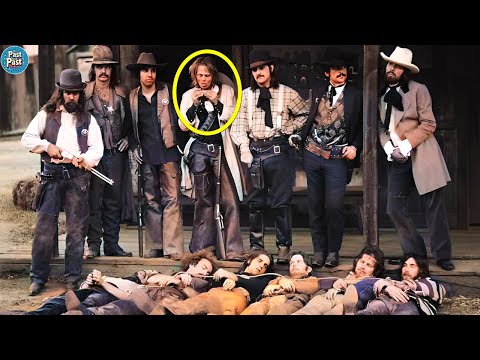
Olive Oatman’s tattooed face told a haunting tale of captivity and survival. This 1890s gang photo shows 11 young men—only two would live to see the 1900s. Jesse James, once a Confederate soldier, became a legend feared across the country for robbing banks and trains. Bat Masterson swapped his gun for a pen, becoming a journalist in New York City. Johnny Ringo, leader of the Cochise County Cowboys, lived and died by the gun in the lawless West.
John Wesley Hardin’s glare mirrored his deadly past—27 men and countless legends trailed him. Cowboys roped a grey wolf on the open prairie in 1887. Inside a rugged Idaho ranch in 1872, Rose Dunn, just a teenager, ran through gunfire to deliver a weapon, earning her place in outlaw legend.
A black Union soldier rested outside a slave auction house in 1864 Atlanta. Buffalo Bill posed with Pawnee and Sioux warriors. His 1895 souvenir photos turned shootouts and raids into collectible pieces of Western myth. Cowboys branded cattle in the early 1900s. Doc Holliday, a tubercular dentist turned gunslinger, made history at the OK Corral.
Annie Oakley became a legend by 16. Four frontier women posed proudly in 1885 Dallas. A man in a loaded burro crossed the Oklahoma plains in the 1890s. Deadwood, 1876—the Big Horn Store anchored a town bursting with miners, dust, and restless ambition. In 1894 Alaska, trappers posed in furs. In 1909, a Washington family posed with rifles and fresh game.
These are the faces they didn’t want you to see—the outlaws, the lawmen, the survivors, the rebels. Each photo is a doorway into a past that refuses to stay buried. But this is only the beginning. The frontier holds more secrets, more stories, and more shadows than any single image can contain. And what lies ahead will challenge everything you thought you knew about the Wild West.
In 1888, a lone cowboy rode near Sturgis, his silhouette against the Dakota sky a study in solitude. He carried no name worth remembering, yet his image outlived every outlaw who thought himself immortal. The frontier had a way of elevating the anonymous and erasing the famous.
That same year, engineers and surveyors marked rugged lands with chains and compasses, carving order from chaos. A Nebraska family stood before their sod home, the butcher’s lens revealing raw pioneer life—mud walls, sun-cracked faces, and a quiet dignity no hardship could strip away.
In 1888, a man rode home with an antelope slung across his saddle, his kill proof of survival and skill in the wild frontier. Oxar Ranch cowboys gathered for dinner in 1886, their laughter echoing off canyon walls. A Yellowstone tribal family in 1871 survived off wild sheep in Idaho’s remote mountain terrain, their story written in footprints and smoke.
By 1902, cowboys gathered near a chuck wagon, sharing breakfast after long rides across the Texas plains. In 1873 Utah, a Native scout watched from a timber tower, his eyes sweeping the wilderness for signs only he could read.
In 1880 Oregon, a proud hunter showed off his kill—antlers and hide—capturing the spirit of self-reliance that defined the frontier. Military Plaza in San Antonio, 1887, buzzed with soldiers, vendors, and the clatter of wagon wheels. Circa 1900, cowboys and horses gathered near Dodge City’s watering hole, the dust of the trail still clinging to their boots.
Glacier National Park, 1912 to 1915—a Native couple rode through wonder, a baby cradled behind, the mountains indifferent to the passage of time. In 1866 Virginia City, wagons crowded the Wells Fargo office, gold dust and secrets changing hands in equal measure.
Montana, 1908. Cheyenne warriors on horseback sat in solemn silence before a coming battle, their faces carved from stone and history. Pine Street in 1881, Abilene teamed with wagons and saloons, the air thick with whiskey and ambition. Lexington, 1900—school kids bumped along in a wagon, learning before the bus was born.
In 1890 North Carolina, horses were swapped mid-patrol, a small moment of frontier practicality. A Texas family in 1918 posed stiff and serious, their faces betraying nothing of the flu that would soon sweep the world.
Circa 1897, miner George Carmack posed with pride, his discovery set to spark a stampede. San Antonio’s Commerce Street in 1892 was alive with hustle, horses, and a growing South Texas spirit. From 1895 to 1896, students and teachers posed in a camp school—books scarce, hope abundant.
Tonopah, 1902. Two women posed boldly on horseback, one rumored to be Wyatt Earp’s wife. Water burst from an artesian well in the 1880s, Kern County hope flowing in drought-stricken California. Circa 1900 Nebraska, a local saloon buzzed with pool games and stiff drinks, the click of balls a soundtrack to frontier leisure.
Between 1885 and 1890, ox-drawn wagons carried immigrant families across Texas, chasing hope through the San Angelo dust. In 1873, Sheridan hunters lived in makeshift homes, their camp a cluster of canvas and smoke. Mounted Black cowboys in Bonum, Texas, stood proud, defying odds with strength, dignity, and quiet defiance.
Dodge City, 1872, armed its visitors—a town where the welcome mat was a loaded shotgun. In 1880 Montana, the Bob Saloon opened its doors to dusty travelers. Four men strolled Eureka’s dusty streets in 1900. Gold Edge, Montana, 1905—shops, horses, and stillness defined a town built on mining grit and daily grind.
Around 1890, four men and a bartender posed inside a saloon, captured by John C.H. Grabill. Native men skinned a bovine, their hands moving with the precision of centuries. In 1913, Mississippi cotton mill kids labored long hours, their childhoods spun into thread.
An early 1900s Raton restaurant stood sturdy, wooden beams and plain design echoing the heart of small-town America. In 1875, Jim Hawkins posed with pride, rifles in hand—founder of Texas’s Company D and symbol of frontier law. In 1889 Soda Springs, eager travelers packed into a carriage headed for healing waters at the famed hot springs.
In 1887 Arizona, tents at Peck Lake Camp showed the rugged setup of hunters deep in wild country. At Nevada’s Damar newspaper office in 1895, workers printed by hand, ink-stained fingers shaping the news of the day. This 1900 photo of Morenci’s copper mine shows industry carved from dust, where heat and metal shaped a desert empire.
In 1890 Santa Fe, dusty streets lined with shops and saloons buzzed with life in the heart of the southwestern frontier. At King Ranch in 1890, five Texas Rangers stood tall, rifles raised and ready in the name of Western justice. In 1907 Texas, school children gathered outside a one-room building, learning with grit where books were few and hope was high.
But even as towns grew and schools opened, the old ways refused to die. In 1873, near Camp Apache, armed Kiowa warriors stood tall—proud symbols of Native resistance on a frontier that was shrinking beneath their feet. And what happened next would tear the West apart.
Apache spirit dancers in 1887 wore haunting masks, their bodies moving in rhythms older than any treaty. Between 1887 and 1892, Native leaders met US officials, capturing tense negotiations as expansion swept across tribal lands. Every handshake in those photographs concealed a broken promise. Around 1900, Harry Pton played fiddle by the fire, his music a small rebellion against silence.
In 1886 Nebraska, a pioneer family followed their wagon, their belongings stacked like a prayer against the sky. In 1907, Adele von Ohl Parker dazzled the Wild West crowd—her horse-riding mastery lit up Buffalo Bill’s big show, a woman commanding the ring while men cheered. Circa 1895 in Creede, Colorado, a packed platform showed how railroads brought life and connection to remote western towns.
Wilton, North Carolina, 1890—quiet streets and scattered wooden buildings, the frontier’s edge fading into memory. In 1880 Bodie, California, crowds gathered outside the Mono Bank, gold fever driving wild growth in the iconic boom town. Between 1880 and 1890, Native camps with tents and meat racks reflected food preservation traditions passed down through generations.
Before 1900 in Colorado, a miner rested beside his family, power lines hinting at progress near the depths of a major mine. Native chiefs on horseback in 1905 showed strength, culture, and quiet resistance—their eyes fixed on a horizon that was no longer theirs. In 1889, the Grand Minnetonka Hotel stood in South Dakota, luring visitors to hot springs healing waters and frontier luxury.
Around 1900, a traction engine hauled freight across the Mojave Desert, driving western progress one iron wheel at a time. In 1895, deep underground in Nevadaville, weary miners posed with faces lit by grit, surrounded by the shadows of danger. In 1875 Utah, a man developed photos by hand, showing early photography’s craft—each image a small miracle of chemistry and patience.
On May 14, 1862, freed Black Americans gathered in Virginia, their faces carrying the weight of a new beginning. Cowboys rested by the Yellowstone River with fire pits and gear in the rugged outdoors. In 1887, Colla Texas Rangers posed with pride, embodying frontier lawmen whose stories became dime novel legends.
Founded in 1882, Kingston thrived after silver’s discovery—once home to legends like Twain and Cassidy. Around 1903, women shot pool with bold smiles, defying social norms and claiming space in a man’s saloon world. Tents lined Pine Ridge in 1891, showing army presence after the Wounded Knee tragedy—a wound that would never fully heal.
In 1875 Utah, LDS missionaries baptized Paiute natives, an image of faith meeting tradition on the western frontier. Native women gathered in a roofless tent, sharing community life. Around 1908 in Kansas, a boy gripped a rifle as his family rode a wagon. In the early 1900s, a Lakota family stood outside a wooden cabin, showing strength and adaptation.
In 1886 Colorado, Bogard and Ice Steel stood proud outside their pawn shop. Ore wagons rolled through Silver King, Arizona, during the mining boom of the 1880s. This 1890 saloon scene captured laughter, drinks, and bold personalities. San Francisco residents watched as fire destroyed homes after the 1906 earthquake.
In 1889 South Dakota, three men and their dog braved icy water, chasing gold dreams and frozen streams. Courtney’s tent store in 1899 Alaska aided Klondike prospectors on their icy journey. In 1899, General Kby stood with rifle in hand, ready for battle in the distant Boer War.
But beyond the gold camps and saloons, another story was unfolding—one that would redefine the frontier forever.
In 1871, cowboys and Native Americans posed together, a rare peaceful moment frozen before the storm. In 1874 Utah, a native boy rested beside his dog, the simple bond outlasting empires. Gold miners in 1898 Alaska posed in snow, chasing Klondike fortune through frozen rivers and shattered dreams.
Between 1887 and 1892, cowboys roped a buffalo midstrike, the beast’s power humbling every rider. A busy 1800s grocery store sold meats and liquor, alive with daily trade. In 1889 West Union, Art Pullum stood with hunting gear—quiet strength built for daily frontier survival.
Around 1900, gamblers focused on cards at Bisby’s Orient Saloon, a true Wild West scene. Armed guards protected a Wells Fargo wagon in 1890 Sonora, ready for stagecoach robbers. Texas outlaw turned sheriff John King Fischer became legend after a violent end.
Wagons crossed the Colorado River in 1903, guided by rope and grit. Geronimo and Apache prisoners, 1886—their eyes still held the fire of a people unconquered.
These photos were never meant to be seen. Now they are yours. Which face will you never forget?
Report this article
Select a reason for reporting:






