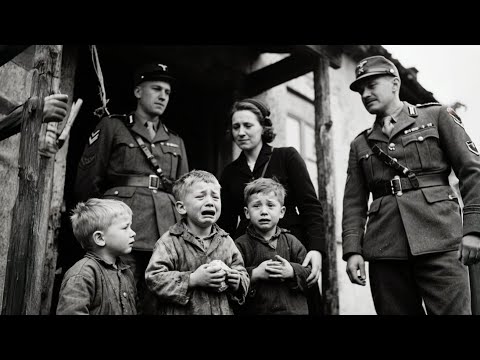
Bavaria, May 1945. The village of Graffinir lay silent in the morning light, smoke from destroyed buildings drifting through empty streets like ghosts. Sergeant John Wallace pushed open the door of a stone house, his rifle ready—and stopped. Three children sat on the floor, too weak to stand, their eyes enormous in faces that were mostly skull. The youngest couldn’t have been more than four. In the corner, their mother knelt with her hands pressed together, not in surrender, but in prayer. Wallace lowered his weapon. He’d seen combat for 11 months, but nothing had prepared him for this.
The war in Europe had ended on May 8th, but the suffering didn’t stop with the signatures. Germany was a landscape of destruction—cities reduced to rubble, transportation networks obliterated, agricultural systems collapsed. The civilian population, which had endured years of rationing and bombing, now faced a crisis more immediate than occupation: starvation.
Sergeant Wallace had arrived in Germany with the Third Infantry Division in March 1945, part of the final push into Bavaria. He was 26, from Iowa, the son of farmers who’d survived the Depression by sheer stubbornness and careful resource management. He understood hunger, had seen it during the Dust Bowl years. But what he encountered in the weeks after Germany’s surrender was different. This wasn’t economic hardship. This was systematic collapse.
The village of Graffinir was small, maybe 2,000 people before the war, and strategically insignificant. But refugees fleeing eastward from advancing Soviet forces had swollen its population to nearly 5,000. Food supplies had been cut off. The black market charged prices only the wealthy could afford. Everyone else starved.
Wallace’s unit was assigned occupation duties—maintaining order, searching for weapons, processing displaced persons. Standard procedures for an army that had just defeated an enemy and now had to manage the aftermath. But within days of arriving, Wallace realized that the most pressing issue wasn’t security. It was survival.
The first house he searched belonged to the Mueller family. Hinrich Mueller had been a school teacher before the war, called up for service in 1943, captured by Americans in France in 1944. He was still in a POW camp somewhere. His wife Anna remained in Graffinir with their three children: Hans, age 8; Greta, age 6; and little Friedrich, age 4.
When Wallace knocked, Anna opened the door slowly, her face gaunt, her dress hanging loose on a frame that had lost perhaps 40 pounds. Behind her, the children sat on the floor because they lacked the energy to stand. The house smelled of damp stone and nothing else—no cooking odors, no wood smoke, just cold emptiness.
Wallace had been briefed on non-fraternization policies. Don’t get friendly with the Germans. Don’t share rations. Maintain professional distance. The enemy might be defeated, but they were still the enemy. But standing in that doorway, looking at children whose ribs stood out like ladder rungs, policy seemed abstract and irrelevant.
“When did they eat last?” Wallace asked through his interpreter, Private David Klein, who’d grown up speaking German in Milwaukee.
Anna’s hands trembled as she answered. Klein translated: “Three days ago. Potato soup. The last potatoes.”
“Where’s the father?”
“Prisoner. American camp. I don’t know where.”
Wallace looked at the children again. Hans stared back with eyes that held no hostility, no fear—just exhausted acceptance. Greta leaned against her brother, her breathing shallow. Friedrich had stopped moving entirely, his face pressed against the cold floor.
“Wait here,” Wallace said.
He returned to the temporary command post his unit had established in the village square. His commanding officer, Captain Robert Morrison, was reviewing requisition forms when Wallace entered.
“Sir, we’ve got a situation.”
Morrison looked up. He was 32, a lawyer from Philadelphia in civilian life—practical and by the book.
“What kind of situation?”
“Civilian starvation. I just searched a house—three kids who haven’t eaten in days. And that’s not an isolated case. From what I’ve seen, half the village is in the same condition.”
Morrison set down his pen. He’d known this was coming. The intelligence briefings had warned that German civilian populations were facing food shortages, but knowing abstractly and confronting it directly were different things.
“What do you want me to do about it, Sergeant?”
“We’ve got rations. We’re eating three times a day. These people are dying.”
“They’re enemy civilians.”
“They’re children.”
The two men stared at each other. Morrison had spent 11 months enforcing military discipline, following orders, maintaining the chain of command that kept an army functional. But he’d also spent 11 months watching young men die. And somewhere in that experience, he’d developed a pragmatic sense of what mattered and what didn’t.
“All right,” Morrison said finally. “Medical emergency exception to non-fraternization policy. You can distribute emergency rations to prevent imminent death, but document everything. If this becomes a scandal, I need paper trails showing we followed humanitarian protocols.”
Wallace nodded and left before Morrison could change his mind.
He returned to the Mueller house that afternoon with a box of rations: canned meat, crackers, chocolate, powdered milk. Not generous portions, but enough to keep three children alive. Anna opened the door, saw the box, and her knees buckled. She caught herself against the doorframe, tears streaming down her face.
“Danke,” she whispered. “Danke, danke, danke.”
Wallace set the box on the floor. The children stared at it like it might disappear. He opened a can of Spam, cut it into pieces with his utility knife, handed portions to each child. They ate slowly, their stomachs too shrunken to handle much food at once.
“Tell her they need to eat small amounts frequently,” Wallace said to Klein. “Too much at once will make them sick.”
Klein translated. Anna nodded, unable to speak, just holding Friedrich against her chest while the boy ate his piece of Spam in tiny bites.
Word spread quickly. By evening, a line had formed outside the command post—mothers with children, elderly people who could barely walk, a few men too old or injured for military service. All of them starving. All of them desperate.
Captain Morrison looked at the line and made another decision that violated policy. He authorized the distribution of rations to anyone who could demonstrate genuine need. The criteria were simple: if you looked like you were dying, you got food.
Wallace and his squad—eight men who’d fought from Normandy to Bavaria—became an impromptu relief organization. They moved through the village house by house, assessing conditions, distributing rations, trying to prevent deaths that would happen if they did nothing.
Private Tommy Martinez from Texas carried a little girl named Lisel four blocks to the medical station because she was too weak to walk. Her mother walked beside him crying, apologizing in broken English, thanking him over and over. Martinez, who’d shot German soldiers in combat three weeks earlier, felt something crack inside his chest.
Corporal James O’Connor from Boston found an elderly couple in their eighties who’d been locked in their apartment for days, unable to descend the stairs for lack of strength. He carried them both down one at a time, settled them in the makeshift aid station, brought them soup he’d made by mixing K-rations with hot water.
Private First Class William Chun, Chinese American from San Francisco, discovered a woman trying to nurse an infant despite being so malnourished she’d stopped producing milk. Chun brought powdered formula, showed her how to mix it, stayed while the baby drank, making sure mother and child were stable before leaving.
The stories multiplied. Each house revealed another crisis. Each intervention prevented another death. The soldiers worked fourteen-hour days distributing food, cleaning wounds, carrying people too weak to move—doing the basic work of keeping human beings alive.
Not everyone approved. Lieutenant Colonel Frank Benson arrived from division headquarters on the third day, walked through Graffinir, observed the relief operations, and called Morrison into a commandeered office.
“Captain, what the hell do you think you’re doing?”
Morrison stood at attention. “Sir, we’re preventing civilian deaths in accordance with Geneva Convention obligations regarding occupied territories.”
“You’re fraternizing with the enemy. You’re giving them our rations while American soldiers in the Pacific are still fighting and dying.”
“These are children, sir. Non-combatants. Starving non-combatants.”
“They’re German. Their fathers and brothers wore uniforms and shot at us. Their government started this war and fought it until their cities were rubble. Why should we feed them now?”
Morrison had anticipated this argument. He’d prepared a response that was tactical rather than emotional. “Sir, if we let civilians die in areas under our occupation, we create a humanitarian disaster that will undermine our authority and potentially spark resistance movements. Dead children create martyrs. Fed children create stability.”
Benson studied him coldly. “That’s a very convenient rationalization, Captain.”
“It’s also the truth, sir.”
Benson left without issuing direct orders, which Morrison interpreted as tacit approval. The relief work continued, though everyone understood they were operating in a gray area where policy hadn’t caught up with reality.
But the real resistance came from within the unit itself. Sergeant Carl Davis, who’d lost his brother at Omaha Beach, confronted Wallace one evening while they were inventorying remaining rations.
“You’re giving food to the people who started this war,” Davis said. His voice was flat, controlled anger barely contained.
“I’m giving food to children who didn’t start anything.”
“Their parents voted for the regime. Their fathers served in the military. They supported everything that led to this.”
Wallace didn’t have a good counterargument, because Davis wasn’t entirely wrong. Collective guilt was a complicated question. But individual starvation wasn’t complicated at all.
“Look,” Wallace said, “I can’t fix the past. Can’t bring your brother back or undo the war. But I can give a can of Spam to a four-year-old who’s dying. So that’s what I’m doing.”
“It’s not justice.”
“No. It’s mercy. Sometimes that’s more important.”
Davis walked away without responding. But the next day, Wallace saw him carrying a bag of rations into a house where a family of six was living in two rooms. Davis didn’t mention it, and Wallace didn’t ask. Some transformations happened without words.
By the second week, the immediate starvation crisis had stabilized. People were eating enough to stay alive, but malnutrition had done damage that food alone couldn’t fix. Children developed vitamin deficiencies that manifested as bleeding gums, night blindness, muscle weakness. Elderly people’s immune systems had collapsed, leaving them vulnerable to infections that would have been minor under normal circumstances.
The division medical officer, Captain Richard Hayes, established a clinic in the village church—the only building large enough to accommodate the caseload. He worked eighteen-hour days treating conditions he’d only read about in medical school: scurvy, pellagra, severe protein deficiency.
One afternoon, Anna Mueller brought Friedrich back to the clinic. The boy had been eating regularly for ten days but wasn’t improving. He remained lethargic, his skin developing a yellowish tint, his belly distending despite the food intake.
Hayes examined him carefully. “How long has he been like this?”
“Since winter,” Anna said through Klein’s translation. “He got sick in January. I thought it was just hunger.”
Hayes recognized the symptoms: protein deficiency so severe it had caused edema and possible liver damage. The boy needed specialized treatment—vitamins, protein supplements, careful monitoring. Treatment that exceeded what a field medical station could provide.
“He needs a hospital,” Hayes told Anna. “A real one. Can I arrange transport to the military hospital in Munich?”
Anna’s face went white. “They’ll take him from me.”
“No. You can go with him. We’ll arrange papers, transportation, everything. But he needs treatment I can’t provide here.”
Anna looked at her son, at the American doctor whose kindness made no sense after years of propaganda about enemy cruelty—and nodded.
Friedrich and Anna left for Munich the next day in a jeep driven by Private Martinez. Hayes wrote a detailed medical referral, and the hospital admitted the boy immediately, assigning Anna a cot beside his bed. Hayes never learned if Friedrich fully recovered—the chaos of postwar Germany swallowed individual stories—but he’d done what he could, and that had to be enough.
Not every encounter ended simply. Elizabeth Hoffman barricaded herself and her five children inside, screaming through Klein that she’d rather die than accept help from the people who destroyed her home. Wallace looked past her at the children, still as stones. “Tell her she has every right to hate us. But tell her the children don’t deserve to die for that hatred.”
Elizabeth crumpled, sobbing in the doorway. Her youngest, Anna, was within an hour of death when the medics arrived. She survived.
On the third day, Elizabeth found Wallace. “I teach lies,” she whispered. “You save my children. I am sorry.”
The weeks that followed turned starving civilians into people with names. Martinez learned Lisel loved to sing. O’Connor heard the Bergmans’ bakery recipes. Chun befriended Stefan, a teenager who dreamed of rebuilding Germany as an engineer.
When the division received transfer orders in June, the village gathered in the square. Anna Mueller pressed a hand-carved wooden horse into Wallace’s hands—one Hinrich had made before the war. “For remember,” she said.
Decades later, the horse sat in a museum in Graffinir, mute testimony to a choice. Wallace kept his on a shelf until 1998, telling his children that history is made of small moments—a can of Spam, a carried child, mercy chosen when policy said otherwise.
What small choice in your own life might be rippling forward through generations right now, without your ever knowing it?
Report this article
Select a reason for reporting:






