September 12th, 1944. The transport truck rattled to a stop outside Camp Concordia, Kansas, and 23 German women sat frozen in the canvas-covered darkness. They had been captured in France, members of the Women’s Auxiliary Corps, and now they were being delivered to a fate they could only imagine through the lens of propaganda. Elise Kohler pressed her face to a gap in the canvas and caught her first glimpse of the American heartland—endless wheat fields stretching toward a horizon so vast it made her dizzy. She had expected prison walls, guard towers, brutal conditions. Instead, she saw farmland that looked almost peaceful in the late summer light.
“You will be fed,” Captain Ruth Callaghan told them in rough German. The words hung in the air like an unexpected gift. Elise felt her stomach clench. She couldn’t remember the last time she had eaten a full meal.
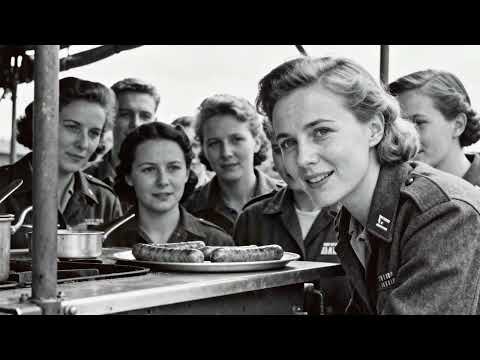
They were marched toward a long wooden building. Through the windows, Elise caught sight of something that made her stop so abruptly that Britta bumped into her from behind. Long metal tables. Trays of food. Not scraps, not thin soup or stale bread—actual food. Sausages glistening with moisture, bread that appeared soft and fresh, containers of what might be fruit.
Sergeant Devereaux gestured toward the tables with a casual wave. “Vienna sausages, help yourself.”
No one moved. 23 German women stood in a semicircle, their eyes fixed on the small pink cylinders as though they might suddenly vanish like a mirage. In their experience, food had become a tool of control, doled out in carefully measured portions that kept you alive but always hungry. The idea that their captors would simply offer abundance violated everything they understood.
It was Sophie Reimann who broke the spell. The older woman stepped forward with deliberate slowness, her movements careful as though approaching a wild animal. She picked up a single Vienna sausage, holding it in her palm like something precious. She looked at Captain Callaghan, waiting for the reprimand, the slap, the punishment for her presumption. Instead, the American officer simply nodded.
That small gesture unleashed something. Sophie bit into the sausage, and the expression that crossed her face was almost painful to witness. Within seconds, the other women surged forward, their carefully maintained military discipline evaporating in the face of genuine food. Elise found herself at the table, her hands shaking as she picked up three sausages. The texture was strange—softer and smoother than any German sausage she remembered, with a slight sweetness that surprised her.
She had expected the Americans to stop them, to laugh at their desperation or snatch the food away as some cruel joke. Instead, Sergeant Devereaux simply watched with an expression Elise would later recognize as sadness. Private Henry Tucker, a young soldier who looked barely older than Lotte, brought out additional trays. More sausages, fresh bread, small paper cups filled with fruit cocktail swimming in sweet syrup.
Britta sat down on a bench, tears streaming down her face as she chewed, unable to reconcile American generosity with everything she had been taught to believe. Elise looked down at her hands, still holding a half-eaten sausage, and felt the first tremor of doubt about everything she thought she knew.
The days that followed established a rhythm that felt surreal in its ordinariness. Each morning at 6:00, the women were awakened not by shouting or harsh bells, but by Corporal Elena Ramirez, who knocked gently and announced breakfast in accented but clear German. Breakfast became a daily miracle—scrambled eggs, toast with actual butter, sometimes even strips of bacon that crackled with salt and fat. The women ate with continued disbelief, waiting for the day when the abundance would end. But that day never came.
After the first week, Sergeant Devereaux proposed that the German women help with kitchen duties. Elise volunteered first, driven partly by boredom, but mostly by a desire to understand these strange Americans who fed their enemies better than Germany had fed its own soldiers. Working beside Sergeant Devereaux and Private Tucker, she began to see American abundance from a different angle. The supplies that arrived weekly were staggering—crates of canned goods, sacks of flour and sugar, fresh vegetables and meat. Private Tucker, the farm boy from Kansas, explained in simple English that his family’s farm produced more wheat than they could use. “America has mucho food,” he said, gesturing broadly. “Plenty.”
The concept was difficult to grasp. How could a country at war have so much that they could feed enemy prisoners generously? In Germany, even before the war, there had been rationing and shortages. The idea of surplus, of waste even, seemed almost obscene.
Elise’s English lessons began by accident. She was helping Sergeant Devereaux prepare lunch when he pointed to a large pot and said something she didn’t understand. She stared blankly, and he repeated the word more slowly. “Pot.” She repeated it carefully, and his face broke into a wide grin. Within days, their communication had expanded beyond simple gestures. She began carrying a small notebook, writing down new words phonetically and practicing them during evening hours. Captain Callaghan noticed her progress and began stopping by the kitchen to conduct informal lessons, teaching Elise more complex phrases with patient persistence.
The other women watched with mixed reactions. Sophie approved, arguing that understanding their captors’ language was practical. Britta seemed almost jealous, though she lacked the confidence to join. Käthe remained suspicious, convinced that learning English was a betrayal. But Lotte, the youngest, began shadowing Elise in the kitchen, picking up words with the quick absorption of youth.
Food became the vocabulary through which understanding grew. Elise learned that Vienna sausages were not from Vienna at all, but an American creation named for the Austrian city. She learned the word cornbread and tasted the golden, slightly sweet bread that Private Tucker’s mother had taught him to make. She learned casserole and meatloaf and dozens of other terms for dishes that had no German equivalent. But more than vocabulary, she was learning about American abundance through their relationship with food. Sergeant Devereaux explained that his family in Louisiana had been poor, but never hungry. “There was always something to eat,” he said, “even if it was just rice and beans.” The concept fascinated and disturbed Elise in equal measure. In Germany, poverty and hunger had always been intertwined.
In late October, Captain Callaghan announced that the camp would observe Thanksgiving in November, and she wanted the German women to help prepare the feast. She explained the holiday’s origins in halting German—pilgrims and Native Americans, a celebration of harvest and gratitude. The women listened with polite confusion. A holiday centered entirely around eating seemed excessive, almost wasteful. But Captain Callaghan was insistent, and she asked Elise to help translate recipes and cooking instructions.
As November approached, the kitchen became a site of intense activity. Sergeant Devereaux ordered supplies that seemed impossibly extravagant. Turkeys—multiple turkeys—sweet potatoes, cranberries, pumpkins for pies. He showed Elise how to make stuffing, how to baste a roasting bird, how to whip cream until it formed soft peaks. She worked beside him, learning not just cooking techniques, but something deeper about a culture that expressed love and community through the generous sharing of food.
November 23rd, 1944. Elise woke before dawn, her stomach tight with anticipation that had nothing to do with hunger. Today was Thanksgiving, and the kitchen had been preparing for three days straight. She dressed quickly and made her way across the compound in the pre-dawn darkness, her breath forming small clouds in the cold Kansas air. Inside the kitchen, Sergeant Devereaux was already working, his sleeves rolled up as he basted the massive turkeys that had been roasting since midnight. The smell was overwhelming—rich and savory in a way that made Elise’s mouth water despite her nervousness.
By noon, the dining hall had been transformed. Long tables covered with white cloths held more food than Elise had seen in one place since before the war. Three enormous turkeys, their skin golden and glistening. Mountains of mashed potatoes swimming in butter and cream. Sweet potato casserole topped with pecans. Green beans cooked with bacon. Cranberry sauce that gleamed like rubies. Fresh baked rolls that Private Tucker had spent all morning perfecting. And pies—so many pies—pumpkin and apple and pecan, their crusts flaky and perfect.
The German women filed in at Captain Callaghan’s invitation, and the sight stopped them in their tracks. This wasn’t a meal; this was abundance taken to an almost obscene extreme. Britta’s hand found Elise’s arm, gripping it tightly as though she needed physical support to process what she was seeing. Even Sophie, usually so composed, stood with her mouth slightly open in undisguised shock.
But what made the moment truly surreal was the presence of American families from the nearby town. Mrs. Florence Whitmore had arrived with her church group, bringing even more food to add to the already overflowing tables. She approached the German women with a warm smile that seemed genuine rather than forced, greeting them in careful German that Captain Callaghan had helped her practice. “Welcome. Today we give thanks together.”
The meal began with Captain Callaghan offering a brief speech about gratitude and the American tradition of sharing harvest abundance with neighbors and strangers alike. Elise translated for the women who still struggled with English, though the message seemed clear enough without words. They were being invited not just to eat, but to participate as guests rather than prisoners.
What followed was perhaps the strangest few hours of Elise’s life. She sat at a table between Mrs. Whitmore and Sergeant Devereaux, eating turkey with cranberry sauce, learning to appreciate the strange sweetness of candied yams, trying pumpkin pie for the first time and finding it unexpectedly delicious. Around her, the other German women were having similar experiences. Their initial wariness gradually melting into something approaching enjoyment. Lotta actually laughed at something Private Tucker said, her young face lighting up in a way Elise hadn’t seen since their capture. Britta accepted a second helping of mashed potatoes with tears in her eyes. Even Käthe, still suspicious, couldn’t entirely hide her appreciation.
The letter arrived on December 4th, addressed to Britta Lindemann through the International Red Cross. It was the first communication any of the women had received from Germany since their capture, and word spread through the barracks within minutes. The women gathered around as Britta opened the thin envelope with trembling hands, her face pale in the weak winter light filtering through the windows.
The letter was from her aunt in Berlin, written in a shaky hand that suggested either age or distress. Britta read it silently first, her expression growing increasingly stricken. Then, in a voice barely above a whisper, she began to translate for the others. Her parents’ apartment building had been destroyed in an Allied bombing raid in August. They had survived, but were now living in a single room with three other families. Food rations had been cut again. Her younger brother, only 16, had been conscripted into the Volkssturm. Her aunt wrote that she was eating one meal a day, usually potato soup thin enough to see through. She had sold her wedding ring for a loaf of bread.
The words hung in the air like an accusation. Elise felt her stomach turn, and not from hunger. That morning she had eaten scrambled eggs, toast with jam, and two Vienna sausages. She had actually left food on her plate because she was full. The contrast was obscene.
Sophie sat down heavily on her bunk, her face unreadable. “We are eating better as prisoners than they are as free Germans,” she said quietly. The observation was simple and devastating in its truth.
More letters trickled in over the following weeks. Käthe learned that her family in Hamburg was surviving on ration cards that provided barely 1,200 calories a day. Lotte received word that her mother had died, though the cause was unclear—starvation, illness, or simply the accumulated weight of loss, the letter didn’t specify. Each piece of news from Germany painted the same picture of a country collapsing under the weight of its own ambitions. The women’s relationship with their American meals became complicated, laden with guilt that sat heavy in their stomachs alongside the abundant food.
Elise found herself unable to finish breakfast one morning, pushing away half-eaten sausages while thinking of Britta’s brother scrounging for scraps in ruined Berlin. Sergeant Devereaux noticed her untouched plate and approached with concern. “You sick?” he asked in his simple English. She shook her head, unable to explain the moral complexity of feeling guilty for eating well. How could she tell him that every bite felt like a betrayal of her starving countrymen?
Captain Callaghan understood better when Elise finally found the words to explain. The officer listened quietly, then responded with unexpected wisdom. “Your family is not suffering because you are being fed. They are suffering because your country started a war it could not win. Eating or starving will not change that.”
January 1945 brought news that changed everything. American newspapers began publishing photographs and detailed accounts from the Soviet advance into Poland. The images were grainy and difficult to see clearly, but the accompanying descriptions left no room for misunderstanding. Concentration camps, gas chambers, systematic murder on a scale that defied comprehension. Places with names like Auschwitz and Majdanek that meant nothing to Elise until she read what had happened there.
Captain Callaghan made the newspapers available in the common room, a decision that Private Tucker quietly questioned. “Why show them this?” he asked. “Why make it harder?”
“Because they need to understand what they were part of,” the captain replied. “Even if they didn’t know, especially if they didn’t know.”
Elise found the newspapers after her kitchen shift, still wearing her apron spotted with grease from frying bacon. She sat down to read expecting more war updates, perhaps news of the ongoing fighting in Belgium. Instead, she found herself staring at photographs of walking skeletons in striped uniforms, of piles of emaciated bodies, of ovens designed for purposes her mind initially refused to accept. The article described systematic starvation, deliberate deprivation of food used as a weapon of extermination. While German soldiers and auxiliary workers had received rations, while officers had eaten well, millions had been deliberately starved to death in camps scattered across the Reich.
The irony was sharp enough to draw blood. She thought of every meal she had eaten in the past four months, every Vienna sausage, every piece of buttered toast, every Thanksgiving turkey and slice of pie. She had been eating abundantly while her own country operated factories of starvation.
Sophie found her there an hour later, the newspaper clutched in her hands, tears streaming silently down her face. Sophie picked up another paper and began to read, her expression hardening with each paragraph. The other women gathered gradually, drawn by some unspoken understanding that something fundamental had shifted. They read in silence, passing the papers between them, their faces reflecting the same horror and disbelief.
Britta was the first to speak, her voice hollow. “We received chocolate rations. I remember complaining when they changed brands while this was happening. We complained about chocolate.” The statement hung in the air, a confession and an accusation combined.
Elise remembered those chocolate rations, too. The small squares wrapped in foil that the Auxiliary Corps received monthly. She had saved hers sometimes, making them last, savoring each bite. The memory now felt poisoned, contaminated by the knowledge of where that chocolate had come from, who had been denied food so that German soldiers and workers could enjoy small luxuries.
Käthe stood abruptly and left the room, her face green. They heard her vomiting in the latrine, though whether from physical illness or moral revulsion was impossible to say. Lotte sat with her knees drawn up to her chest, rocking slightly, her youth making the revelation somehow even more devastating. She had been only 16 when she joined the Auxiliary Corps, too young to question, too naive to understand.
May 8th, 1945. Victory in Europe Day. The war was over, and with its end came the question that had haunted the women for months. What happened now?
Captain Callaghan called a general assembly in the dining hall, the same room where they had shared Thanksgiving dinner six months earlier. The 23 German women gathered with a mixture of hope and dread, knowing that this moment would define the rest of their lives.
“Repatriation procedures have been finalized,” Captain Callaghan announced in her careful German. “Transport ships are being arranged to return prisoners of war to Germany. You will be processed through displaced persons camps before being released to return to your homes.” She paused, observing the faces before her. “Those who wish to return will depart within three weeks.”
The silence that followed was heavy with unspoken questions. Return to what? Britta’s family was living in one room, starving. Lotta’s mother was dead. Käthe had received no word from Hamburg in two months and feared the worst. Germany was not just defeated, but devastated, occupied, divided. The country they had served no longer existed in any meaningful sense.
Elise stood slowly, her heart pounding so hard she could feel it in her throat. “Captain Callaghan, may I speak?”
“Permission granted.”
The words came harder than any English lesson she had mastered. “Some of us have been discussing our situation. We understand that Germany is our homeland, but we also understand that the Germany we believed we were serving was built on lies and atrocities.” She glanced at the other women, seeing her own conflict reflected in their faces. “We have been treated with more dignity and kindness as prisoners here than we ever received as servants of the Reich. We have been fed while our countrymen starved. We have been shown mercy we do not deserve.”
Sophie rose to stand beside her, followed by Lotta and Käthe. Britta remained seated for a long moment before finally standing as well, tears already streaming down her face. Five women in total, half of the original group that had arrived the previous September.
“Captain,” Elise continued, her voice steadier now, “we wish to know if there is any possibility of remaining in the United States. Not as prisoners, but as immigrants. We understand this is unprecedented. We understand we have no right to ask, but we are asking anyway.”
The American soldiers exchanged glances of complete surprise. Sergeant Devereaux looked at Captain Callaghan with raised eyebrows. Private Tucker’s mouth hung slightly open. This was not a scenario anyone had prepared for. Prisoners of war did not ask to stay with their captors.
Captain Callaghan recovered her composure first. “I will need to contact my superiors in Washington. This is beyond my authority to approve, but I will present your request.” She looked at each of the five women standing before her. “I need to understand your reasoning. Why would you choose to stay in a country that was your enemy?”
Elise answered without hesitation. “Because here, we were treated as people, not as tools of a lie.” Captain Callaghan nodded slowly, and the long wait for Washington began. Weeks later, word arrived: temporary residency granted, pending review. The five women wept and laughed in the same breath.
Twenty-two years later, on a bright June morning in 1967, Elise pulled a tray of Vienna sausage rolls from the oven of her bakery on Main Street in Concordia. The scent of fresh bread filled the air, just as it had in her father’s Munich shop.
Mrs. Whitmore stopped by for her Tuesday purchase, chatting about Britta’s new baby. Sophie taught German at the high school. Lotte nursed at the local hospital. Käthe, who returned to Germany in 1951, still wrote letters.
Elise thought of that first day—the trays, the trembling hands, the impossible words. “Help yourself.” She had taken more than sausages. She had taken a chance on hope.
What would you have chosen—the ruins of home, or the mercy of strangers?
Report this article
Select a reason for reporting:






