In 1934, walking into a Midwestern bank meant facing a man with a Thompson submachine gun, a bulletproof vest, and four armed accomplices—not some amateur with a note. The teller wasn’t just worried about losing money; he was worried about his life. And if the robbers decided to take hostages, he might spend the next twenty miles clinging to the side of a getaway car, wind whipping his face, as bullets flew. This was the Public Enemy era, and the men behind these heists were not amateurs—they were folk heroes to some, and nightmares to others.
Today, we’re diving into the most insane, audacious, and flat-out unbelievable bank robberies of the Great Depression. Forget Bonnie and Clyde—they were small-time. We’re talking about the heavy hitters: the guys who hit two banks in one day, the man who broke out of an escape-proof jail with a piece of wood, and the gang that turned downtown Sioux Falls into a shooting gallery.
Let’s start in Oklahoma. November 1st, 1932, in Tulsa. Pretty Boy Floyd—his friends called him Chock—walks into a bank in his own hometown. Half the town knew him by sight. He’s not wearing a mask. He says hello to people on the sidewalk on the way in. And when he comes out with $2,530 in cash, nobody calls the cops because half the town is silently rooting for him. The locals called him the Robin Hood of Cookson Hills. The rumor was that Floyd would tear up mortgage papers when he robbed a bank, burning the debts of struggling farmers. Most historians say it was exaggerated, but the people believed it hard enough that bank insurance rates in Oklahoma doubled.
On December 12th, 1931, Floyd pulled off the most efficient bank robbing day of the Depression: he robbed the bank in Paden, then drove down the road and robbed the bank in Castle—two banks, one afternoon, same Tommy gun. He was so unbothered that he often introduced himself by name during the robbery. “Hey, I’m Charles Floyd. Would you mind opening that drawer for me?” Try that today and see how it works out.
Now, jump forward to March 6th, 1934, Sioux Falls, South Dakota. The Security National Bank and Trust. This one is so wild that the local newspaper had to stack six headlines on the front page just to fit the story. The crew: John Dillinger and a fistful of associates, including a 5’4″ fireplug of pure violence named Baby Face Nelson. They came in with Thompson submachine guns. While they’re cleaning out the cash drawers, the alarm gets tripped. Outside, motorcycle officer Hale Keith pulls up. Baby Face Nelson, standing at a second-floor window, swings the machine gun out and cuts Keith down before he even gets off his motorcycle. The newspaper described Nelson as gloating while he did it. Keith somehow lived—a miracle.
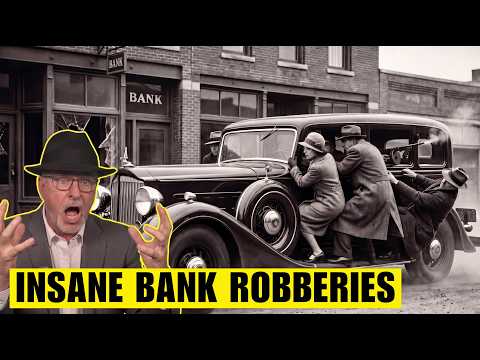
Now the bank’s a fortress, and the gang has to get out. They grab five employees—Mildred Bostic, Emma Kabatch, Mary Lucas, Alice Belgian, and Leo Olson—and make them stand on the running boards of the getaway Packard. That’s a strip of metal about as wide as a shoe. Five people clinging to the side of the car, wind hitting them in the face, police shooting at the car they’re physically attached to. They were what I’d call bullet stoppers. The gang got out with $46,000. The hostages were eventually dumped on the side of the road and walked back to town in the cold.
Two weeks before Sioux Falls, the same core group had shot up a resort in northern Wisconsin called the Little Bohemian Lodge, trying to dodge an FBI raid. Melvin Purvis and his men accidentally gunned down three innocent civilians in the dark while Dillinger and Nelson slipped out the back. The disaster embarrassed Hoover so badly that he made the manhunt personal. By Sioux Falls, these men had the full weight of the federal government pointed at them.
If this is sticking with you, hit that subscribe button, because what’s coming next makes Sioux Falls look organized. A week later, March 13th, 1934, in Mason City, Iowa, the First National Bank. Same crew, seven men, one Buick sedan. They expected $240,000. They walked away with $52,000. Why? Because one teller, Harry Fisher, locked himself in the vault and handed out stacks of $1 bills. The big bills stayed in the back. So here’s Dillinger in the lobby with a Tommy gun, smoke filling the air, and a teller passing out dollar bills like he’s making change at the county fair.
And speaking of smoke, the bank guard, Tom Walters, fired a tear gas cartridge from his bulletproof perch, hitting one robber square in the back. The guy’s walking around trailing tear gas like the lead car in a parade. The other gang members tried to shoot Walters but couldn’t penetrate the bulletproof glass. That same glass is still in the Mason City Public Library today.
When the gang fled, they grabbed bystanders off the street, including a pharmacist named C.D. McColloch, and made them ride on the sides of the Buick. Some accounts put the hostage count at 24 people in that one car. As they left town, they threw roofing tacks out the windows to flatten the tires of any cop dumb enough to chase. The Mason City library still has some of those tacks.
The whole thing went sideways when they counted the money on the side of the road and realized they’d been duped. Harry Fisher, the teller, probably needed a clean pair of pants. And Dillinger? He had bigger problems.
We have to talk about the wooden gun. Crown Point, Indiana, January 30th, 1934. The Lake County Jail—what the authorities bragged was escape-proof. On March 3rd, Dillinger walked out the front door with a piece of wood. He carved a block into the shape of a pistol, blackened it with shoe polish, and stuck it in a guard’s ribs. “Hey, this is Dillinger. If you move a muscle, I’ll blow your head off.” The guard believed him. Dillinger grabbed two actual machine guns from the armory, locked the guards in a cell, and walked out. Then he stole Sheriff Lillian Holley’s personal Ford V8 and drove away singing “I’m Heading for the Last Roundup.”
He drove that stolen car across the state line into Illinois—a federal crime under the Dyer Act. That’s the moment J. Edgar Hoover got a legal hook into Dillinger. Melvin Purvis, already hunting Pretty Boy Floyd, added Dillinger to his list. Dillinger’s lawyer later implied the wooden gun story was a fabrication, but Dillinger didn’t care. He wanted the story in the headlines because it made every lawman in America look like a fool.
A couple months before the wooden gun, Dillinger and his crew had pulled the East Chicago job. They walked out with $20,000 and killed a patrolman named William O’Malley. But here’s the detail: Dillinger was wearing a bulletproof vest. O’Malley shot him four times in the chest, and the rounds didn’t penetrate. Dillinger then machine-gunned O’Malley dead. The getaway car had armor steel plating and bulletproof glass. Imagine being a Depression-era cop with a .38 revolver and a wool uniform, rolling up on guys wearing body armor and driving a tank.
That gets us to why these robberies were insane in the first place. It wasn’t just about the loot—it was the showmanship. One out of four working adults had no job. Banks had foreclosed on everything. The newspapers were the only entertainment most people could afford. So when Pretty Boy Floyd told a teller his real name, or Babyface Nelson cracked a joke through a machine gun, or John Dillinger sang a cowboy song while driving the sheriff’s car out of town, that wasn’t just crime. That was theater. It was a giant middle finger to the institutions that had let everybody else’s life burn down.
The bankers and lawmen who wrote the official version of the 1930s—the one where these men were rabid animals—well, the people who lived through it weren’t so sure. That’s why a teller wouldn’t always sound the alarm, why a town like Solsberry never gave Pretty Boy up, and why 20,000 people showed up at his funeral when Purvis and the FBI finally shot him down in a cornfield in Ohio in October 1934.
And three months earlier, in July 1934, Purvis was outside the Biograph Theater in Chicago when Dillinger walked out of the movies and into a trap. The Public Enemy era didn’t end with a dramatic last stand. It ended on a sidewalk under a marquee’s light with a federal agent in the crowd.
The newspapers sold the legend, but the legend had a price. By the time the FBI caught up with them, the glamour had worn off. Baby Face Nelson went down in a hail of gunfire in November 1934, taking two agents with him. Pretty Boy Floyd’s funeral drew thousands, but his death was a lonely one in a cornfield.
The banks got their revenge, not with bullets, but with vaults and alarms. The running boards disappeared, replaced by locked doors and armed guards. The showmanship that made them folk heroes became a liability. In the end, the outlaws were just men with guns, and the government had more guns.
So here’s the question: were they heroes or villains? Or just desperate men in desperate times? Drop a comment below and tell me which outlaw you want me to dig into next.
Report this article
Select a reason for reporting:






