Daniel Reeves stood motionless in the middle of his bakery, staring at the dark display panel of the oven as if it had personally betrayed him. The repair estimate was folded in his pocket—a number that didn’t just fix a machine, it ended a business. The kind of number that quietly closes doors that have been open for decades.
Flour still dusted his hands. A tray of half-prepared dough sat abandoned on the counter. A thin beam of late afternoon light slipped through the front window and stretched across the empty glass display case. Empty. That hadn’t happened before, not even on bad days.
His eyes shifted to the photograph behind the register, slightly crooked. Martha stood mid-laugh, flour on her cheek, holding up a burnt loaf like a trophy. “Proof,” she used to say, “that even failures can feed someone.” Daniel swallowed. The silence pressed in.
Then, a soft chime. The door opened.
Daniel didn’t turn right away. Customers had slowed down months ago. Most days they didn’t come at all. But something about the air shifted—subtle, heavy.
He turned. A man stood just inside the doorway, tall, still, wearing a worn military jacket that had seen more weather than years. His beard was uneven. His face lined in a way that didn’t come from age alone. Beside him, a large, quiet dog—alert in a way that didn’t feel like a pet, more like a partner.
The man didn’t step forward immediately, didn’t speak, just stood there, letting his eyes adjust, or maybe letting the room adjust to him. Daniel noticed the way the dog scanned the room—not nervous, measured, trained.
Daniel wiped his hands on a towel. “What can I get you?” His voice sounded smaller than he intended.
The man hesitated, then shook his head slightly. “Just looking.” But his eyes betrayed him. They drifted to the display case, to the empty shelves, to the single tray of bread behind the counter.
Daniel followed his gaze. There were exactly three loaves left. That was it. No backup, no second batch, no tomorrow if those didn’t sell.
The dog took a small step forward—not pulling, not begging, just present.
Daniel exhaled slowly. “Sit anywhere,” he said.
The man nodded once, moved to the corner table near the window. The dog lay down beside him without being told, perfectly still.
Minutes passed. Daniel pretended to rearrange things that didn’t need rearranging. He kept glancing over. The man didn’t ask for anything, didn’t call out, didn’t complain—just sat there, hands folded, eyes distant, like someone who had learned how to wait, because waiting was all that was left.
The sun dipped lower. The bakery grew dimmer. And Daniel knew something he didn’t want to admit. No one else was coming, not today, not before closing, not before those loaves turned into waste instead of income.
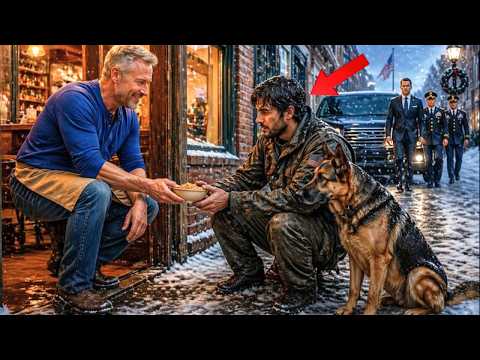
He walked to the counter, picked up one of the loaves—still warm, still soft. He held it for a moment, the way you hold something that matters more than it should. Then he walked over and set it gently on the table.
The man looked up, confused. “I didn’t order.”
“I know.”
Silence. The dog lifted its head, watching.
Daniel nodded toward the bread. “It’s fresh.”
The man didn’t move right away, didn’t reach for it. “Can’t pay,” he said quietly.
Daniel shrugged, didn’t ask. Another pause, longer this time—the kind of silence where pride and need argue with each other.
The man finally reached out, tore a small piece, and gave it to the dog first. The dog took it carefully, no rush, no desperation. Then the man ate, slowly, like someone who had learned not to trust full meals.
Daniel stepped back, returned to the counter, but something inside him had shifted—not relief, not satisfaction, something quieter, something steadier.
The man finished the bread, every crumb. He stood, walked back to the counter. “Thank you,” he said, simple, direct, but it carried weight.
Daniel nodded. The man hesitated, then reached into his pocket, pulled out a small coin, worn smooth, old. He placed it on the counter. “It’s not much.”
Daniel pushed it back gently. “Keep it.”
The man studied him for a second, like he was trying to understand something deeper than the gesture. Then he nodded once, turned, and left. The dog followed without a sound.
The bell chimed again, and the bakery was quiet again. Daniel looked at the remaining two loaves, then at the dark oven, then at Martha’s photograph. “Failures can feed someone,” he murmured.
He turned off the lights early that night, locked the door, and walked home with empty hands.
The next morning came too quickly. Daniel unlocked the bakery out of habit, not hope. The air inside was cold, still. He stepped in, paused. Something was different. At first, he couldn’t place it. Then he saw it—a truck parked across the street, clean, out of place. Then another, and another—black, polished, engines off, waiting.
Daniel frowned, stepped further inside, set his keys down slowly. The door opened behind him. He turned.
The same man stood there—the same jacket, the same stillness, the dog at his side. But this time, he wasn’t alone. Two other men entered behind him, straight posture, eyes scanning everything—not like customers, like evaluators.
Daniel’s chest tightened. “What’s going on?” he asked.
The man stepped forward, calmer now, clearer. “My name is Marcus Hale.”
Daniel said nothing. Marcus gestured lightly around the bakery. “You gave away your last bread yesterday.” It wasn’t a question.
Daniel shrugged, didn’t seem like it mattered. Marcus studied him. It mattered.
A pause. “Then I’ve spent the last six months traveling across this state,” Marcus continued, “looking for something.”
Daniel crossed his arms slightly. “What?”
Marcus glanced at the dog, then back. “Someone who still understands what this place was built for.”
Daniel frowned. “I don’t follow.”
One of the suited men stepped forward, placed a folder on the counter, opened it. Inside—documents, numbers, plans. Daniel didn’t touch them.
Marcus spoke again. “I own a logistics company,” he said simply. “We supply food networks across three states.”
Daniel blinked, didn’t respond. Marcus continued. “I also fund community food programs—small towns, places that got left behind.” His voice softened slightly. “Places like this.”
Daniel’s eyes flicked to the empty shelves, then back. “And?” he said.
Marcus stepped closer. “You didn’t know who I was. You didn’t expect anything in return. You gave anyway.”
Daniel hesitated. “Then yes.”
Marcus nodded. “That’s exactly who I’ve been looking for.”
Silence filled the room—heavy, uncertain. Then Marcus pushed the folder slightly forward. “We’re opening this place,” he said, “not as it was, but as something bigger.”
Daniel didn’t move, didn’t breathe. “You’ll run it,” Marcus added.
Daniel let out a small, disbelieving laugh. “I can’t even fix my oven.”
Marcus smiled faintly. “You won’t have to.”
The suited man spoke for the first time. “Full renovation, new equipment, staffing support, supply chain integration.” The words sounded distant, like they were meant for someone else.
Daniel shook his head slowly. “Why me?”
Marcus didn’t hesitate. “Because yesterday, when it actually cost you something,” he glanced toward the door, “you still chose to give.”
The dog stepped forward slightly, sat beside Daniel—calm, certain. Marcus reached down, resting a hand briefly on the dog’s head. “He doesn’t trust easily,” Marcus said. “Neither do I.”
Daniel looked at the dog, then at the bread crumbs still faintly visible on the table from yesterday, then at Martha’s photo. His voice came out quieter this time. “What happens if I say no?”
Marcus met his eyes. “Then I find someone else.” A beat. “But I don’t think you will.”
The bakery was silent again, but it wasn’t empty anymore—not in the same way. Daniel exhaled slowly, looked at his hands, still rough, still tired. Then he looked up.
“Okay.”
Marcus didn’t smile, didn’t celebrate. He simply nodded, once, the way a man does when a long search finally ends. Then he turned to the suited man beside him. “Get the crew here by Monday. Start with the oven.” The man was already on his phone before the sentence finished.
Daniel stood there, folder open in front of him, the numbers blurring together. It didn’t feel real. None of it did. He kept waiting for the catch, the fine print, the moment Marcus would laugh and say it was all a test of something else entirely.
But Marcus was already pulling out a chair at the corner table, settling in like he’d been coming here for years. The dog circled once and lay down. “Sit,” Marcus said, not as a command, just an invitation.
Daniel sat.
For a long moment neither of them spoke. The morning light was thin and grey through the window, catching the dust in the air. Marcus looked around the bakery slowly, taking it in properly this time—the cracked tiles near the counter, the faded menu board, the photograph of Martha still hanging slightly crooked.
“Tell me about her,” he said.
Daniel’s throat tightened. “My wife. She started this place with me. Thirty-one years.” He paused. “She passed three winters ago.”
Marcus didn’t offer the usual condolences. He just waited, letting the silence do its work.
“She’s the reason I kept it open,” Daniel went on, his voice steadier now. “Even when it stopped making sense. Even when the numbers said walk away.” He glanced at the photo. “I couldn’t. Not while she was still watching.”
Marcus followed his gaze. “She’d have liked yesterday,” he said quietly.
Daniel almost laughed. “She’d have called me an idiot for giving away the last loaf.” A pause. “Then she’d have done the same thing.”
The crew arrived Monday, exactly as promised. By Wednesday the old oven was gone—hauled out in pieces, the rusted carcass carried through the back door while Daniel watched from the sidewalk, arms folded, saying nothing. A new one came the following morning, gleaming and enormous, and it took three men to fit it into place.
Daniel stood in front of it for a long time before he turned it on. The display panel lit up—clean, blue, alive. He set his hand flat against the warm metal and let out a breath he felt like he’d been holding for years.
By the end of the second week, the shelves were full again. Not just bread. Pastries, rolls, trays of things Daniel hadn’t made in months because there’d been no point. The smell drifted out the front door and down the street, and people noticed. They always noticed a smell like that.
The first customer through the door that Friday was a woman Daniel didn’t recognize, holding a flyer. “Is this the place doing the community kitchen thing?” she asked.
Daniel blinked. “The what?”
She held up the flyer. Marcus’s name was on the bottom, along with a phone number and a line in bold: Free hot meals, weekdays, no questions asked.
Daniel stared at it. Marcus hadn’t mentioned that part.
He looked toward the corner table, but it was empty. Marcus was out front, on the sidewalk, talking quietly with one of the crew. As if he felt the weight of Daniel’s stare, he glanced back through the window and raised one hand—half a wave, half a promise.
Daniel shook his head slowly. Then he turned to the woman and gestured toward the counter. “Yeah,” he said. “This is the place.”
She smiled and stepped inside, and the bell above the door chimed—soft, familiar, unchanged.
By noon the bakery was full. Not crowded, not chaotic, just full. People at the tables, people at the counter, the low hum of conversation layered over the sound of the new oven working the way it was meant to. Daniel moved between them, pouring coffee, handing out paper bags, learning names he’d forget by tomorrow but would ask for again anyway.
Then the door opened, and the noise of the room seemed to dip, just slightly, the way it had that first afternoon.
The dog came in first, tail low, steady. And behind him, a young man in a thin jacket, hair too long, eyes too old for his face. He stopped just inside the doorway, the way Marcus had, letting the room adjust to him.
Daniel set down the pot of coffee. He didn’t ask what the man wanted. He didn’t need to.
He walked to the counter, picked up a loaf—still warm—and carried it over.
The young man stared at the bread, then at Daniel, his jaw tight. “I can’t pay,” he said, the words rehearsed and worn.
Daniel shrugged. “Neither could the last one.” He nodded toward the corner table. “Sit. Eat. That’s the whole rule.”
The man hesitated, then sat. The dog lay down beside him, and Daniel noticed the way the young man’s hand found the dog’s back, steadying himself. Across the room, Marcus caught Daniel’s eye and raised his coffee cup—no words, just that quiet nod.
Daniel returned to the counter, wiped his hands on his towel, and looked up at Martha’s photograph, still crooked, still watching. “Failures can feed someone,” he murmured, and this time it sounded less like a memory and more like a promise.
The oven hummed. The bell chimed. The door kept opening.
What would you give away if you knew it might come back as something bigger?
Report this article
Select a reason for reporting:






