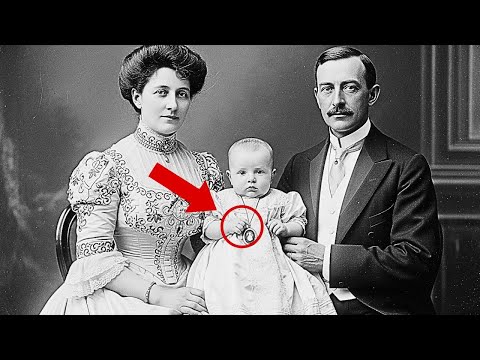
The October wind rattled the windows of the Vandermir estate as Dr. Sarah Chen stepped into the library, her breath catching at the sight of a century-old portrait. A distinguished couple sat stiffly, cradling an infant dressed in white silk. But something was wrong—the baby’s calm was too perfect, and in one tiny hand, she clutched a small, dark object.
“That’s Harrison and Constance Vandermir with their son William,” the estate attorney said, but Sarah’s eyes narrowed. The baby’s pose was unnatural, the couple’s smiles frozen. She photographed the portrait and took it back to her lab, where a high-resolution scan revealed the object: a medallion engraved with the number 2847.
Sarah’s heart raced. Babies didn’t wear numbered tags. This wasn’t a family heirloom—it was an identification tag. The awkward pose, the stiff expressions, the eerie calm—suddenly took on a sinister meaning. She needed to find out who this baby really was.
The photographer’s stamp led her to Bentley and Associates, a Fifth Avenue studio that catered to New York’s elite. But a business directory listed them under two categories: photographers and domestic placement services. Why would a high-end studio be involved in domestic placement?
A letter from a society woman made it explicit: “I’ve engaged Bentley for our portrait next month. They’ve assured me they can provide a suitable infant for the composition.” Sarah sat back, stunned. Bentley wasn’t just photographing families—they were renting out babies as props for wealthy couples who wanted the appearance of parenthood.
But that didn’t explain the numbered medallion. Rental arrangements wouldn’t require identification tags—unless the babies were being cycled through multiple sessions, treated as inventory. Sarah zoomed in again on the medallion. Number 2847 was clearly visible. If this was an identification system, there had to be records.
She made a list of archives to contact, but one possibility stood out: the New York Foundling Hospital. Orphanages often used numbered identification systems. With growing dread, Sarah suspected she knew where these borrowed babies had come from.
The New York Foundling Hospital stood on East 68th Street, its brick façade unchanged since the nineteenth century. Sarah arrived with letters of introduction and a knot of apprehension, meeting Sister Margaret, the elderly archivist who managed the historical records.
After Sarah explained her investigation and showed the Vandermir portrait, Sister Margaret’s expression darkened. “There are things in these archives the church would prefer remained private,” she said quietly. “But some truths need to be known.”
She led Sarah into a narrow room lined with leather-bound ledgers. “Yes, Dr. Chen, we have records of what you’re describing. It was called the presentation program, operating from 1895 to 1918.”
The ledger documented children sent out for temporary family placements—for photographic purposes. Pages listed them by number, not name: identification number, age, physical description, date sent out, studio name, payment received, date returned. Some bore notations in faded ink: returned ill. not returned. deceased. adopted by client family.
Sarah found number 2847 on page 176. Female infant, a Brookxer, 6 months, fair, blue eyes. Sent to Bentley and Associates, September 15th, 1910. Payment $25. Returned September 18th, 1910. Condition acceptable.
The baby was a girl—not the Vandermirs’ son, William. The entire narrative was fabricated. Sister Margaret found the intake file: Baby 2847 had been brought to them in March 1910 by a Lower East Side midwife. Mother unknown, likely an immigrant who couldn’t keep the child. The baby was baptized Mary, but that name appeared nowhere in the placement records.
The ledger showed Mary had been sent out sixteen times between April 1910 and December 1911. Sixteen different wealthy families had held her, posed with her, created false portraits. Each time, the hospital collected payment.
The final entry was dated January 7th, 1912. Deceased. Cause: pneumonia. No family notified. Buried City Cemetery, plot unmarked. She was not yet two years old.
“How many children?” Sarah asked, her voice barely steady.
“The ledgers document 847 children over twenty-three years,” Sister Margaret said. “Some were sent out dozens of times. Some were adopted by families who’d used them in portraits—essentially purchased as servants.”
Sarah thought of the numbers, the quiet inventory of small lives. Then she turned back to the Vandermir name, determined to understand how a borrowed baby had become a fabricated heir.
At the New York Public Library’s genealogy division, Sarah pulled the Vandermir society announcements. Harrison Vandermir had married Constance Whitmore in 1889. For fifteen years, the society columns mentioned them at galas and charity balls—but never a child. No birth announcements. No christenings.
Then, in October 1910, a single notice appeared: Mr. and Mrs. Harrison Vandermir are pleased to announce the arrival of their son, William Harrison Vandermir, born September 20th, 1910.
Sarah checked the city birth records. No birth certificate existed for William Vandermir on that date—or any date. The announcement was a fiction printed in ink.
At the New York Historical Society, she found the Vandermir family papers. A letter from Harrison to his attorney, dated August 1910, discussed inheritance concerns. My father’s will stipulates the estate passes to my heir upon my death. Constance and I remain childless. I seek counsel on satisfying inheritance requirements without challenging the will’s validity.
The attorney’s reply was coldly pragmatic. There are established discreet methods for families in similar circumstances. A formal portrait documenting parenthood, combined with appropriate social announcements and backdated documentation, has proven sufficient. I can recommend a photography studio and a physician who will provide a birth certificate for a reasonable fee.
Sarah sat back, the pieces locking into place. The Vandermirs had rented baby Mary, posed with her for Bentley’s camera, and announced a son who never existed. After the portrait, they claimed William was delicate and kept him from public view, hiring a nanny—documented in employment records—paid handsomely to maintain the fiction.
In March 1912, a death notice appeared: William Harrison Vandermir, beloved son, passed peacefully. March 3rd, 1912. Private services. No death certificate existed, because William had never existed.
Baby Mary had died in January 1912. Just two months before the Vandermirs announced their fictional son’s death. Financial records showed Harrison paid a city clerk $500 that January for ‘documentation services.’
They had exploited a vulnerable child as a prop in their inheritance fraud, then lived comfortably for decades on money obtained through deception. The Vandermirs’ fabricated grief had purchased their fortune.
Tracking Bentley and Associates proved difficult. The studio had closed in 1920, but Sarah found an obituary for Thomas Bentley from 1923, mentioning his daughter, Margaret Bentley Hartwell. Sarah eventually contacted Margaret’s granddaughter, Patricia Hartwell, now in her eighties, living in Connecticut.
Patricia agreed to meet, curious about the interest in her great-grandfather’s business. When Sarah explained her research, Patricia’s face grew troubled. “My grandmother rarely spoke about her father’s business. She seemed ashamed, though I never understood why.”
She retrieved a wooden box labeled, Father’s burden. Do not open until after my death. Inside were photographs of babies crying, sleeping, being posed with props. Each had a number on the back. These were working photographs—documentation of inventory.
But what struck Sarah most were Thomas Bentley’s handwritten journal fragments. One entry from 1920 read: “I closed the studio with relief and guilt. For 25 years, I facilitated a practice I knew was wrong, but justified through profit. We told ourselves the children were temporary participants. We ignored how many sessions each child endured, how the repeated handling traumatized them. We pretended not to notice when babies came back sick or injured. We were complicit in treating human infants as rentable props.”
Another entry described his conflict with his daughter. “Margaret refuses to inherit the business. She calls what we did legalized kidnapping for vanity. Perhaps she’s right. I’ve created thousands of false family portraits while exploiting the city’s most vulnerable children.”
A final entry chilled Sarah. “I kept count. Our studio alone used 267 different infants. 43 died before age 5. I don’t know how many others suffered in ways we never documented. I’ll answer for this someday, though society will never hold me accountable. The families we served are too powerful.”
Patricia wiped tears away. “I never knew. My grandmother became a child welfare advocate in the 1930s. Now I understand she was trying to atone for her father’s actions.” She looked at Sarah. “This needs to be known. These children deserve their story told.”
To understand how the presentation program was eventually exposed, Sarah researched Eleanor Morrison, a journalist and progressive reformer whose papers were archived at the New York Public Library. Morrison’s investigation had begun in 1917 when a former foundling hospital nurse contacted her anonymously, providing ledger copies and lists of participating studios.
Morrison’s notes revealed the enormous scope. At least 12 photography studios in New York City had participated, along with orphanages and maternity homes serving poor and immigrant populations in Boston, Philadelphia, and Chicago. Babies were selected based on appearance. Fair-skinned, light-haired infants commanded higher fees. They were often sedated with laudanum to keep them docile during sessions.
Morrison documented specific cases of harm. One infant died after aspirating during a session. Another suffered a broken arm when dropped. Several children contracted diseases from being handled by multiple people without sanitation. The institutions accepted these casualties as costs of a profitable program.
But what drove Morrison’s investigation was discovering that some families who’d commissioned portraits subsequently adopted those specific children—not as family members, but as servants bound by legal contracts. She interviewed young adults who’d experienced this fate. One woman described being used in a portrait session at age one, then adopted by the same family when she was three. “They never called me daughter. I was the help. The portrait showed them as loving parents while I slept in a closet and worked from dawn until night.”
Morrison’s articles in the New York World in February 1918 exposed the presentation program. Public reaction was explosive. Progressive groups rallied behind her investigation, but wealthy families exerted tremendous pressure to bury the story. Morrison received threats. Newspapers faced advertising boycotts, and witnesses recanted after being pressured. But Morrison persisted.
Her investigation contributed to child welfare reforms. New York passed legislation in 1919 prohibiting commercial use of institutionalized children. The presentation program ended, though no one was prosecuted and no families were publicly exposed. Morrison’s final note from 1920 showed both satisfaction and frustration: “We’ve prevented future harm, but provided no remedy for past injustices. Perhaps decades from now, someone will find these records and tell the complete story.”
With Morrison’s research as foundation, Sarah began identifying other children exploited through the presentation program. The foundling hospital ledgers documented 267 children used by Bentley alone. Across 12 studios, Sarah estimated at least 2,000 children had been exploited over 23 years.
She created a database from the ledgers. Devastating patterns emerged. Of the 267 children Bentley used, 43 had died before age 5—a 16% mortality rate significantly higher than already tragic rates for institutionalized children. The repeated exposure to different environments, handling by strangers, stress, and sedation made them vulnerable to disease.
Many children appeared repeatedly. One infant, number 1847, had been sent out 27 times between ages 3 months and 18 months before dying. Another, number 312, was used in sessions for two years before being adopted for domestic service.
Sarah cross-referenced ledgers with portraits in museum collections and family archives. She found seven portraits beyond the Vandermir image, showing babies wearing numbered medallions. Each showed wealthy families posing with borrowed infants, creating false legacies while exploiting vulnerable children.
One disturbing discovery involved three different wealthy families who’d commissioned portraits between 1908 and 1910. Close examination revealed all three featured the same infant—identifiable by a distinctive birthmark. Baby 2134 had been used to create three separate fictional children for three separate families.
Sarah documented each case meticulously, finding portraits where handling was visibly awkward, where infants’ expressions showed distress, where clothing didn’t fit because it belonged to the studio rather than the family.
She reached out to descendants of families whose portraits showed evidence of borrowed babies. Most were shocked, some defensive, others grateful for truth. Several agreed to let their portraits be included in Sarah’s research. Others refused contact or threatened legal action. Sarah understood their discomfort. These families had built identities on false narratives. But she believed truth mattered more than protecting comfortable fictions—especially when that truth acknowledged the suffering of exploited children.
Throughout this research, Sarah kept returning to baby Mary’s portrait—held by the Vandermirs, a number around her neck. This was personal now, a responsibility spanning 114 years.
After six months of research, Sarah prepared to go public. She submitted a paper to the Journal of American History titled Borrowed Legacies: Child Exploitation and Gilded Age Family Photography. Despite initial skepticism, her documentation—ledgers, Morrison’s investigation, Bentley’s confessions, survivor testimonies, photographic evidence—was irrefutable. The journal accepted and prominently featured it.
Simultaneously, Sarah organized an exhibition at the Metropolitan Museum titled False Portraits: The Hidden Truth in Gilded Age Family Photography. It featured the Vandermir portrait prominently alongside other identified portraits, foundling hospital ledgers, Morrison’s materials, and historical context. Most importantly, it centered the children’s experiences, making their exploitation visible and undeniable.
The media response exceeded expectations. The New York Times ran a front-page feature: When Family Portraits Weren’t Family: Museum Exhibition Exposes Gilded Age Child Exploitation. National media picked up the story. NPR produced a segment featuring Sarah, Sister Margaret, and Patricia Hartwell, who spoke publicly about her great-grandfather’s role.
Public reaction was intense and divided. Progressive organizations and child welfare advocates praised the research, but resistance came from historical preservation societies representing Gilded Age families, arguing Sarah was judging historical practices by contemporary standards. The Vandermir family’s remaining connections demanded the portrait be removed, claiming defamation. The museum’s legal team defended the research as legitimate historical scholarship.
The controversy increased public interest. The exhibition, originally planned for three months, was extended to six due to overwhelming attendance. The museum installed a remembrance wall where visitors left thousands of messages: We remember you. Your suffering matters. You deserve better.
The foundling hospital issued a formal apology acknowledging the presentation program. Sister Margaret worked with Sarah to create a memorial garden dedicated to children who died in the institution’s care, specifically mentioning those exploited through the program. Several universities incorporated Sarah’s research into curricula. Graduate students began researching similar practices elsewhere. International media covered the story, with historians in other countries identifying comparable practices in Victorian England and Paris.
Throughout the attention, Sarah remained focused on the children, always bringing conversations back to their experiences and their right to be remembered with dignity.
Sarah’s research had exposed a systematic exploitation, but she wanted to do more than document historical injustice. She wanted to honor the children individually—to restore their humanity beyond the numbers they’d been assigned. Working with genealogists and adoption researchers, she began the painstaking work of tracing what had happened to survivors of the presentation program.
Many children had died young, like Mary, but others had survived into adulthood. And Sarah discovered some had living descendants who’d never known their family history. She found the great-granddaughter of baby 1634, a child who’d been used in seven portrait sessions before being adopted by a Philadelphia family as domestic help.
The great-granddaughter, Linda Morrison, had grown up hearing vague family stories about her great-grandmother being taken in by a wealthy family, but never knew the full truth. When Sarah showed Linda the foundling hospital ledgers and the portraits featuring her great-grandmother, Linda wept. “My great-grandmother died when I was young, but my grandmother told me she’d always seemed sad, always felt she didn’t belong anywhere. Now I understand why. She spent her whole life knowing she’d been bought, used, discarded by her birth family, and exploited by the family that adopted her.”
Sarah connected with 12 descendant families over several months. Each conversation was emotional, often painful. Some families had suspected parts of their history but never had confirmation. Others were completely blindsided by discovering their ancestors had been part of this program. But most expressed gratitude for finally knowing the truth, for understanding the source of family trauma that had echoed through generations.
One descendant, Marcus Williams, whose great-grandfather had been baby 3421, became particularly active in Sarah’s project. Marcus was a social worker specializing in foster care reform, and he saw direct connections between historical child exploitation and contemporary child welfare issues. “What happened to these children—treating them as commodities, prioritizing institutional profit over their well-being, failing to see them as fully human—these patterns still exist,” he told Sarah. “We’ve changed the language and improved some protections, but vulnerable children are still exploited in various ways.”
Marcus helped Sarah organize a gathering of descendant families at the Metropolitan Museum during the exhibition. Twenty-three people attended, representing 11 children who’d been part of the presentation program. They stood together before the portrait of baby Mary held by the Vandermirs and shared stories of how their ancestors’ exploitation had affected their families across generations.
“My great-grandmother never spoke about her childhood,” one woman said. “She suffered from what we’d now call complex trauma. She couldn’t bond properly with her own children. That pain traveled through my family for four generations. Finally, naming what happened to her, acknowledging it publicly, helps us heal.”
Sarah arranged for the museum to create a digital registry where descendants could add information about their ancestors, sharing photographs, stories, and memories. The registry became a powerful counternarrative to the false portraits, restoring identity and humanity to children who’d been reduced to numbers.
One year after Sarah’s initial discovery, a memorial service was held at the New York Foundling Hospital’s memorial garden. Over 300 people attended—descendants, historians, child welfare advocates, and members of immigrant community organizations. The morning was gray and cold, but there was warmth in the gathering. A sense of justice finally acknowledged.
Sarah stood before the crowd. The portrait of baby Mary was projected on a screen behind her, alongside photographs of other identified children from the presentation program. “Mary was not yet two years old when she died,” Sarah began, her voice carrying across the garden. “She came to America’s shores through circumstances we can only imagine. Her mother unable to keep her, her father unknown. She deserved to be loved, protected, given a chance at life. Instead, she was treated as a commodity—rented out sixteen times to create false legacies for wealthy families, then discarded when she became sick.”
She paused, looking at the descendants present. “Mary’s story and the stories of at least 2,000 other children like her were buried for over a century. But their photographs told the truth. The numbers around their necks, the awkward poses, the haunted eyes—these preserved evidence of their suffering and of a system that prioritized wealth and vanity over the most vulnerable members of society.”
The memorial garden now featured a bronze sculpture of a child holding a medallion, with plaques listing the names of children who died while part of the presentation program. For those whose birth names were unknown, their identification numbers were engraved alongside the name they’d been given at the institution. Baby 2847—Mary.
The Metropolitan Museum announced the Vandermir portrait and exhibition materials would become a permanent installation, ensuring the story remained visible. The foundling hospital committed to digitizing all historical records related to the presentation program, making them publicly accessible. A scholarship fund was established in the children’s honor, supporting foster youth and vulnerable children pursuing education.
Most significantly, New York City’s council passed a resolution officially acknowledging the exploitation, apologizing for the city’s complicity in allowing institutional profit to override children’s welfare, and committing to ongoing vigilance against contemporary forms of child exploitation.
Sarah returned to her conservation lab late one evening, looking at Mary’s portrait one final time before it was installed in its permanent exhibition space. The tiny face stared back, still showing that forced calm, still wearing that numbered medallion, still held by strangers who’d used her to create a false legacy. But now Mary’s story was known. Her short life was acknowledged. Her suffering was recognized.
The photograph was no longer just evidence of exploitation. It had become a testament to the importance of remembering, of speaking truth, of ensuring that no child’s life, however brief or marginalized, is forgotten by history.
Sarah thought about all the people who had touched this story across twelve decades: the anonymous nurse who’d contacted Eleanor Morrison; Thomas Bentley, who’d kept his guilty journal; Margaret Hartwell, who’d preserved evidence despite shame; Sister Margaret, who’d opened archives despite institutional discomfort; Patricia, who’d shared her family’s burden; and Marcus and other descendants who’d turned family trauma into advocacy.
The portrait would remain on display—no longer a symbol of Gilded Age glamour, but a reminder of the cost of that glamour, paid by children like Mary, whose numbered medallion finally spoke its truth. In the exhibition text beside the portrait, the final words read: “Mary, 1910–1912. You were seen. You are remembered. You mattered.”
As Sarah turned off the lab lights, she glanced once more at the tiny face in the photograph. The medallion’s number seemed to glow in the dimness—no longer a mark of ownership, but a badge of survival, a silent witness to a truth finally told. She wondered how many other unnamed children still waited in forgotten archives, their stories buried under decades of silence. How many more portraits hung in family homes, their subjects’ true identities erased by convenience and greed? And she knew her work was far from over.
What forgotten child will you remember today?
Report this article
Select a reason for reporting:






