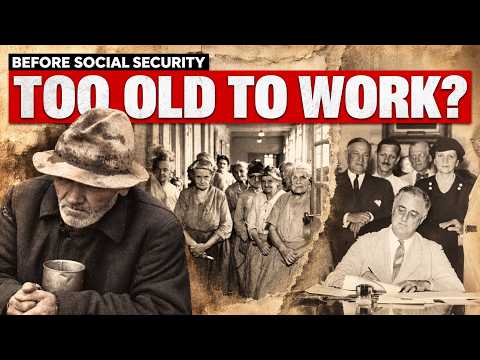
Imagine working from the moment you could carry a bucket of water until your back finally gave out—and then having absolutely nothing. No pension, no savings, no government check. You just stopped being useful. In America, for nearly three centuries, that was the deal. You worked until your body broke, and after that, you relied on your children, begged for charity, or entered a place so grim that people would rather die than walk through its doors.
They called them poorhouses. For millions of elderly Americans, that was the final chapter.
Today, Social Security feels as permanent as the highway system. But for most of American history, the idea that the government owed you anything in old age was considered absurd—even radical. It wasn’t until 1935 that the United States created a federal program to protect its elderly from absolute destitution. The road to that moment was paved with suffering, political pressure, and a Great Depression that forced the country to confront a question it had avoided for over 150 years: What happens to people when they can no longer work?
To understand why America had no safety net for so long, you need to understand the philosophy that built the country. From the beginning, American society was constructed around self-reliance. The founding ethos was independence, personal responsibility, pulling yourself up. If you failed, that was on you. If you grew old and couldn’t support yourself, that was also on you. The government’s job was to protect your liberty, not to feed you.
This wasn’t just politics—it was a moral framework. It separated the “deserving poor” (orphans, widows, the disabled) from the “undeserving poor,” which in practice often included anyone who simply ran out of money. This distinction, inherited from English poor laws, would shape how America treated its elderly for centuries.
In early colonial communities, people took care of their own. If your neighbor’s father was too old to farm, the town might pitch in or the church would step up. This was called outdoor relief—small amounts of food, clothing, or firewood without removing people from their homes. It was informal, local, and mostly worked when populations were tiny and everyone knew each other.
But as cities grew and immigration surged, that neighborly system cracked. By the early 1800s, populations were exploding. Waves of immigrants flooded in from Ireland, Germany, and across Europe. The industrial economy created a new kind of poverty—structural, not seasonal. People were chewed up by factories and spit out with nothing. The elderly, who had spent decades doing backbreaking labor, were increasingly seen as burdens—not just by society, but by their own families.
This is where the poorhouse enters the story. And if you think of a poorhouse as a rustic retirement home, you would be dead wrong. These institutions were designed not to help people, but to deter them. The philosophy was that public assistance should be so miserable, so degrading, that no one would willingly accept it unless truly desperate.
By the mid-1800s, nearly every county in the United States operated one. Picture a large decaying building on the outskirts of town, usually on a farm. Inside, the elderly were mixed with orphaned children, people with severe mental illness, alcoholics, criminals—anyone society didn’t know what to do with. No separation, no specialized care, no dignity. The food was often rotten or barely sufficient. Sanitation was an afterthought. Medical care was virtually nonexistent. And the people running these places were typically political appointees whose primary objective was to cut costs, not care for human beings.
If you entered a poorhouse, you often lost everything: your personal property, your right to vote, in some cases even your right to move freely. In certain states, residents were forced to wear a letter P on their clothing—a public brand of shame, a scarlet letter for the crime of growing old without money. The message was unmistakable: You are less than a full citizen now. You are a burden, and you should be ashamed.
Investigations in the 1850s by New York State legislators revealed horrifying conditions. Diets were nutritionally barren. Clothing was insufficient, especially in winter. Disease ran through the buildings like wildfire. Staff had no training—the superintendent was often simply whoever had the right political connections. And perhaps the cruelest irony: many poorhouses were called poor farms because residents, including elderly people who could barely stand, were expected to work the land. The idea was that labor would rehabilitate them, cure them of the moral failing of poverty. In reality, most were already too old, too sick, or too broken to work.
Between 20 and 25% of everyone who entered an almshouse died inside its walls.
For most of the 1800s and well into the 1900s, the poorhouse wasn’t a fringe institution. It was the primary form of institutional care for elderly Americans with no family to support them. There was no Medicaid, no Medicare, no nursing homes as we know them. If you were old and broke, the poorhouse was literally the end of the road.
And the numbers tell a brutal story. By the early 1900s, estimates suggest that between one-third and one-half of all elderly Americans were living in poverty. One out of every two or three people over 65 in the richest, most industrialized nation on earth could not support themselves. These weren’t lazy people. They had built railroads, worked in textile mills, plowed fields for decades, raised families. They had done everything society asked, and their reward was destitution.
Some will say, “Didn’t families take care of their elderly?” Yes, many did. Multigenerational households were common. But industrialization was ripping that system apart. Families that once lived and worked together on farms were scattered across cities. Young men left rural towns for factory work. Women entered the workforce. Families got smaller. And the economic reality was that many working-class families simply couldn’t afford another mouth to feed. Taking in your aging mother when you’re already struggling to feed four children on a factory wage wasn’t a matter of love or duty—it was arithmetic. And the numbers often didn’t add up.
Fraternal organizations and mutual aid societies tried to fill the gap—groups like the Oddfellows, the Masons, and ethnic and religious societies pooled resources to provide small benefits in times of sickness or old age. At their peak, tens of millions of Americans belonged to at least one. But the benefits were small, unreliable, and available only to members. They were a band-aid on a gaping wound.
There was one group of elderly Americans who did receive a pension in the 1800s: Civil War veterans. In 1862, Congress established a pension system for Union soldiers disabled in service. Widows and orphans of soldiers killed in action could also receive benefits. Initially modest—about $8 a month for a totally disabled enlisted man—the system expanded dramatically. By 1890, any disabled Union veteran could qualify. In 1906, old age itself became a sufficient qualification. By 1910, over 90% of surviving Civil War veterans were receiving pensions. At its peak, the program consumed nearly 40% of the entire federal budget. It was America’s first de facto social security system—but only for a very specific segment of the population.
The program proved something important: the federal government was capable of administering a large-scale pension system. But it also proved something else—the political will to extend that protection to ordinary Americans simply did not exist. Civil War veterans were heroes who had earned their pensions through sacrifice. The average worker, in the eyes of politicians and industrialists alike, had earned nothing beyond the wages already paid.
Meanwhile, the rest of the world moved forward. In 1889, German Chancellor Otto von Bismarck created the world’s first government-run pension system. Britain followed in 1908. Denmark, France, and others created similar programs. America watched and did nothing. The arguments against a national pension were always the same: it would undermine self-reliance, create dependency, it was socialism. And for decades, those arguments won.
But then the ground shifted. The 1890s and early 1900s saw a growing progressive movement that challenged the idea that poverty was simply a moral failing. Social reformers like Jane Addams, who ran Hull House in Chicago, documented the devastating conditions of working-class life. Journalists and academics published detailed investigations into the lives of the elderly poor. Slowly, public opinion began to change. A few states experimented with old age pension programs in the 1920s, but they were pathetically inadequate—means-tested, underfunded, and tiny. By 1935, 30 states had some form of old age pension on the books, but only about 3% of elderly Americans were actually receiving any state benefits. Three percent. That number alone tells you how seriously the political establishment took elderly poverty before the Great Depression.
And then the bottom fell out.
On October 29, 1929, the stock market crashed, and the American economy entered a free fall. Banks collapsed by the thousands. Factories shuttered. Unemployment soared to 25%. And for the elderly, it was nothing short of apocalyptic.
People who had spent their entire lives saving watched their nest eggs evaporate overnight. Unlike younger workers who might find new employment, the elderly had no fallback. They couldn’t return to the factory floor. They couldn’t start over. By 1934, over half of all elderly Americans lacked sufficient income to be self-supporting. More than 50%. And these weren’t just people who had been poor their whole lives—this was the middle class. People who had owned homes, run small businesses, put money in the bank. All of it was gone.
The family structures that had historically served as the last line of defense were themselves collapsing. Adult children who were losing their own homes could not provide homes for their parents. Elderly couples married for decades were separated and sent to different poorhouses because there was no room for them together. Old women rummaged through garbage cans behind restaurants searching for scraps. Suicide rates among those over 65 reached a staggering 52.3 per 100,000.
And here’s what made the Depression different: the suffering was too widespread, too visible, too obviously systemic to blame on individual moral failure. When a quarter of the workforce is unemployed and millions of elderly are starving, you can’t tell them to just work harder. The old arguments about self-reliance rang hollow when the entire economic system had failed.
This is where we meet Francis Townsend, a retired physician in Long Beach, California. He was 66, broke, and staring down a future of poverty. One evening in late 1933, he looked out his rear window and saw three elderly women picking through garbage cans searching for food. The sight enraged him. Here were women who had lived full lives, contributed to society for decades, reduced to scavenging like animals.
Townsend proposed that the federal government pay every citizen over 60 a monthly pension of $200—roughly $4,700 today—on two conditions: you had to be retired, and you had to spend the entire amount within 30 days. The spending requirement was clever—it would inject massive cash into the economy every month, creating demand and jobs.
He published his idea as a letter to the editor in September 1933. Within weeks, he was flooded with mail. Within two years, there were roughly 8,000 Townsend Clubs with a peak membership of about 2 million people—roughly 1% of the entire U.S. population and about 10% of the nation’s seniors. They wrote letters to Congress by the tens of thousands. They held rallies. They ran candidates. And they scared the hell out of Washington.
Most economists agree the Townsend Plan was financially unfeasible—paying $200 a month to every American over 60 would have cost over $20 billion a year when the entire federal budget was around $6.5 billion. But what it accomplished was far more important than policy. It changed the conversation. The question was no longer whether the government should act, but how.
Into that moment stepped Franklin Delano Roosevelt. In June 1934, he created the Committee on Economic Security and appointed his Secretary of Labor, Frances Perkins, as chairman. Perkins was the first woman ever to hold a cabinet position. She had witnessed the Triangle Shirtwaist factory fire in 1911, which killed 146 workers, and that tragedy had shaped her entire worldview.
Roosevelt told her directly: “You believe in it. Therefore, I know you will put your back to it more than anyone else, and you will drive it through.” And she did.
The bill they proposed was revolutionary by American standards but deliberately conservative in design. Roosevelt and Perkins understood that if the program were to survive politically, it had to be structured not as welfare, but as insurance. Workers would pay into the system through payroll taxes during their working years and receive benefits when they retired. As Roosevelt famously said, “With those taxes in there, no damn politician can ever scrap my Social Security program.”
The political battle was fierce. Business groups called it “the ultimate socialistic control of life and industry.” Conservative politicians warned it would destroy the work ethic. But this time the political calculus was different. The Depression had been too devastating, the suffering too widespread, the public too angry. Congress passed the Social Security Act by overwhelming margins. On August 14, 1935, Roosevelt signed it into law.
The first monthly check wasn’t issued until January 1940. A woman named Ida May Fuller of Ludlow, Vermont received check number one for $22.54. She had paid $24.75 into the system over three years of work. She lived to be 100, collecting nearly $23,000 in benefits over her lifetime—arguably the best Social Security investment in history.
The impact was transformative. Before Social Security, the poverty rate among Americans over 65 was estimated at over 35% as late as 1959—and almost certainly much higher in the decades before. Today, Social Security single-handedly keeps roughly 22 million Americans above the poverty line, including about 15 million elderly recipients. The elderly poverty rate has fallen from that devastating figure to under 10%. No single government program in American history has done more to reduce poverty.
And there’s a less obvious consequence that doesn’t get talked about enough. Social Security didn’t just save the elderly from poverty—it created the concept of retirement as we know it. Before Social Security, retirement as an expected, ordinary phase of a life well-lived was virtually unknown among working-class Americans. You didn’t retire. You worked until you couldn’t, and then you coped. Social Security gave people permission to stop. It said: You have earned the right to rest.
But the story doesn’t end with the signing ceremony. Social Security inadvertently created a new industry and new problems the framers never anticipated. The original act prohibited old age assistance payments from going to residents of public institutions—the intent being to discourage states from dumping their elderly into poorhouses. It worked. Poorhouse populations dropped rapidly. But because elderly people now had monthly cash income, they could afford private care arrangements, and private for-profit nursing homes began springing up across the country. Many were little better than the institutions they replaced, warehousing residents in substandard conditions while collecting their Social Security checks. The poorhouse didn’t disappear. In many ways, it was privatized.
It took decades of additional legislation, regulation, and public outrage to improve conditions in the nursing home industry. And some would argue the system is still deeply flawed—that we still haven’t fully answered the question of how a wealthy society should care for its most vulnerable members.
What matters is the sheer scale of what changed. In the span of a single generation, America went from a country where old age was synonymous with poverty and fear—where the best you could hope for was that your children would take you in, and the worst was a slow death in a county poorhouse—to a country that guaranteed its elderly citizens a basic floor of economic security. That floor has been raised and strengthened over the decades, and it remains one of the most popular and politically durable programs in American history. So popular that politicians have called it the third rail of politics—any attempt to dismantle it is the equivalent of political self-destruction.
And yet, we should never forget what came before. The millions of Americans who lived and died before 1935 without any protection at all. The men who built this country’s railroads and factories and were cast aside when their strength failed. The women who raised families for decades and then, when their husbands died, found themselves with nothing. The elderly couples separated and sent to different poorhouses. The old women picking through garbage for food. The countless unnamed people who died alone in poverty in a country that told them their suffering was their own fault.
The creation of Social Security wasn’t an act of generosity. It was an act of necessity—forced by a depression that exposed the brutal truth beneath the mythology of American self-reliance. It took a complete economic collapse, a mass movement of angry elderly citizens, a visionary doctor in California, and a president willing to fight his own political class to make it happen. And even then, it almost didn’t.
Francis Townsend spent the rest of his life arguing that the benefits were too low, that the program didn’t go far enough. He pushed for more generous pensions through the 1940s and 1950s, and his clubs continued to meet and organize for years. He died in 1960, just as Social Security was finally beginning to reach the scale that could meaningfully reduce elderly poverty. He never saw the full impact of what his movement helped create. But without his anger, without those two million organized seniors demanding change, it’s an open question whether Roosevelt would have had the political cover to push the legislation through when he did.
There’s a tendency in American culture to look back at the past with rosy nostalgia—to imagine simpler times when communities took care of each other and families stayed together and everyone was fine. But the historical record tells a very different story. Before Social Security, old age in America was, for millions of people, a sentence. A sentence to poverty, to dependence, to indignity. The program that changed that wasn’t inevitable. It was built by people who looked at the suffering around them and decided that a wealthy nation could do better.
The question for our generation is whether we’ll continue to believe that.
What do you think—is Social Security a promise we should protect at all costs, or is it time to rethink how we care for our elderly?
Report this article
Select a reason for reporting:






