June 12, 1944. Santa Monica Beach, California. The sun burns bright over the Pacific as a military truck stops by the sand. Twelve young German women, prisoners of war, step down, blinking into the light. They expect barbed wire and shouting guards, but instead, they hear laughter, music, and the crash of warm ocean waves. American families are picnicking nearby. Children play with toy planes. The smell of grilled corn and salt fills the air.
And there, the enemy walks barefoot into the California surf. A US nurse offers them towels. A reporter snaps a photo. And at that moment, something impossible happens. Prisoners begin to smile. Enemies are supposed to fear each other. Yet here, under the California sun, they begin to see something else. Kindness, humanity, freedom. But soon, one photograph will set off outrage across America and change their lives forever.
For two hours each week, these German women—some nurses, some clerks, some barely twenty—were allowed to swim under guard. It was a strange rule, born from the Geneva Convention. That treaty said prisoners of war must be treated fairly, given food, medical care, and even moments of recreation. America followed those laws strictly, even when emotions ran high.
The irony was painful. Back in Europe, American soldiers were dying in Normandy. Bombs still fell on German cities. Yet here in California, the enemies of those soldiers floated freely in the sun. One of the women, Ingrid Schaefer, closed her eyes and whispered, “This feels like heaven on Earth.” But guilt quickly followed. She remembered the sound of air raids over Hamburg, the letters that never arrived, and her fiancé who had vanished at Stalingrad. She wondered if it was wrong to feel joy while her country burned.
On the pier, a young journalist named Dorothy Chen raised her camera. She captured the scene: prisoners laughing, water splashing, an American flag fluttering above them. The picture would soon appear in newspapers across the country. And not everyone would see it as kindness.
For now, though, the moment felt almost peaceful. The women swam, the guards watched, and the waves kept coming. What none of them knew was that this quiet California afternoon would soon become a national argument, one that questioned not only the treatment of prisoners, but the meaning of mercy itself.
This wasn’t propaganda. It was reality. And it was only the beginning.
The scene on Santa Monica Beach looked simple. A few German women swimming under watchful eyes. But behind that short moment stood pages of rules, laws, and promises written years earlier. The United States was proud of following the Geneva Convention of 1929, an agreement made after World War I. It said that prisoners of war must be treated fairly. They could not be starved, beaten, or humiliated. They were allowed medical help, mail from family, and a little free time.
By 1944, America held more than 400,000 German POWs in over 500 camps across the country. Some worked on farms, some built roads, and some helped in hospitals. Compared to the harsh prison camps in Europe or Asia, these places looked almost peaceful. The beach trips for the women in California were part of this same idea. Keeping the prisoners healthy and calm until the war ended. Commanders said recreation reduced fights, sadness, and escape attempts. To the US Army, it was practical, not emotional.
Each visit followed rules. Only two hours at the beach. Guards at every corner. No talking to civilians. No photographs allowed. But rules on paper and reality on sand often drift apart. Locals began to notice the trucks arriving. Some smiled. Some frowned. “Rumors spread fast. They start treating Nazis like tourists,” one man said at a diner. Another replied, “Better to show mercy. It proves we start not like them.”
Ingrid and the other women did not understand all the words, but they felt the looks. When they swam, people on the pier pointed. Some whispered. One boy threw a small stone into the water near them. His mother pulled him back. “Don’t sit,” she said quietly. “The war will end someday.”
At the camp, after each beach trip, soldiers wrote short reports. No incidents. Prisoners behaved. Recreation beneficial. Those simple lines kept the program alive. Sergeant Williams followed the handbook carefully. To him, the beach wasn’t set kindness. It was duty. “We signed that treaty for a reason,” he told a younger guard. “If our boys get captured, we want them treated the same way.”
Still, even among Americans, feelings were divided. Some soldiers had lost friends in Europe. Seeing German prisoners laugh felt wrong. “Why should they get the ocean when our dead are in it?” one asked bitterly. But the army didn’t change the rule. Not yet. The system believed fairness showed strength. The government called it moral discipline.
For Ingrid, that discipline was confusing. She dreamed of home, of hunger, of nights hiding in cellars. Then she woke up each day to warm California air, regular meals, and gentle waves. The contrast felt impossible. One night, lying in her bunk, she whispered to another prisoner, “They say we lost the war, but here, they treat us as if we won.” That quiet paradox sat heavy in every heart, American and German alike. But the calm would not last long. The next time the women walked onto that beach, someone else would be waiting with a camera, a notebook, and a story that would turn kindness into controversy.
The morning the journalist returned, the air was bright and sharp with sea salt. The twelve German women had begun to relax during their weekly trips. They laughed softly now, dipping their feet into the cold Pacific water. But this time, a new sound joined the ocean waves—the click of a camera.
Dorothy Chen, a young reporter for a Los Angeles newspaper, had heard rumors about Nazi women swimming at Santa Monica. At first, she didn’t believe it. But when she saw them with her own eyes, smiling freely under an American flag, she knew the story would cause a storm. She wrote in her notebook, “Enemy women, healthy, tanned, guarded by our soldiers. A strange picture of mercy in wartime.”
That afternoon, the photograph appeared in the newspaper. The headline read, “German women prisoners given beach privileges.” The reaction was immediate. In cafés, barber shops, and train stations, people talked angrily. “My brother died in Italy,” one man said, slamming the paper, “and these women get sunshine.”
Letters poured into the editor’s office. Some called the story disgraceful. Others said, “This is what makes America different. We don’t become the monsters we fight.” Within days, radio shows and even Congress mentioned the article. Questions were asked. Was this legal? Was it moral?
The War Department released a statement reminding the public of the Geneva Convention. It said, “The United States must honor its commitments, even toward the enemy.” Still, outrage grew. One Los Angeles mother wrote, “While we ration sugar and butter, the enemy gets the ocean. Where is justice?”
At the camp, the guards felt the pressure. Sergeant Williams received new orders. No more press. No more civilians near the site. He was angry, but calm. “The picture shouldn’t have been taken,” he told the prisoners. “Now everything changes.”
For the women, confusion replaced peace. They hadn’t meant to cause trouble. Ingrid felt guilty again, as if joy itself was a crime. “They think we wanted fame,” she said softly to another prisoner, “but we only wanted to feel human.”
Dorothy Chen, meanwhile, struggled with her own conscience. Her editor praised her for the exclusive scoop. But at night, she couldn’t sleep. She had seen how the women smiled—not proud, just tired. She started to wonder if the truth was more complicated than the anger she had printed.
A week later, the beach program was officially suspended. The truck no longer came. The ocean disappeared behind barbed wire and army paperwork. But one question hung in the air. Was kindness a weakness, or was it proof of strength? That question, born from one photograph, would follow everyone involved—the guards, the journalist, and the prisoners—far from the Pacific shore.
Soon, the desert would replace the sea, and heat would replace mercy.
By August 1944, the ocean was only a memory. The twelve women were loaded onto a train heading east. Through dusty windows, they watched green fields fade into endless desert. The final stop was a prisoner camp near Phoenix, Arizona, where the air shimmered with heat and sand stretched as far as the eye could see.
When the train doors opened, the wind felt like a furnace. Ingrid blinked in the brightness. The smell of salt and seaweed was gone. Now there was only dust, sweat, and sunburn. “This is no heaven,” one woman whispered.
The new camp followed the same Geneva rules—clean water, food, work, and a small place for recreation. Instead of the Pacific, there was a narrow concrete pool, twelve meters long. “Here’s your new beach,” said Sergeant Williams quietly. He had been transferred with them, though his voice sounded heavier now. Ingrid dipped her hand in. The water was warm, not refreshing. “The sea breathed,” she said softly. “This one doesn’t stir.”
Life in Arizona followed a strict rhythm. Breakfast at six, work in the fields by seven, pool hour in the late afternoon. They were treated correctly, but kindness now felt cold and mechanical. Ingrid kept a small bottle of Santa Monica sand hidden in her foot locker. She touched it each night. “Proof that beauty existed,” she whispered.
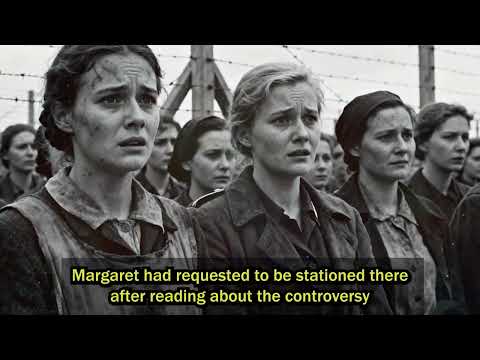
In the camp infirmary, Ingrid met Margaret Evans, the American nurse who had once offered her a towel on the beach. Margaret had requested the posting after reading about the controversy. “I wanted to see who they really were,” she later said. At first, their conversations were short and polite. But soon they spoke about families, about fear, and about how the war had stolen years from both sides. “My brother is fighting in France,” Margaret told her. “I pray for him every night.” Ingrid answered quietly, “I pray, too, for mine, though he may already be gone.”
One dry afternoon, a Red Cross letter arrived from Leipzig. Ingrid’s hands trembled as she opened it. Her sister Clara had written: “Our home is gone. The city burns every night, but we are alive. Mother prays for you every evening. She says you are in heaven because you are in America, a land where bombs do not fall.” Ingrid read the line again and again. The same words she had whispered on the beach, now returned to her across an ocean of pain.
That night, she sat under the bright Arizona stars and understood a hard truth: captivity could feel safer than freedom. A camp report from late 1944 noted that over ninety percent of German POWs gained weight within their first six months. “We live better here than our families back home,” one prisoner wrote. “That is a hard truth to carry.”
Then, one calm evening, a shout broke the quiet. “Fire! Fire in the storage shed!” Flames rose into the dark sky. Guards and prisoners ran together with buckets of water. Ingrid and Margaret rushed toward the infirmary. Inside the shed, a young prisoner named Hans was trapped behind fallen boxes. “Help me!” he cried. Together they pulled him free as part of the roof collapsed behind them.
By midnight the fire was under control. Investigators suspected sabotage, but Sergeant Williams said, “Most of these prisoners helped fight the fire. That matters.” When it was over, Ingrid and Margaret sat outside, hands black with ash. “You saved a man tonight,” Margaret said. Ingrid shook her head. “No—we saved each other.”
In May 1945, the radio crackled: “Germany has surrendered. The war in Europe is over.” For a long moment, no one moved. Some prisoners smiled in disbelief. Others cried quietly. Margaret found Ingrid near the empty pool. “You should be happy,” she said. Ingrid looked up, eyes full of sadness. “For you, yes. For us—I don’t know. We will go home to ashes.”
The ship reached Germany in the cold winter of 1946. The docks were broken, the air smelled of smoke and metal. Clara waited at the station in Leipzig, her hair thin, her coat patched. They hugged tightly and cried. At night, Ingrid told her sister about California, the beaches, the desert, and the kind nurse named Margaret. Clara listened with wide eyes. “It sounds like a dream,” she said. Ingrid nodded slowly. “It was real. They called it the enemy’s land, but it was the first place I felt free.”
Ingrid became a nurse again in a small village hospital. When patients asked where she learned her gentle way of care, she smiled and said, “In a place far from here, where enemies became friends.” Margaret wrote from California, sending pictures of the same beach where the story had begun. “The sea is still blue,” she wrote. Ingrid kept that picture on her desk for the rest of her life.
They had come as prisoners of war, expecting punishment and hate. Instead, they found kindness, warmth, and dignity. As one former POW later wrote, “We came as conquerors. We left as students.” In the end, America’s greatest weapon was not its bombs, but its humanity.
But the story leaves us with one haunting question: if a single photograph of mercy could divide a nation, what does that say about us—and about the mercy we choose to show today? Tell us your thoughts in the comments below.
Report this article
Select a reason for reporting:






