On a chilly February evening in 1909, a double-barreled shotgun blast shattered the silence of a rural road outside Ada, Oklahoma. Farmer Allen Augustus Babbitt tumbled from his wagon, his blood soaking into the grass as his horses bolted into the darkness. The shooter emerged from behind an elm tree, mounted his horse, and rode off toward the Texas border without a word. The man in the saddle was James B. Miller—known to some as “Killing Jim,” to others as “Deacon Jim.” He was a Methodist churchgoer who never touched liquor or swore, yet he was more deadly than the legendary John Wesley Hardin.
Hardin claimed 42 kills and became a household name, but his reputation was built on self-written prison memoirs that no one could verify. Miller, by contrast, was a professional who kept his mouth shut. He documented at least a dozen kills, and some estimates run as high as 51—a number he confessed to with his dying breath. So why does history remember Hardin and forget Miller? The answer lies in the way they lived—and the way they died.
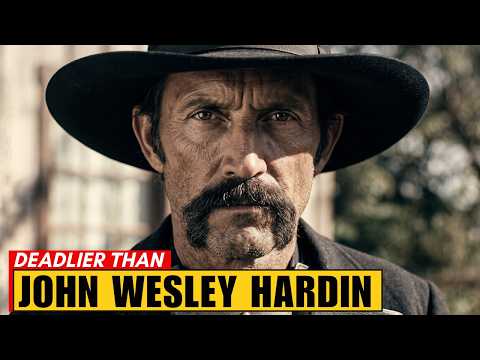
Born in 1861 in Arkansas, Miller moved to Texas as a child. His first confirmed murder came in 1884 when he shot his brother-in-law, John Coop, off his porch with a borrowed shotgun. Convicted of life in prison, he walked free on a technicality and never spent a day behind bars. He had a gift for evading consequences. By 1900, he had settled in Fort Worth, where his wife ran a boarding house and he advertised himself as a hired gun. His fee ranged from $150 to $2,000—a small fortune at the time—and his clients were cattlemen and businessmen with rivals to eliminate.
Miller’s method was meticulous. He would be seen having breakfast in a town 100 miles from his target, then ride through the night to ambush his victim at dawn or dusk from behind a tree. By the next morning, he’d be back at the same hotel, sipping coffee. His signature was a double-barreled shotgun loaded with buckshot, fired from cover. He wore a long black coat year-round—even in Texas heat—and beneath it, a steel plate sewn into the lining that saved his life more than once.
The two lawmen who caused Miller the most trouble were Sheriff George “Bud” Frazer and former deputy Allen Babbitt. Frazer once gave Miller a deputy’s badge, then fired him when he discovered Miller was killing prisoners for sport. On April 18, 1894, Frazer confronted Miller in the streets of Pecos. He shot Miller in the arm, then the leg, then emptied his pistol into his chest. Miller fell, and Frazer walked away. But when friends carried Miller upstairs to prepare his body, they found the steel plate riddled with bullets—and Miller still breathing. He survived, and nine months later, he walked into a tavern in Toyah, Texas, and shot Frazer in the back of the head at point-blank range. No steel plate could stop that.
Miller’s luck finally ran out with the Ada murder. Babbitt, the victim, was a former deputy U.S. marshal and well-connected. A young ranch hand who had guided Miller to the spot cracked under questioning, and Ada’s police chief, George Colbert, arrested Miller in Fort Worth. Before the trial could begin, a mob of 30 to 40 businessmen—many of them Masons like Babbitt—stormed the jail, dragged Miller and three others to a livery stable, and strung them up from the rafters. Miller didn’t beg. He handed his diamond ring to his wife and his diamond pin to a man in the crowd, then said, “Let the record show I killed 51 men. Let them take it.” He jumped from the box himself.
That was the last mass lynching in American history. Hardin, meanwhile, died at 42 in an El Paso bar, shot in the back of the head over a dice game. His end was romanticized; Miller’s was ugly and forgotten. But the difference in their fame comes down to one thing: Hardin talked, and Miller didn’t. Until his final breath, Miller kept his secrets—and history kept its silence.
But there’s more to the story than a simple contrast between a braggart and a professional. The Ada lynching didn’t just end Miller’s life—it exposed a fault line running through the heart of Oklahoma society. The men who hanged Miller were not outlaws. They were the town’s leading citizens, the very men who sat on church pews and ran the banks and owned the dry-goods stores. They had decided that the courtroom would not suffice, that the trial scheduled for April 20 would be too slow, too uncertain, too public.
Why? Because Miller’s arrest had begun to unravel something far larger than a single murder. Jesse West and Joe Allen, the two farmers who had paid Miller through the middleman Berry Burrell, were sitting in the same jail cell. If the trial went forward, they would testify. And their testimony would reveal that the plot against Babbitt had been hatched not in a shadowy back room but in the open, among men who considered themselves respectable.
The mob was not just punishing a killer. It was silencing witnesses. By hanging all four men in one night, the businessmen of Ada ensured that no cross-examination would ever take place, no names would be entered into the public record, no further questions asked. The photograph taken that morning—four bodies dangling from a livery stable rafter—was meant to be a warning, and it was. But it was also a confession.
Now consider the strange afterlife of Deacon Jim. For decades, his name faded into obscurity. Hardin’s ghost lingered in dime novels, in Bob Dylan’s 1967 album, in the romantic haze of a West that never really existed. Miller’s ghost lingered nowhere. He had no ballad, no memoir, no myth. He was simply a man in a black coat who killed for money and died on a rope, his diamond ring pressed into his wife’s palm.
But in recent years, historians have begun to dig. Court records, newspaper archives, and county ledgers have been cross-referenced. What they found was a pattern of disappearances stretching across Texas and Oklahoma—men who had crossed the wrong rancher, the wrong sheriff, the wrong business partner. In at least a dozen cases, a man in a long black coat had been seen in the vicinity days before. In several others, a hotel clerk remembered a quiet guest who tipped well and never spoke.
The tally has crept upward. Some researchers now believe Miller’s own claim of 51 kills may not have been a deathbed boast but a precise accounting. He was, after all, a man who kept his mouth shut. When he finally spoke, it was not for glory. It was for the record.
And yet the question remains: if Miller was the more prolific killer, why did Hardin get the fame? The answer may lie in something deeper than self-promotion. Hardin killed in passion—over dice, over insults, over whiskey. He was a character out of a frontier myth, a man whose violence could be dressed up as tragedy. Miller killed in cold blood, for cash, from behind a tree. There is no romance in that. There is only the terrifying face of a man who treated murder as a business.
Perhaps that is why we forget him. Not because he was less deadly, but because he was too deadly to make into a legend. The West preferred its villains with a streak of poetry. Deacon Jim Miller had none. He had only a steel plate, a diamond pin, and a promise to his wife that he never broke—until the morning they hanged him in a livery stable and the sun came up over Ada.
But the story of Deacon Jim Miller does not end with that photograph. There is a curious footnote that historians rarely mention, one that ties the killer to the very man whose name outshines his own. Miller’s wife, Sally, was John Wesley Hardin’s first cousin. The two families were bound by blood long before they were bound by legend. When Hardin was gunned down in that El Paso saloon in 1895, it was Miller—already a rising name in the shadow trade—who quietly attended the funeral. No one recorded what he thought. No one asked.
Perhaps he saw in Hardin’s fate a warning. Hardin had talked, and the talk had made him a target. Miller chose silence, and the silence made him a ghost. But there is another reason the two men diverged in memory: Hardin killed in a world that still believed in the code of the gunfighter. Miller killed in a world that had begun to industrialize death. The West was closing, and the men who closed it were not heroes—they were contractors.
Consider the timing. Hardin’s killings clustered in the 1870s, when newspapers were hungry for frontier drama and dime novels were selling by the thousands. Miller’s career peaked after 1900, when the frontier was fenced, the railroads ran on schedule, and murder for hire had become a dirty little secret rather than a public spectacle. The public didn’t want to read about a man who killed for $150 and a train ticket. They wanted outlaws with nicknames and shootouts at high noon.
There is one more piece of the puzzle, and it is perhaps the most unsettling. In the weeks before the Ada lynching, Miller had been talking. Not to the newspapers, not to his lawyers, but to a cellmate—a petty thief named Ed Coker who was later released without charge. According to Coker’s own account, which he gave to a Fort Worth reporter in 1911, Miller had begun to list his jobs. Not the twelve that historians can document. All of them. He spoke of a judge in New Mexico, a sheriff in the Panhandle, a woman in San Antonio whose husband had paid double to make it look like an accident. Coker claimed Miller laughed when he said it. Not a cruel laugh. A tired one.
If Coker was telling the truth, then the men who hanged Miller were not just silencing witnesses to the Babbitt murder. They were silencing a man who had decided, at the very end, to tell the truth. That is the cruelest irony of all. Miller spent his life keeping secrets, and when he finally chose to speak, the town of Ada chose to hang him before he could finish the sentence.
The record shows he said 51. But the record also shows that the mob took his diamond pin and his ring and his life before a single court reporter could take down a single name. What we know of Deacon Jim Miller is only what he chose to confess in his final seconds—and what a handful of historians have been able to reconstruct from the silence he left behind.
There is a lesson here, and it is not a comfortable one. History does not remember the most dangerous men. It remembers the loudest. It remembers the ones who wrote their own stories, who posed for photographs, who gave interviews from prison cells. The quiet ones—the professionals, the contractors, the men in black coats who tipped well and never spoke—they vanish. Their graves go unmarked. Their names become footnotes.
And yet, every so often, someone pulls a thread. A court record here. A hotel ledger there. A cellmate’s confession published in a newspaper nobody read. And slowly, the shape of a man emerges from the dark—a man who killed more men than the legends ever did, and who died in a livery stable while the sun came up over Ada.
That man had a name. James B. Miller. And for a hundred years, the only thing anyone remembered about him was that he was the one nobody remembered.
So the next time someone mentions John Wesley Hardin—the fastest gun, the deadliest man in the West—remember the quiet deacon in the black coat. He killed more men, kept his word, and died without a ballad to his name. History rewards the loud, but the truth belongs to the silent.
Miller’s grave in Fort Worth is unmarked. No stone, no legend, no song. Just a patch of grass where a man who confessed to 51 kills was laid to rest beside the wife he never betrayed. Hardin got Bob Dylan. Miller got a footnote. Which one would you rather be remembered as—and does it even matter, if the grass grows the same over both?
Report this article
Select a reason for reporting:






