In 1893, the Waldorf Astoria opened its doors as the world’s largest hotel—a glittering cathedral of marble and gaslight, where Nikola Tesla kept a permanent suite and the social elite danced beneath crystal chandeliers. But hidden within its blueprints was a chilling secret: service corridors sized to fit a coffin, freight elevators reserved for nighttime cargo, and basement rooms packed with ice where bodies waited in the dark for undertakers who only ever used the back door. This is the story of how the most lavish buildings in American history were designed, from their foundations upward, to make death disappear.
William Waldorf Astor demolished his own mansion on Fifth Avenue and spent $4 million—a sum that could have bought 260 brownstones—to build a palace that sold a single, intoxicating illusion: that ordinary life, with all its mess and mortality, had been abolished at the door. Guests would not see dirt, hear noise, or encounter sickness. And they would certainly, absolutely under no circumstances, encounter death.
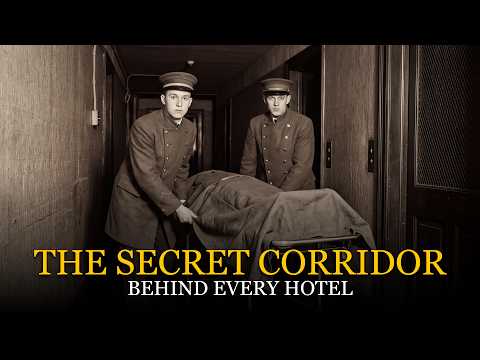
But death did come to the Waldorf. It came in the quiet hours, behind locked doors, in the bodies of elderly guests and the despairing. And when it did, a meticulously choreographed system swung into action—a system so precise, so hidden, that the paying guest never knew.
The architect, Henry Janeway Hardenbergh, drew two sets of corridors into every floor plan. The public hallways were wide, carpeted in deep pile, lined with electric sconces and framed artwork. The service corridors, tucked behind unmarked doors, were narrow, floored in bare concrete, their ceilings low and threaded with pipes. Every service corridor was built to a minimum width determined not by laundry carts or room service trays, but by the dimensions of a standard adult coffin: six feet long, two feet wide. The freight elevators were sized accordingly. The turns were angled to allow a long, rigid object to navigate corners. This was not an afterthought—it was specified in the plans.
George Boldt, the hotel’s manager, kept 970 servants on the payroll even when occupancy plummeted to 40 guests during the Panic of 1893. “The illusion was the product,” he understood, “and the illusion required a full staff operating at peak readiness, whether the hotel held 400 guests or four.” His most consequential hire was Oscar Tschirky, the maître d’hôtel who memorized the preferences of every significant guest and trained his staff in the art of making unpleasant reality disappear.
When a chambermaid found a body, she had one absolute instruction: “Do not scream. Do not cry out. Close the door. Walk, do not run, to the house telephone. Call the floor supervisor. Use the code phrase.” The code phrases varied—“a sleeper,” “a permanent checkout,” “a room requiring special attention”—but the principle was universal. The chain of command was rigid: chambermaid to floor supervisor, floor supervisor to house detective, house detective to house physician, house physician to general manager. At each link, the circle of knowledge expanded by exactly one person. By the time the general manager was involved, perhaps five people in a building of nearly a thousand employees knew what had happened.
The house physician’s task was not merely medical but administrative. If he determined the guest had been ill, he could arrange for the body to be transported to a hospital before officially pronouncing death. The death certificate would list the hospital, not the hotel, as the place of death. This was not technically illegal—it was a gray area of medical practice that hotel physicians navigated with practiced skill. The hotel’s name never appeared. The room number was never printed.
The physical removal began with the body wrapped in the room’s own sheets. The route proceeded from the guest room through the service door into the narrow concrete corridor to the freight elevator, which descended to the basement. There, in rooms lined with zinc or tin and packed with ice, the body waited while arrangements were made with the undertaking firm. The undertaker’s man arrived at the back entrance, always in the alley, never on the avenue. The entire process, from basement to alley, took less than twenty minutes. By morning, the room had been stripped, cleaned, and prepared for the next guest.
The financial stakes were enormous. A single line in the morning newspaper could empty 300 rooms by nightfall. A reported suicide was catastrophic—the newspapers of the 1890s treated hotel suicides as front-page news, printing the hotel’s name, the room number, the method. If 5% of reservations for the following week were canceled, the hotel lost several hundred dollars in room revenue alone. Add the loss of dining and bar revenue, and the damage to reputation among the social elite, and a single printed name could cost thousands. But the worst scenario was contagion. In an era before antibiotics, a death from a communicable disease could trigger a quarantine order that would brand the hotel for years.
The system ran for decades—through financial panics, wars, and epidemics. It ran because every person involved, from the chambermaid to the general manager to the architect to the undertaker, understood the financial logic that sustained it. But no system built on concealment can run forever. Eventually, the forces that crack every facade gathered enough strength to break through. The wrecking ball was already swinging.
The first blow came not from a wrecking ball but from a headline. In 1899, a reporter for the New York Journal bribed a discharged bellman for the details of a death that had occurred three weeks earlier on the seventh floor. The story ran under the banner “THE HOTEL THAT BURIES ITS GUESTS.” It named the Waldorf. It described the service corridors. It claimed—falsely, but persuasively—that bodies had been stored in the wine cellars.
Boldt’s response was immediate and ruthless. He denied everything. He produced a physician’s affidavit swearing the guest had died at a hospital on West 34th Street. He threatened the Journal with a libel suit so expensive that Hearst’s lawyers advised retreat. The story was retracted. But the damage had been done—not to the hotel’s bookings, which recovered within a month, but to the wall of silence itself. The bellman had talked. And he had been believed.
From that year forward, the system required a new layer of defense. The house detectives were no longer merely guards against scandal. They became hunters of leaks. They kept files on every employee, noting debts, drinking habits, resentments, anything that could be used to predict who might talk. A chambermaid whose brother had been fired was watched. A porter who gambled was watched. The building had always concealed death from the guests. Now it began concealing its own secrets from its own staff.
By 1907, when the Plaza opened, the concealment had become an industry science. The Plaza’s architect, also Hardenbergh, refined the service corridor to a width of six feet and three inches—an extra three inches, the plans noted, to accommodate the turning radius of a hospital stretcher. The freight elevators were fitted with removable ceiling panels. The basement cold rooms were lined with cork insulation and fitted with drains, so that ice melt would not pool on the floor.
The new hotels also introduced a formal position that the Waldorf had invented only informally: the night manager. Ostensibly, he supervised the lobby and the front desk after midnight. In practice, he was the sole authority for any death that occurred between eleven at night and seven in the morning. He carried a locked ledger, kept in a wall safe behind the front desk, in which each incident was recorded under a false name and a false date. The ledger never left the building. It was burned, volume by volume, at the end of each year.
But the most significant evolution of the system came from outside the hotel industry entirely. In 1915, New York City’s chief medical examiner, Charles Norris, began a campaign against precisely the kind of discretionary death certification that hotel physicians had relied upon for two decades. Norris was a reformer. He had seen too many certificates signed by family doctors who had never examined the body. He demanded that every death in a public accommodation be reported directly to his office, and that the body be inspected by a city examiner before removal.
The hoteliers fought him. They lobbied. They donated to the right campaigns. But Norris was relentless, and in 1918 his reforms became law. From that year, a hotel physician could no longer quietly arrange for a body to be transported before death was pronounced. The city examiner had to come. And the city examiner had to see the room.
The old system did not die. It simply learned to move faster. If the city examiner had to see the room, then the room had to be prepared before he arrived. The body could no longer be taken to a hospital. But it could be moved to another room—a service room, a storage closet, a suite already vacant on the same floor—so that the examiner would inspect a space that bore no trace of the guest’s long illness or final struggle. The certificate would list the new location. The hotel’s public floors remained untouched.
And so the corridors widened, the ledgers burned, and the machine adapted once more. But the adaptations were growing more expensive, more visible, and more legally precarious. The age of the private kingdom was ending. The age of the corporation was beginning. And corporations, unlike patriarchs, keep records.
By the 1920s, the Waldorf’s own investigator logs had grown thick with euphemism. “Guest removed for medical attention” appeared so often that a clerk could copy the phrase without reading it. But the logs also recorded something new: visits from city examiners, complaints from public health inspectors, and, in 1927, a lawsuit filed by the family of a guest who had died on the ninth floor. The family’s attorney had obtained a copy of the death certificate—and noticed that the place of death was listed as a hospital that had closed three years earlier.
The suit was settled quietly for an undisclosed sum. But the settlement required the Waldorf to admit, in a sealed document, that the guest had died on the premises. For the first time in its history, the hotel’s name appeared on a legal record connected to a death. The wall of silence had been breached not by a newspaper, but by a clerk’s error and a family’s grief.
Lucius Boomer, who had taken over as manager in the 1920s, understood what this meant. The old system—the ice rooms, the coded phrases, the discretionary certificates—was no longer sustainable. When he purchased the Waldorf’s name for one dollar and rebuilt on Park Avenue, he also rebuilt the death protocol. The new Waldorf-Astoria, opened in 1931, had no basement ice rooms. It had a formal agreement with a funeral home three blocks away. It had a written procedure, approved by lawyers, for notifying the next of kin. It had, in short, replaced secrecy with discretion. The difference was subtle but absolute: secrecy meant the hotel controlled the truth; discretion meant the hotel managed its release.
The Great Depression finished what the lawsuit had begun. With occupancy below 50 percent, the new Waldorf could no longer afford 970 servants. The staff was cut to 400. The service corridors remained, but they were no longer staffed around the clock. The freight elevators still ran, but now they carried luggage and linens more often than they carried the dead. The machine that had made death disappear had become a machine that made death quiet—which is not the same thing.
Today, the original Waldorf is gone, replaced by the Empire State Building. But the system it built survives in every luxury hotel that has ever trained a housekeeper to say “a room requiring special attention” instead of “a dead body.” The ice rooms are gone. The ledgers are gone. The house detectives are gone. But the corridors are still there, six feet wide, sized for a coffin, waiting in the dark behind the marble.
And somewhere tonight, in a hotel you have probably stayed in, a service elevator is descending with a cargo no guest will ever see. The doors open onto a concrete hallway. Two people in unmarked clothes move quickly and quietly. On the other side of the wall, a couple laughs over dinner. They will never know. They were never supposed to know.
But you know now. And the next time you check into a grand hotel, run your hand along the wall behind the ice machine. Look for the unmarked door. Listen for the freight elevator at 3 a.m. What do you think you would find if you opened that door?
Report this article
Select a reason for reporting:






