In the dense jungles of Vietnam, a soft thump—like a drumbeat muffled by mud—could mean salvation or doom. For American infantry, it was the sound of their grenadier delivering explosive steel onto enemy positions. For the enemy, it was the last sound they ever heard. The weapon behind that thump was the M79 grenade launcher, a break-action tube that fired 40mm rounds with deadly precision. But this is not just a story about a weapon; it’s about the men who carried it, the grenadiers, who held the most powerful and most exposed position in the squad. Theirs is a tale of sacrifice, ingenuity, and the psychological weight of killing from a distance.
Before the M79, infantry squads had a deadly gap in their firepower. Hand grenades could only be thrown about 35 meters, and mortars couldn’t fire closer than 300 meters. That left a 260-meter dead zone where enemy forces could hide and kill with impunity. Army studies found that 40% of engagements in rough terrain occurred within that gap. The solution was the M79, a single-shot launcher that could throw a grenade 350 meters with manageable recoil. Adopted in 1960, it was in every infantry squad by 1965. But the men who carried it made a trade that defined their war.
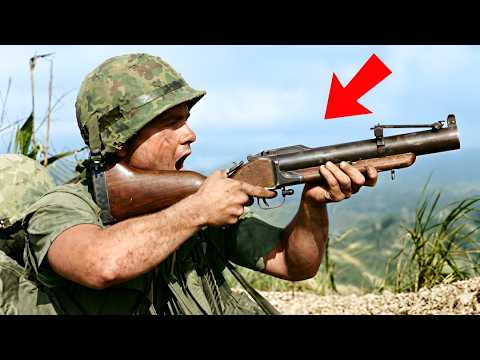
The grenadier surrendered his M-16 rifle for an M1911 pistol—seven rounds of .45 caliber as his only backup. In a war where contact happened at spitting distance, that was a precarious trade. Yet the M79’s ammunition made the grenadier indispensable. The standard M406 high-explosive round threw over 300 steel fragments at 5,000 feet per second, with a 5-meter kill radius and a 130-meter casualty radius. One round could wipe out a football field’s worth of enemies. For close quarters, the M576 buckshot round delivered 20 double-aught pellets with no fuse, a wall of lead at the pull of a trigger. The M397 jumping grenade kicked up 5 feet before detonating, raining fragments on anyone who had gone prone—the very instinct that saved them from everything else.
That lethal loadout made the grenadier the enemy’s highest-value target. Captured NVA documents prioritized killing the man with the grenade launcher. Ambush protocols sometimes called for rushing the grenadier first. He was hunted, and he knew it. Most grenadiers carried 80 to 100 rounds, each weighing half a pound—50 pounds of grenades before water, rations, or anything else. Some carried unauthorized M-16s on slings because the alternative was walking point with a pistol and a prayer. Sergeant Carl Menary of the 2/27th Infantry designed his own carrying vest with 36 individual pockets, distributing the weight across the torso. The Army eventually copied his design.
But the M79 had a critical flaw: its high-explosive rounds needed 14 to 30 meters of flight to arm. In the jungle, where first contact often happened inside 15 meters, the most powerful weapon in the squad became a paperweight. Veterans called these “oh shit” moments. One grenadier fired at an NVA soldier at point-blank range; the unarmed round ricocheted and struck his own squad leader in the groin. He tracked the man down 20 years later to apologize.
Despite the risks, men volunteered for the job. Some performed miracles. In 1969 near the Saigon River, a four-man recon team was surrounded and out of rifle ammunition. Grenadier Billy Cone burned through 75 grenades in minutes, building a wall of explosions around his team. A Cobra pilot, Larry Taylor, landed his attack helicopter in the firefight and pulled the men onto the skids. Taylor received the Medal of Honor, but it wouldn’t have happened without Cone’s thumping.
Another story: October 31, 1967, Captain Riley Pitts of Charlie Company, 2/27th Infantry, walked into a VC ambush. He grabbed an M79 off the ground and began putting rounds directly into bunker apertures. When a captured Chinese grenade landed at his feet, he threw himself on it—it didn’t go off. He got up and kept firing, marking bunker positions until a bullet finally killed him. He was posthumously awarded the Medal of Honor, the first African-American officer to receive it.
But there’s another side to the thumper that hero narratives don’t cover. The M79 killed from beyond visual range. You thumped a round into a tree line and heard the result—screaming, silence, secondary explosions—but you never saw a face. The round left your barrel and the result arrived as sound, with a 1-to-2-second gap between the thump and the crump. In that gap, your brain had time to register that you had just put something in motion that couldn’t be called back. A rifle doesn’t give you that pause. The thumper built a delay into the act of killing, and that delay gave the brain just enough room to observe itself doing it.
Some men compartmentalized it; others carried that window home. Veterans describe hearing the thumper sound decades later—in a car door closing wrong, in construction noise—and being pulled back to the silence before the impact. That gap, that tiny cathedral of time where violence was in the air and you were the one who put it there. The M79 was impersonal by design. You fired at a grid reference, a tree line, a sound, and the weapon did the rest. Some grenadiers felt like they were operating a system, not fighting a person. That psychological distance was efficient in combat and corrosive afterward.
By the late ’60s, the Army introduced the M203 underbarrel launcher, letting grenadiers keep their rifles. Most line units switched by ’71. But the M79 didn’t disappear. Special operations kept it—MACV-SOG operators sawed down the barrel and wore them on their hips; Navy SEALs used the China Lake pump-action that held four rounds. The M79’s range, accuracy, and trigger were superior. The men who needed the best kept choosing the weapon everyone else had thrown away. It showed up again in Grenada, Panama, the Gulf, Afghanistan, and Iraq. Special forces carried them into the 2000s.
But the weapon was always the simple part. The complicated part was the man—the one who traded his rifle for 50 pounds of explosive and a pistol, who walked point knowing he was the highest-value target, who could level a tree line at 300 meters but couldn’t defend himself at 10. Who pulled the trigger, watched the round arc, listened to the silence, and heard what happened on the other end. The M79 was the simplest weapon of the Vietnam War. Carrying it was the most complicated job in the squad. And the men who did it—who thumped round after round into jungle they couldn’t see through, who built walls of fragmentation around teams that would have died without them, who hauled that weight through mud and monsoon for 12 months and then came home and heard that sound in their sleep for the rest of their lives—they were never just grenadiers.
They were the squad’s conscience and its fist wrapped in the same man. But the story doesn’t end with the men who came home. It continues in the ones who never got the chance, and in the ones who did and found that the war had followed them back.
Consider what the grenadier carried beyond the weight. He carried the responsibility of being the squad’s problem-solver. When a machine gun pinned the platoon, it was his thumper that arced a round through the canopy and silenced it. When a bunker refused to fall, it was his 40mm that found the slit. He was the man everyone looked to when the situation went from bad to hopeless. And when he delivered, he earned a quiet nod, a hand on the shoulder, a muttered thanks. But when he missed, when the round sailed wide or failed to arm, the silence that followed was his alone to bear.
There’s a story that doesn’t make the citations. A grenadier in the 1st Cavalry Division, name lost to the records, was credited with saving his platoon during a night ambush near Bong Son. He fired over 60 rounds into the darkness, adjusting each one by sound alone. When dawn came, they counted 22 enemy dead. He never spoke about it afterward. His squad mates said he seemed to shrink into himself, as if the act of killing at that scale had hollowed something out. He survived the war but never quite came home.
The M79 demanded a certain kind of man—one who could think in arcs and angles, who could calculate distance and elevation in the space of a breath, who could trust a weapon that sometimes refused to fire when it mattered most. But it also demanded something darker: the willingness to kill without seeing, to send death arcing through the air and wait for the sound that told you it had landed. That waiting, that one-to-two-second eternity, was the grenadier’s private hell. Some men learned to fill it with action—reloading, moving, shouting orders. Others couldn’t.
After the war, the Army tried to forget the M79. It was a relic of a conflict they wanted to bury. But the men who carried it couldn’t forget. They heard the thump in their dreams, in the slam of a screen door, in the backfire of a truck. Some sought help. Many didn’t. The grenadier’s burden was invisible, carried in silence long after the weight of the rounds was gone.
And yet, ask any of them today, and most will tell you they’d do it again. Not because they loved the killing, but because they loved the men beside them. The grenadier was the squad’s insurance policy, the one who made the impossible possible. When the radio called for fire and none came, when the mortars were out of range and the artillery too slow, the grenadier was there, thumping rounds into the jungle, buying seconds with explosives.
That is the legacy of the M79 and the men who carried it. Not the 350,000 manufactured, not the battles fought across five decades, not the engineering marvel of a 40mm round that could fly 350 meters. It is the image of a young man, barely out of his teens, hauling 50 pounds of grenades through triple-canopy jungle, a pistol on his hip and a prayer on his lips, ready to trade his life for the men beside him. He was the most powerful man in the squad and the most vulnerable. He was the thumper, and his story is the story of Vietnam itself—complicated, painful, and impossible to forget.
The war followed some men home in ways that never made the citations. A grenadier from the 25th Infantry Division, who asked that his name not be used, described waking up in his suburban bedroom years later, convinced he could hear the thump of an M79 in the distance. It was a car door slamming three houses down. He lay there in the dark, heart pounding, waiting for the crump that never came.
Others found different ways to cope. Some became counselors, helping other veterans navigate the invisible wounds. Some retreated into silence, their families learning not to ask. A few, like the grenadier who tracked down his old squad leader in 1988, found a measure of peace in apology and forgiveness. But for every man who found closure, there were others who never did.
The M79 itself became a footnote in military history, a curious artifact of a war that refused to be neatly packaged. Yet its legacy lives on in the men who carried it—the ones who learned to think in arcs and angles, who built walls of fire to save their friends, who heard the thump in their sleep for decades afterward.
They were never just grenadiers. They were the squad’s conscience and its fist, wrapped in the same man, carrying a weapon that was both salvation and burden. And when you see a photo of a young soldier with a blooper slung over his shoulder, remember what he carried wasn’t just 50 pounds of grenades. It was the weight of every life he saved and every life he took, and the silence between the thump and the crump that never really ended.
What do you think—can a weapon so simple leave a wound so deep? Share your thoughts below.
Report this article
Select a reason for reporting:






