The tail gunner of the B-29 Superfortress had one of the most critical and dangerous jobs in World War II. Perched alone in the rear of the massive bomber, he was the last line of defense against enemy fighters. But just how effective was this isolated warrior? The answer might surprise you.
In the heat of battle, the tail gunner’s compartment was a cramped, pressurized capsule. If enemy action threatened, the crew would depressurize the aircraft to prevent catastrophic rupture. At altitudes above 10,000 feet, oxygen masks became essential. The gunner, facing backwards, had to protect the bomber’s tail from attacks coming from behind.
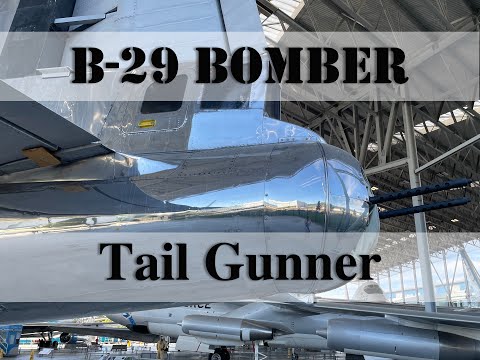
The B-29’s tail turret was equipped with twin .50 caliber Browning M2 machine guns, each capable of firing up to 14 rounds per second. The gunner aimed through an optical pedestal gunsight, which fed data into an analog computer to calculate ballistic solutions. This advanced system gave the gunner a 500-yard advantage over attacking interceptors.
But the tail gunner’s effectiveness wasn’t just about firepower. It was about positioning and tactics. During daylight high-altitude missions, Japanese fighters typically attacked from the front, where the B-29’s nose guns were strongest. Only 16% of attacks came from the tail. However, during nighttime low-altitude missions, the tail was the primary attack vector—60% of attacks came from the rear. The tail gunner’s role became crucial.
The 1945 Operations Analysis report concluded that the B-29’s defensive gun system was highly effective. For tail attacks, the ratio of enemy losses to bomber losses was an astounding 70 to 1—higher than any other gun station. The tail gunner was not just a defender; he was a predator.
Yet, the position had its challenges. The compartment was isolated, and the gunner had to crawl over the tail skid well to reach his seat. Once in position, he connected his communications system and oxygen, ready to face the enemy alone.
As the B-29 roared through the skies, the tail gunner’s eyes scanned the horizon. He knew that his actions could mean the difference between life and death for the entire crew. And as the war progressed, his effectiveness only grew, adapting to the changing tactics of the enemy.
But what was it like in the heat of combat? How did the gunner handle the stress, the isolation, and the constant threat? The story of the B-29 tail gunner is one of courage, skill, and the relentless pursuit of survival in the unforgiving skies of World War II.
To understand the man behind the guns, you have to picture the ritual that preceded every mission. The gunner made his way through the aft section, squeezing past the temperamental Andover APU—the same auxiliary power unit that would later ignite during the Kee Bird’s Greenland salvage attempt in 1995—and crawled over the hump of the tail skid well. He flipped down his padded seat, buckled in, and jacked his comm cord into the box. Around him: a walk-around oxygen bottle, a heated suit rheostat, and, almost absurdly, an ashtray.
Then came the checklist that turned a passenger into a weapon. He flipped the auxiliary power switch to wake the gun chargers, air compressors, and the analog computer. Ten seconds later, AC power. He rotated the computer switch to spin up the gunsight gyros, switched the guns from SAFE to FIRE, and dialed the reticle brightness to taste. Finally, he cranked the interceptor’s wingspan into the sight—a detail that mattered, because the ranging wheel framed those wings to feed the ballistic solution.
The guns themselves were twin Browning M2s, barrels spaced fourteen inches apart, with an arc of travel of thirty degrees in every direction—up, down, left, right. The ammo mix was pure armor-piercing incendiary. No tracers. The reasoning was cold and practical: tracers would only guide the enemy’s aim back to him. Effective range was 900 yards, and that 500-yard cushion over the interceptors was no accident—it was designed in.
Earlier models had experimented with a 20mm center cannon, but it was discarded. The 125-round magazine was too small, the ballistics didn’t match the .50s, and it simply wasn’t worth the weight. By March 1945, a 20th Bomber Command newsletter even directed the installation of a third .50 caliber gun, though most wartime B-29s kept the twin configuration.
What the gunner saw looking forward through the bulkhead opening was a tangle of machinery—ammo boxes, ammo chutes, pressure and heating ducts, the tail skid cavity, and the aft lower turret. He was sealed off from the rest of the crew by the 1,144 armored bulkhead and three panes of ballistic glass. In pressurized flight, the space beyond his compartment was inaccessible. He was, quite literally, alone at the end of the plane.
And that isolation shaped the psychology of the station. The tail gunner couldn’t see the pilots, couldn’t read the cockpit’s mood, couldn’t hear a shouted warning without the intercom. He tracked and fired on fighters through an optical pedestal sight, his left hand on the action switch, his right hand framing the target’s wingspan on the range wheel, his thumb hovering over the triggers.
The numbers from the 1945 Operations Analysis report told a remarkable story. The claims board had screened out duplicates and invalid kills with great care, and even so, the tail station’s loss ratio against attacking fighters stood at seventy to one. The criteria for a confirmed kill were strict—fire, pilot killed, explosion, broke apart, engine failure, bailout—and the tail gunners kept meeting them.
Yet the war was already teaching hard lessons about where the real danger lay. In daylight, the fighters came from the nose. At night, they came from the tail. The gunner’s world was defined by the clock and the altitude, and his effectiveness rose or fell with the tactics of the enemy.
There was one more factor that made the tail position so lethal, and it had nothing to do with the guns themselves. It was the Central Fire Control System—General Electric’s analog brain that networked all the remote turrets together. The tail gunner wasn’t firing alone; he was plugged into a system that let him hand off targets, share solutions, and cover arcs the other gunners couldn’t reach.
When a fighter rolled in from six o’clock, it wasn’t just facing two barrels. It was flying into a coordinated web of .50 caliber fire.
The April 1945 formation charts bore this out. In a standard twelve-plane formation, the tail of the group was protected by forty-one machine guns against level or low attacks from the rear, and fifty-one guns against fighters diving from high six o’clock. No single interceptor could survive that kind of concentration for long.
But the gunner’s war was fought in seconds. An attacking fighter closing at hundreds of miles per hour gave him a window measured in heartbeats—track, range, frame the wingspan, squeeze the thumb triggers. Miss the window, and the fighter flashed past, repositioned, and came again.
The heated suit rheostat mattered more than it sounds. At 30,000 feet, the compartment could drop far below freezing, and numb fingers don’t track fighters. The gunner rode his suit’s warmth the way a pilot rode his throttles—constantly adjusting, never quite comfortable.
And then there was the ashtray. It seems like a small thing, almost comic in a machine built for destruction. But it tells you something about the men who flew these missions. They expected to be up there for hours. They expected to wait. The tail gunner’s war was mostly boredom stitched together with terror—long, cold stretches of empty sky, then a sudden blur of motion and noise.
He learned to read the sky the way a hunter reads a forest. A glint of sun on a canopy. A speck that grew too fast. The distant flicker of guns from another bomber in the formation, warning him where the attack was coming from.
The intercom was his lifeline. Through it came the pilot’s calm voice, the navigator’s updates, the occasional crack of another gunner calling a bandit. When the formation depressurized and the masks went on, those voices grew muffled, distant, filtered through rubber and oxygen.
Still, the record spoke for itself. Seventy to one. The tail gunners of the Twentieth Air Force had turned the back of the Superfortress into one of the deadliest places in the sky—a station the enemy learned to respect, and then to avoid.
But the story of the B-29 tail gunner doesn’t end with the statistics. It ends with the men themselves—who they were, how they trained, and what they carried with them into that lonely capsule at the end of the plane.
Most of them were barely out of their teens. They trained at bases like Las Vegas and Wendover, learning the gunsight’s gyros and the ballistic computer until the checklist was muscle memory. They were taught to think of the interceptor as a math problem—wingspan, range, lead—and then to solve it in under two seconds.
What they carried into the capsule was personal. A photograph tucked into a flight jacket. A lucky coin. A letter they’d read so many times the folds went soft. The ashtray wasn’t decoration—it was a promise that the war would end and there’d be time for small comforts again.
And when it did end, the tail gunners came home to a world that barely understood what they’d done. They didn’t talk much about the seventy-to-one ratio or the analog computer or the cold. They talked about the sky, and the men they flew with, and the strange silence at the end of the plane.
The B-29 tail gunner was the last line of defense and the first to be forgotten—but the record he left behind was written in fire and arithmetic, and it still stands.
So the next time you see a Superfortress in a museum, walk to the back. Look into that cramped, glass-paned capsule. Imagine the cold, the hum of the APU, the voice on the intercom. Then ask yourself: could you have done it?
What would you have carried into that lonely seat at the end of the plane? Share your thoughts in the comments below.
Report this article
Select a reason for reporting:






