The winter wind howled outside the grand palace windows, but inside, the atmosphere was colder still. In a dimly lit chamber, an old man lay dying—his breaths shallow, his skin pale as parchment. Yet, in the corridors beyond, whispers carried not sorrow, but a chilling anticipation. “His death will be a great relief,” a voice murmured, barely audible over the crackling fire. The speaker was none other than his own brother, the heir to the throne.
For years, the royal family had endured the erratic behavior of Prince Leopold—a man whose scandals had tarnished the crown and whose cruelty had left deep scars. But as his life ebbed away, the relief was tinged with a darker truth: no one would mourn him.
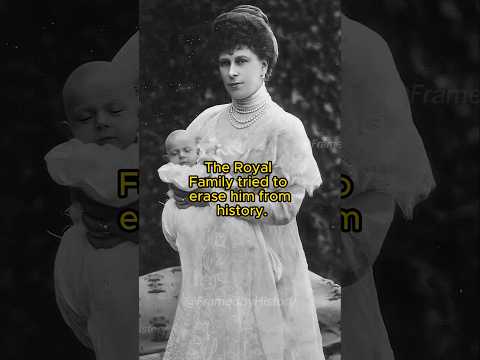
The prince’s story began not in shadow, but in the dazzling light of court. Born the second son, Leopold was never meant to rule, yet his ambition burned brighter than his brother’s. He married a princess of renowned beauty, but behind closed doors, their union was a battlefield. “He broke her spirit,” a lady-in-waiting later confessed. “And she was not the only one.”
Whispers of his affairs were commonplace, but it was his temper that truly terrified the household. Servants learned to read his moods like storm clouds, scattering at the first sign of fury. Even his children—three sons and a daughter—grew up in the shadow of his unpredictable rage. “We learned to be invisible,” his youngest son would later write. “It was the only way to survive.”
As the years passed, Leopold’s behavior grew more erratic. He squandered fortunes on lavish parties and ill-advised investments, while his brother, the crown prince, worked tirelessly to maintain the family’s reputation. The tension between them simmered, a silent war fought in icy silences and pointed remarks. “You are a disgrace,” the crown prince once hissed during a heated argument. Leopold merely laughed. “And you are a fool,” he replied. “The people love me.”
But the people did not love him. They feared him. And when the first rumors of his failing health surfaced, the court held its breath. Some prayed for a miracle; others, for a swift end. The palace physicians spoke of a mysterious ailment—perhaps poison, perhaps merely the wages of a dissolute life. No one dared to ask too many questions.
On the night of his death, the family gathered not in grief, but in grim satisfaction. “It is over,” the crown prince declared, his voice flat. “We can finally heal.” But as the first light of dawn crept through the stained glass windows, a new question hung in the air: What secrets had died with Leopold? And would they stay buried?
The answer came sooner than anyone expected. Within a week of the funeral, a sealed letter surfaced—delivered not to the crown prince, but to the royal council. The wax bore Leopold’s personal crest, and the handwriting inside was unmistakably his: sharp, slanted, and defiant even in ink. “If you are reading this,” it began, “then I am dead, and my dear brother is already measuring the throne for his comfort.”
The council chamber fell silent as the chancellor read aloud. Leopold had not merely squandered fortunes—he had kept records. Every bribe, every illicit affair, every hushed crime committed by the court’s most respected names was catalogued in meticulous detail. “He built an archive of our sins,” the crown prince whispered, his face draining of color. “And he meant to use it.”
But the letter did not stop there. Leopold claimed his illness was no accident. “Someone in this palace has been poisoning me for months,” he wrote. “And I know who.” The names, however, were not in the letter. They were hidden elsewhere—somewhere only Leopold’s most trusted confidant would know.
That confidant, it turned out, was not a nobleman or a courtier, but a servant girl named Mira. She had been Leopold’s personal attendant for over a decade—silent, unobtrusive, and utterly invisible to the court’s elite. When the council summoned her, she arrived with trembling hands but steady eyes. “He gave me a key,” she said quietly. “And a warning.”
The key opened a hidden compartment in Leopold’s study, behind a portrait of his late wife. Inside lay a leather-bound journal—and a small vial of dark liquid. The journal’s final entry was dated just three days before his death. “They think I don’t see them,” it read. “But I see everything. And when I am gone, they will tear each other apart.”
The vial was sent to the palace alchemist for examination. His verdict came swiftly: arsenic, administered in small doses over many months. Someone had been killing the prince slowly, deliberately—and the journal hinted that Leopold had known all along. “I let them think they were winning,” one entry confessed. “It made the game more interesting.”
As the council scrambled to contain the scandal, a second letter arrived—this time addressed to the crown prince himself. It contained a single line, written in Leopold’s unmistakable hand: “Check your wife’s tea.”
The crown prince stared at the words until the ink seemed to swim before his eyes. His wife—the gentle, soft-spoken duchess who had never once raised her voice—was the last person he would have suspected. Yet the seed Leopold had planted was already taking root, and doubt, once sown, does not wither quietly.
He did not confront her. Not yet. Instead, he summoned the palace alchemist in secret and ordered every teapot, every cup, every tin of leaves in her private chambers examined. “Tell no one,” he commanded. “Not a whisper.” The alchemist bowed and vanished into the labyrinth of servants’ corridors, and the crown prince sat alone in his study, staring at the portrait of his brother and wondering how far the poison had truly spread.
Mira, meanwhile, had become the most sought-after woman in the palace. Nobles who had never deigned to learn her name now offered her gold, titles, even marriage proposals—anything for a glimpse of the journal’s remaining pages. She refused them all with the same quiet steadiness. “The prince trusted me,” she told the chancellor. “I will not betray that trust now.”
But trust, in the royal court, was a currency that bought little. Within days, rumors began to swirl that Mira herself had been Leopold’s lover—that the servant girl had shared his bed and his secrets alike. The whispers were baseless, cruel, and entirely predictable. Yet they served their purpose: they made her testimony easier to dismiss.
It was the youngest son, Edmund, who broke the silence. He had been a child of nine when his father’s cruelty was at its height, and he had spent the years since building a reputation for quiet scholarship and utter detachment from court politics. But when he learned of the second letter, he requested an audience with his uncle—and what he revealed in that closed chamber changed everything.
“My father did not write that letter,” Edmund said calmly, laying a sheet of parchment on the table. “Or if he did, he did not write it alone. Look at the slant of the final line—the pressure of the pen. His hand was shaking by then. He could barely hold a quill.”
The crown prince examined the letter again, and cold realization crept through him. The handwriting was Leopold’s, yes—but the final line, the cruel hint about the tea, had been added later. Someone had intercepted the letter, added their own poison, and sent it on. “Someone wants us to turn on each other,” Edmund said. “And they are succeeding.”
The question now was not who had killed Leopold. It was who had finished his work—and why. As the council reconvened behind locked doors, a third letter arrived, this one addressed to no one at all. It was slipped beneath the palace’s main gate and found by a kitchen boy, who carried it, unopened, to the captain of the guard.
The seal was not Leopold’s crest. It was something older—a symbol that had not been used in the kingdom for over a century. The captain’s hands trembled as he broke it open. Inside was a single name, written in a hand no one recognized: “Ask the queen mother what she buried in the garden.”
The queen mother had been dead for fifteen years. Yet the name on the letter was hers, and the garden it mentioned—the old rose garden behind the eastern chapel—had been sealed off since her funeral. The crown prince ordered it dug up at dawn.
They found a small iron chest, rusted shut, buried beneath the roots of a withered rosebush. Inside lay a bundle of letters in the queen mother’s hand, and a portrait of Leopold as a young boy—not the second son, but the first. “He was born before me,” the crown prince whispered, the letters trembling in his grip. “She hid him. She made me heir.”
The letters told the rest: Leopold had been born with a mark the court would have called cursed, and the queen mother, desperate to protect the crown’s image, had swapped the infants and buried the truth. Leopold had learned of it only years later—and the knowledge had curdled him from the inside.
“He never wanted the throne,” Edmund said softly, reading over his uncle’s shoulder. “He wanted to be seen. And we never saw him.”
Mira, summoned once more, confirmed it. “He told me once that his mother’s love was the first lie he ever learned,” she said. “And that he would die before letting another one stand.”
The vial of arsenic was never traced to a killer. Some whispered it was the duchess; others swore Leopold had taken it himself, a final act of theater. The court chose the quieter story, and the scandal faded into rumor.
Edmund left the palace that spring, carrying his father’s journal and a promise to write the true history. “Let them remember him as he was,” he said at the gate. “Not as they wished him to be.”
The crown prince watched him go, the weight of a stolen crown heavy on his brow. Behind him, the rose garden bloomed wild and untended, hiding nothing now.
But the kingdom never learned who had finished Leopold’s last letter—or whether the hand that wrote it still walked among them. What do you think: was it the duchess, the queen mother’s ghost, or someone else entirely?
Report this article
Select a reason for reporting:






