The morning fog hung thick over Portland, Oregon, as Dr. Caroline Webb strolled through the Riverside Antique Market on a Saturday in October 2024. A historian specializing in Victorian mourning customs, she was no stranger to the dusty corners where forgotten history waited to be understood. But nothing could have prepared her for the leather case a dealer named Martin pressed into her hands.
“I found something you might be interested in,” he said, nodding toward a box of old photographs. “It came from an estate in Salem. The family kept it in their attic for generations.”
Caroline opened the case carefully. Inside lay a photograph on thick cardboard, protected by tissue paper. The image showed a young girl, perhaps seven or eight, seated in an ornate chair. She wore a white dress with lace trim and held a porcelain doll in her lap. Her dark hair was curled just so, and a small necklace hung around her neck. At first glance, it seemed a typical Victorian portrait: formal, composed, dignified.
But something was off. The girl’s posture was too perfect, too stiff. Her hands lay unnaturally on the doll, as if someone had placed them there. And her eyes—Caroline leaned closer. They were open, but there was an emptiness, a flatness that sent a chill down her spine.
She turned the photo over. Faded brown ink read: Our beloved Emma, 8 years old, taken from us by fever, March 1899. Forever in our hearts with her cherished companion.
Caroline held her breath. This was no portrait of a living child. It was a memorial photograph—what the Victorians called a post-mortem photo. The girl was already dead when the picture was taken.
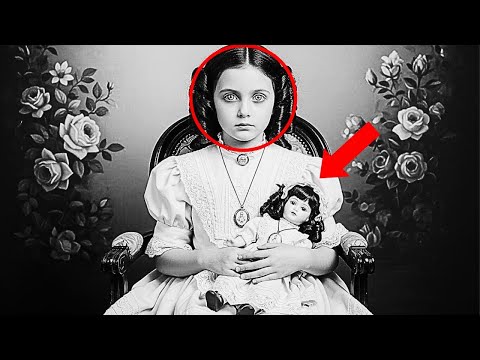
Post-mortem photography was common in the Victorian era, especially for children. Photography was expensive, and for many families, the only photo they would ever have of a departed loved one was taken shortly after death. Photographers developed techniques to pose bodies as if sleeping, or in some cases, as if they were still alive—propped in chairs, positioned with toys or flowers, their eyes sometimes painted open on the print itself.
Caroline paid for the photo and returned to her office, where she placed it under bright archival light. She had seen hundreds of post-mortem photos in her career, but something about this one unsettled her more than usual. The girl’s spine was ramrod straight, her head tilted at an unnatural angle. Her fingers were pressed into the doll’s body with such force that the fabric of its dress was compressed. Living children didn’t hold dolls that way. Someone had positioned Emma’s hands after death and somehow fixed them to maintain the grip.
She zoomed in on the high-resolution scan. The girl’s cheeks were tinted—likely with rouge or paint to simulate life. Her lips were colored similarly. But most disturbing were her eyes. At first, Caroline thought they were simply open, which was common in post-mortem photography. Closer inspection revealed something else: the pupils were slightly different sizes, and the gaze was not quite aligned. Caroline had seen this before—glass eyes temporarily inserted into the eye sockets of the deceased for a more lifelike appearance.
She called Dr. Michael Torres, a colleague who specialized in Victorian funeral practices. He arrived Monday morning with reference materials and a portable microscope. “This is unusual,” Michael said after twenty minutes of study. “The degree of staging here goes beyond typical mourning photography. Look at the background—that painted garden scene, the specific chair, even the doll. Everything is carefully chosen and arranged. This wasn’t just about preserving a memory. Someone was trying to create a specific image, to tell a specific story.”
“What story?” Caroline asked.
Michael pointed to various elements. “The white dress—that’s not typical burial clothing. It’s too elaborate. The curls in her hair—someone spent time arranging those after death. The doll—look closely. It’s expensive. High-quality porcelain. Probably imported. And the way she’s holding it, that forced grip—it’s as if someone wanted to guarantee the doll would be associated with this child forever.”
Caroline felt a shiver. “You think there’s something important about the doll.”
“I think everything about this photo is important. Someone went to extraordinary lengths to stage this image exactly as they wanted.”
Caroline needed to discover who Emma was and why her mourning photo was so elaborately staged. The inscription gave limited information: a first name, an age, a cause of death, and a date. No surname, no location beyond Martin’s mention of an estate in Salem. She began in Salem, Oregon, searching historical archives at the Oregon State Archives. Death records from 1899 were handwritten in large, chronologically ordered ledgers. Caroline scanned the entries for March 1899, looking for any girl named Emma, aged 8, who had died of fever. She found several Emmas who had died that year in Marion County, where Salem is located, but only one matched the age and month: Emma Rose, daughter of Thomas and Catherine Rose, died March 15, 1899, of scarlet fever. The address was on Commercial Street in Salem, in what was then a prosperous residential neighborhood near downtown.
Caroline searched for more information about the Rose family. City directories from the 1890s listed Thomas Rose as the owner of Rose Imports, a business dealing in fine goods, furniture, and luxury items. The family had been wealthy, which explained the expensive photo and elaborate staging. But when Caroline looked for later records, she found something strange. The 1900 census, taken just a year after Emma’s death, showed Thomas and Catherine Rose still living in Salem—but with no children listed. Yet the 1890 census showed the family with two daughters: Emma and an older sister named Margaret, who would have been about 17 in 1899. Where was Margaret? Had she also died? Caroline searched death records but found no mention of Margaret Rose in Oregon during that period. She expanded her search to marriage records, thinking Margaret might have married and left home. Nothing.
Caroline looked again at the photo, examining it with fresh eyes. She zoomed in on the doll Emma held. The porcelain face was delicate, with painted features and glass eyes. The doll wore a miniature dress that matched Emma’s own white dress in style and detail. Someone had deliberately dressed the doll to coordinate with the child’s clothing. Then Caroline noticed something she had missed. Around the doll’s neck hung a tiny locket, barely visible in the photo. She enlarged the image until the surface of the locket became clear. There was an engraving on it. Initials too small to read fully, but the first letter was definitely an M—not E for Emma, but M for someone else.
Caroline felt her heart rate quicken. She pulled out the photo again and examined Emma’s own necklace more closely. It was also a locket, and it too had engraved initials. Caroline adjusted the contrast and brightness of the scan until the letters became legible. M. Margaret Rose. Emma was wearing her sister’s locket, and the doll wore a locket with Margaret’s initial. Something terrible had happened to Margaret Rose. And somehow, this elaborate post-mortem photo of Emma was connected to it.
Caroline knew she had to find out what had happened to Margaret Rose. The fact that a 17-year-old girl had vanished from the census records without any documentation of death or marriage was highly unusual for the Victorian era, when civil records were generally well-kept—at least for wealthy families. She returned to the Oregon State Archives and requested access to all records pertaining to the Rose family from 1895 to 1905. Over the next few days, she pieced together fragments of information from various sources: property records, business licenses, newspaper mentions, church registers, and probate documents.
The Rose family had arrived in Salem in 1887, relocating from San Francisco where Thomas had initially established his import business. They were prosperous and socially prominent, attending the First Presbyterian Church and hosting gatherings in their large Victorian home on Commercial Street. Both daughters had been educated at private schools. The society pages of 1890s newspapers occasionally mentioned the Rose family: Margaret’s piano recital in 1895, Emma’s participation in a church pageant in 1897, Katherine Rose’s involvement in various charitable organizations. Everything pointed to a normal, successful family.
In September 1898, the tone of the newspaper coverage changed. Caroline found a brief article in the Salem Statesman Journal: The Rose family requests privacy in this difficult time. They ask that friends and well-wishers respect their need for seclusion. No explanation was given for what this difficult time entailed. After that article, Margaret’s name disappeared from all public records. She was no longer mentioned in society columns, church bulletins, or other documents. It was as if she had been erased.
Caroline found one more crucial document: a letter from Katherine Rose to her sister in California, dated November 1898. The letter had been preserved in a collection of family correspondence donated to the archives decades earlier. Caroline’s hands trembled as she read it.
Dearest Eleanor, Katherine wrote, I do not know how to bear this grief. We have lost our darling Margaret in the most terrible way. And now Emma asks for her constantly, unable to understand why her sister is gone. The doctors say Emma’s fever is worsening and her heart is weakening. I fear we will lose her too. Thomas has arranged for the photograph to be taken when the time comes, though I cannot bear to think of it. He insists it be done exactly as he has planned, that Emma must be depicted with Margaret’s things, as if her sister is somehow still with her. I think his grief has unhinged his mind, but I cannot fight him. I am too tired, too broken.
Caroline read the letter three times, her understanding of the photo shifting with each reading. Emma’s post-mortem photograph was not merely staged to memorialize her—it was staged to connect her somehow with her dead sister, Margaret. The doll with Margaret’s locket, Emma wearing Margaret’s necklace, the elaborate preparation. It was all Thomas Rose’s way of reuniting his daughters in death, even though they had died months apart. But how had Margaret died? And why was her death hidden, her name erased from the records?
Caroline needed to understand what had happened to Margaret Rose, but the official records had been cleansed or destroyed. She turned to less formal sources: personal diaries, letters, and newspaper archives from surrounding districts where the story might have been reported without the Rose family’s ability to suppress it.
In the collections of the Oregon Historical Society in Portland, Caroline found a set of letters written by a woman named Sarah Winters, who had been a schoolteacher in Salem during the 1890s. Sarah’s correspondence was detailed and gossipy, full of observations about Salem society and the families she knew through her teaching work. In a letter dated October 1898, Sarah wrote to a friend in Portland:
The scandal surrounding the Rose family has shaken Salem society to its foundations. Poor Margaret, only 17 years old, and to die under such circumstances. They say it was an accident, but everyone knows the truth. Thomas Rose has paid a great deal to keep the newspapers quiet, but the servants talk and the story has gone through the town. Catherine Rose scarcely leaves her house now, and young Emma is kept entirely secluded from the outside world. I fear for that child’s mental state. She has lost her sister in the most traumatic way imaginable.
Caroline’s heart pounded. What scandal? What circumstances? Sarah’s letter hinted at foreknowledge without providing details, assuming her correspondent already knew the story. Caroline searched through more of Sarah’s correspondence and found another letter from December 1898 that offered more context.
The official story is that Margaret Rose drowned while boating on the Willamette River, Sarah wrote. But everyone knows she took her own life. The poor girl was engaged to Robert Chambers, the lawyer’s son. And when he broke off the engagement suddenly last summer, she fell into a deep melancholy. Her parents tried everything—travel, doctors, diversions—but nothing helped. They found her body in the river in September. Thomas Rose has paid for silence. And the death certificate says accidental drowning. But we all know the truth. And now they say little Emma is sick with grief and fever, unable to accept the loss of her sister.
Caroline leaned back. The pieces of the puzzle finally fell into place. Margaret had died by suicide in September 1898, a death that carried an enormous social stigma in Victorian society. Suicide was considered not only a tragedy but a sin, a moral failing that cast a shadow over the entire family. Thomas Rose, desperate to protect his family’s reputation and his business interests, had used his wealth and influence to conceal the truth, having Margaret’s death officially recorded as an accident.
Six months later, Emma died of scarlet fever, perhaps weakened by grief and stress over her sister’s loss. And Thomas, in his own grief and possibly guilt, had arranged for Emma’s post-mortem photograph to be staged in a way that symbolically reunited the sisters. Emma dressed in white like a bride or an angel, holding a doll that represented Margaret, wearing Margaret’s locket—forever frozen in an image that denied the tragedy and scandal that had destroyed their family.
Caroline wanted to know more about who had taken the photograph and how it had been staged. Victorian post-mortem photography was a specialized skill, and not every photographer was willing or able to do such work. She searched business directories from Salem in 1899 and found several photography studios active in the city at that time. The most prominent was Hartwell and Sons Photography, located on State Street near downtown.
Caroline found advertisements for the studio in 1890s newspapers, promoting portraits, family groups, and memorial photographs handled with the greatest sensitivity and discretion. The term memorial photographs caught her attention. Not all studios advertised this service explicitly. It was considered somewhat morbid by some parts of Victorian society, though the practice was widespread. The fact that Hartwell and Sons specifically mentioned it suggested they specialized in post-mortem work.
Caroline searched for any surviving documents from the studio. Most 19th-century photography businesses had not preserved their records. Glass negatives were fragile, took up enormous storage space, and few photographers anticipated that their work would have historical value. But she found a reference in the Oregon Historical Society’s catalog to a collection of Hartwell studio papers donated in 1967 by the photographer’s grandson. The collection was small—a few dozen letters, some business ledgers, and a diary kept by William Hartwell, the studio’s founder.
Caroline requested access and spent an afternoon reading through the diary entries from 1899. William Hartwell’s notes were mostly brief, recording clients, types of photographs, and occasionally technical details about lighting or posing. But the entry from March 18, 1899, was unusually long and emotionally detailed.
Today I undertook the most disturbing commission of my career, Hartwell wrote. Thomas Rose came to my studio three days ago, stating that his youngest daughter had died of fever and requesting a memorial photograph. This in itself is not unusual. I have photographed many deceased children over the years and have always approached the work with compassion and professionalism. But Mr. Rose’s demands were extraordinary and deeply troubling.
He insisted the child be seated upright in a chair, not lying in repose as is customary. He brought specific clothing—an elaborate white dress that appeared to have been made for the purpose. He brought a doll, which he instructed be placed in the child’s arms and fixed there. Most disturbingly, he demanded the child’s eyes appear open and her expression suggest not sleep or peace, but alertness—as if she were alive and aware.
Caroline closed the diary, her hands trembling. Thomas Rose had orchestrated every detail to create an illusion of life and unity, a final, desperate attempt to keep his daughters together. The photo was not just a memorial—it was a denial of death itself, a fabrication of peace where there had been only tragedy.
“Some photos capture life, others death,” Hartwell had written. “This one captured something in between that I cannot name and do not wish to remember.”
Caroline now understood the full weight of that statement. The photo was a testament to a father’s love twisted by grief, a secret kept for over a century. She had finally uncovered the truth—but at what cost?
What secrets do you think are hidden in the old photographs you’ve seen?
Report this article
Select a reason for reporting:






