Morgan Chen had restored thousands of historical photographs, but the moment she adjusted the contrast on the 1899 family portrait, her breath caught. There was a fifth figure in the image—a small child, hidden for over a century by water damage and a deep crease. As the face emerged pixel by pixel, Morgan’s pulse quickened. The child was white, sitting among a Black family in Victorian Philadelphia. This wasn’t just a restoration project anymore. It was a mystery.
The client, Mrs. Patterson, had no idea. “There’s never been any mention of another child,” she whispered when Morgan called. But the image was clear. A little girl, perhaps four years old, positioned at the front of the group as if she belonged there. Morgan spent the next days reconstructing the damaged area, and with each passing hour, the child’s face grew sharper—solemn, pale, and utterly out of place in the rigid racial hierarchy of 1899.
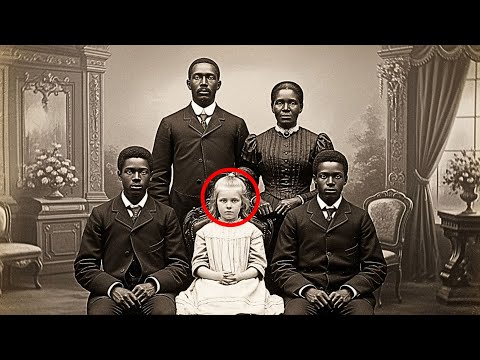
Determined to uncover the truth, Morgan dove into archives. The 1900 census listed Thomas and Ruth Parker, a Black couple, with their two adult children—and in the margin, a cramped notation: “Sarah, age five, white.” Church records revealed that Sarah had been baptized at the African Episcopal Church of St. Thomas, with Thomas and Ruth listed as her parents. “They claimed her officially,” the archivist said. “In the eyes of the church, they were her family.” But civil law would never recognize such a union.
The letters came next. Mrs. Patterson found a cache from Ruth to her sister, dated 1897–1902. “The child is well and growing,” Ruth wrote in September 1899. “We have made our peace with the looks we receive at market.” Another letter described Sarah’s laughter filling the house. But the tone shifted in 1901: “Sarah grows tall and asks questions about her mother. We tell her what we know, which is little enough. She is ours now in all the ways that matter.”
Then came the discovery that shattered everything. A newspaper article from January 1902: “Police were summoned to a residence on Lombard Street following complaints from neighbors regarding a white child living in the home of Thomas and Ruth Parker.” A neighbor, Mrs. Henrietta Worthington, had reported the family, claiming the child’s “moral education” was at risk. The Society for Organizing Charity intervened. By March, Sarah had been removed and adopted by a white family, the Brennans. “She asks repeatedly about Mama Ruth and Papa Thomas,” a follow-up report noted. “Mrs. Brennan is confident that with time and proper discipline, these unsuitable attachments will fade.”
Morgan sat in the dim light of her studio, staring at the restored photograph. Five faces looked back at her across 125 years. Four had been remembered. One had been erased—not by damage, but by deliberate forgetting. “Who were you?” she whispered to the child. “And why did they hide you?” The answer lay in the silence of the archives, waiting to be uncovered.
Morgan traced Sarah forward through the decades, one fragile document at a time. The 1910 census placed her as Sarah Brennan, sixteen years old, living with the Brennans in Germantown—listed as their adopted daughter, her education stopped at the eighth grade. By 1920, she had vanished from that household entirely. Then a marriage certificate surfaced from 1918: Sarah Brennan, age twenty-four, wed to William Foster, a postal clerk.
Children followed—Robert, Margaret, Joseph—and the family settled into a quiet life in Fairmount. The 1940 census confirmed it: Sarah Foster, age forty-six, still alive, still in Philadelphia. Morgan cross-referenced obituaries and genealogy forums until a name emerged from the tangle. Margaret Foster Coleman, age eighty-seven, living in a retirement community in the suburbs. Sarah’s granddaughter.
Morgan’s hands trembled as she dialed the number. An elderly voice answered, wary but curious. “Mrs. Coleman, I’m a photo restorer, and I believe I’ve discovered something important about your grandmother’s early life.” A long pause stretched across the line. “My grandmother died in 1967,” the woman said slowly. “I was only fourteen, but I remember her. What is this about?”
Morgan chose her words with care. She described the photograph, the hidden child, the Black family who had raised her. She mentioned the letters, the church records, the removal order. “I think she may have been taken from them against her will.” Another pause, longer this time. Then, quietly: “Can you come see me? I think we need to talk in person.”
They met three days later—Morgan, Mrs. Patterson, and the elderly woman whose apartment smelled of lavender and old paper. Margaret Coleman settled into her armchair and stared at the restored photograph spread across the coffee table. Her weathered hands trembled as she reached toward it. “I knew there was something,” she said finally. “My grandmother never spoke much about her childhood, but when she did, there was always this sadness in her voice.”
She told them about the fragments she remembered. Sarah had mentioned being adopted, that her birth mother died when she was small. But she’d also spoken of another mother—one who sang to her, braided her hair, taught her to pray. “She said she’d been happy once before she had to leave.” Margaret’s voice cracked. “We thought she was confused, mixing up memories. But she wasn’t, was she? She was remembering.”
Mrs. Patterson reached across and took Margaret’s hand. “We found letters,” Morgan said gently. “From Ruth Parker to her sister. She wrote about Sarah constantly—how she was growing, learning, laughing, how much they loved her.” Margaret closed her eyes. “Ruth,” she repeated softly. “Grandmother used to say that name sometimes, especially near the end when her mind was starting to go. ‘I want to see Ruth,’ she’d say. ‘I want to go home to Ruth.'”
The three women sat in silence for a moment, the weight of a century pressing down on them. Then Margaret wiped her eyes and looked up. “Tell me about them,” she said. “Tell me about the people who loved my grandmother.”
Morgan and Mrs. Patterson spent the next two hours sharing everything they had uncovered. Thomas, who worked the docks and brought home a crying orphan because he couldn’t bear to leave her alone. Ruth, who added Sarah’s name to the family Bible and fought to keep her when the authorities came. Samuel and Grace, who had a little sister for six precious years. “My grandmother married my grandfather in 1918,” Margaret said softly. “She chose him because he reminded her of someone from her childhood—a man who was gentle and strong.” She touched Thomas’s face in the photograph. “Maybe this was who she remembered.”
Mrs. Patterson leaned forward. “Did she ever try to find them? After she was taken?” Margaret shook her head slowly. “I don’t think she could. The Brennans were strict. They punished her when she talked about her old family, told her it was shameful, that she should be grateful to have been saved from that situation.” She paused. “Eventually, she learned not to speak about it. But she never forgot.”
Morgan looked at the photograph again—at Sarah’s small, solemn face, at Thomas and Ruth standing behind her with quiet dignity. “Then we need to make sure the world doesn’t forget either,” she said. “Sarah was their daughter, even if the law didn’t recognize it. That makes you two something, doesn’t it?”
Margaret looked at Mrs. Patterson, and for the first time that afternoon, a smile broke through her tears. “It makes us family,” she said. Mrs. Patterson laughed and cried at the same time, reaching out to clasp the other woman’s hand. “Then we have a lot of catching up to do.”
Outside, the afternoon light slanted through the window, falling across the restored photograph like a blessing. Morgan watched the two women—descendants of the same love story, separated by race and time and silence—begin to talk. There was so much left to uncover, so many questions still unanswered. But for now, this was enough. The child in the photograph had a name again. And soon, the whole world would know it.
The weeks that followed were a blur of phone calls, emails, and late nights at the studio. Morgan worked with Margaret and Mrs. Patterson to assemble a dossier—every document, every letter, every census entry—and submitted it to the Historical Society of Pennsylvania. “This is no longer just a family story,” the archivist told them. “It’s a documented case of forced separation. It belongs in the public record.”
But Morgan wasn’t finished. She kept returning to the photograph itself, to the way Sarah’s small hands were folded in her lap, to the faint shadow at the edge of the frame. Something still nagged at her—a detail she couldn’t name. She reopened the high-resolution scan and began examining the background, the painted studio backdrop, the ornate chair Thomas stood beside.
That was when she saw it. Behind Ruth’s shoulder, half-swallowed by the painted parlor scene, was a second child’s face—faint, almost ghostly, as if the photographer had captured a reflection in a mirror. Morgan zoomed in, her heart hammering. The face was darker than Sarah’s, with wide eyes and a small, solemn mouth. A Black child, perhaps the same age, standing just out of the family’s tight circle.
She called Mrs. Patterson immediately. “There’s someone else in the picture,” Morgan said. “A second child. I think—I think Sarah wasn’t the only one they hid.” A long silence. Then Mrs. Patterson’s voice, barely a whisper: “My grandmother once mentioned a boy. A cousin, she said, who died young. But there were never any records.”
Morgan pulled up the church ledgers again, searching for any mention of a boy in the Parker household. Nothing in the baptism records. Nothing in the census. But in a margin note from 1898, tucked beside Ruth’s name, she found a single line in the archivist’s cramped hand: “Parker household also shelters orphaned boy, Eli, age 6. No papers. Ill with fever.”
She traced the name through the death records. Eli Parker, buried in the churchyard of St. Thomas in the spring of 1899—just months before the photograph was taken. Morgan sat back, the pieces clicking into place. The Parkers had taken in two children, not one. Sarah, who survived and was taken away. And Eli, who never made it into the family Bible, whose face was captured only as a shadow.
She called Margaret that evening. “Your grandmother had a brother,” Morgan said. “For a little while, at least. His name was Eli.” The old woman was quiet for a long moment. Then she began to cry—not with grief, but with something closer to relief. “She wasn’t alone,” Margaret said. “All those years I thought she was the only one. But she had a brother.”
Morgan looked at the photograph on her screen, at Sarah’s pale face and the ghostly shadow behind Ruth. Two hidden children. One remembered, one forgotten. Both loved. “We’re going to find him too,” she told Margaret. “We’re going to bring them both back into the light.”
Morgan returned to the churchyard that autumn, a small crowd gathered beside a weathered stone. Margaret and Mrs. Patterson stood together, hands clasped, as Reverend Williams read Eli’s name aloud—the first time it had been spoken in public in over a century. “He was loved,” the reverend said. “He was theirs.”
Later, Morgan framed a second copy of the portrait, this one with Eli’s faint face gently enhanced. She hung it beside Sarah’s in the church archive, two hidden children finally restored to their family. “They were never forgotten,” Margaret whispered. “Just waiting to be found.”
Morgan looked at the two photographs, at the love that had survived erasure, and felt something settle in her chest. Some restorations, she realized, were never about the picture at all.
What would you have done, if you’d found a secret hidden in your own family’s attic?
Report this article
Select a reason for reporting:






