Sergeant William Hayes had seen enough war to last a lifetime. He’d stormed beaches, trudged through frozen mountains, and witnessed the worst that humanity could offer. But nothing—nothing—prepared him for the moment Corporal Morrison slid open the rusted bolt of a forgotten boxcar outside Nuremberg.
The smell hit first. Human waste. Rot. Sickness. The stench of people dying slowly in an enclosed space. Morrison staggered back, gagging. Hayes pulled his scarf over his nose and stepped forward.
Inside, in the dim light, shapes moved. Eyes reflected like animals in a cave. Thirty-seven women—German military personnel—huddled together, skeletal and silent, their uniforms hanging like sheets on wire frames. They had been locked in that car for six days. No food. No water. Left to die by their own retreating officers.
Hayes felt his stomach turn. This wasn’t combat. This wasn’t collateral damage. This was deliberate.
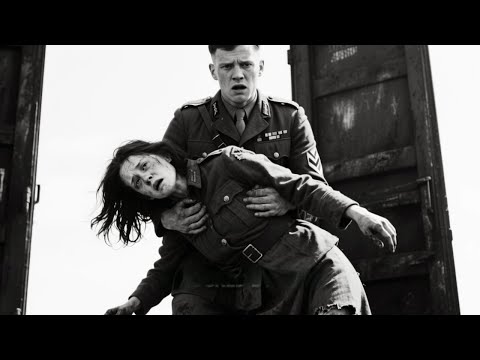
He made a decision. “Get them out. All of them. Get medics here now. Water, blankets, whatever we’ve got.”
“Sarge, we don’t have orders to—”
“I don’t care. Get them out.”
Moving them was delicate work. Some could walk if supported. Others had to be carried. The unconscious ones required careful handling. Dehydration, starvation, exposure—Hayes wasn’t a medic, but he’d seen enough to know these women were close to death.
His squad worked without complaint. Morrison and Kowalski rigged a stretcher from salvaged wood and canvas. Private Chen found a water pump that still worked and filled every canteen they had. Feldman stayed with the women, translating, reassuring, explaining that they were safe now.
Safe. The word sounded absurd.
The first woman Hayes helped out collapsed the moment sunlight hit her. She couldn’t stand, couldn’t hold her own weight. He caught her before she hit the ground, shocked by how little she weighed—like holding a bundle of sticks wrapped in cloth. She looked up at him with eyes that had forgotten what mercy looked like.
That’s when he said it. The words that would be recorded later in his official report and repeated in dozens of witness statements. The words that captured the moment when the war became personal in a way it hadn’t been before.
“You have to come with me. All of you. Right now.”
Not a question. Not a request. An imperative. A promise.
The medics arrived within the hour. Captain David Rothstein, battalion surgeon, took one look at the women and started issuing orders in the calm, clipped voice of someone who’d seen too much suffering to waste time on shock.
“IV fluids for anyone who can’t drink. Slow rehydration. If you give them too much too fast, they’ll die anyway. Blankets—get them warm. Check for frostbite, infections, open wounds. Move them to the field hospital tent. Now.”
Hayes rode in the truck with the first group. They didn’t speak. Most couldn’t. They just sat wrapped in army blankets, swaying with the truck’s movement, looking out at the German countryside like it was a foreign land.
Maybe it was. Maybe Germany had become foreign to everyone who’d ever believed in it.
At the hospital, nurses swarmed—American, British, women who’d spent years patching up soldiers were now treating enemy prisoners with the same care they’d given their own. Hayes watched Lieutenant Sarah McBride, a tough New Yorker who’d worked in a Harlem hospital before the war, gently clean a German woman’s face while murmuring soft words in English. The woman probably didn’t understand, but clearly felt.
“How bad is it?” Hayes asked Captain Rothstein.
The doctor looked tired. “Three of them won’t make it. Maybe more. The rest, if we can stabilize them, they’ll survive. But it’ll take weeks, months for some.”
“What kind of people do this to their own soldiers?”
“The kind who lose wars and panic. The kind who decide some lives are expendable.” Rothstein paused. “The kind we’ve been fighting for four years.”
The story spread fast. By evening, half the division knew about the boxcar. By the next morning, it had reached headquarters. An intelligence officer arrived with a stenographer to take statements. The women who could speak were interviewed. Evidence was documented. Photographs were taken.
The dead woman was buried with military honors—not German honors. American. Captain Rothstein insisted. “She was a soldier. She died because her commanders abandoned her. That deserves recognition, not a ditch.”
So they buried her in the temporary Allied cemetery outside Nuremberg. A chaplain said words over her grave in English and German. Three of the rescued women attended, supported by nurses. They couldn’t cry—too dehydrated for tears—but their faces held everything words couldn’t.
Hayes stood at attention during the service, thinking about his sister back in Ohio. She was a telephone operator, too. What if she had been sent overseas? What if some American officer had decided she was expendable?
The thought made him sick.
The women started recovering slowly, painfully. Medical care and regular meals worked miracles, but the psychological damage took longer to heal. They’d been betrayed by their own people, left to die by officers they’d served faithfully. That kind of wound didn’t close easily.
One of the women spoke English. Her name was Margaret Fischer—thirty-two years old, a former schoolteacher from Munich who’d been conscripted into the Luftwaffe Auxiliary Corps in 1943. She’d operated radio equipment, tracked flights, processed communications. Non-combat role, but essential work.
Hayes talked with her on the third day. She was sitting up in bed, color returning to her face, hands steady enough to hold a cup of weak tea. She looked at him with clear, intelligent eyes.
“Why did you help us?”
The question was direct. No preamble.
Hayes considered his answer. “Because you needed help.”
“We are the enemy.”
“You were dying in a boxcar. That’s not combat. That’s—I don’t know what that is, but it’s not something I can walk away from.”
Margaret looked down at her tea. “Our officers told us Americans would kill prisoners. That you were barbarians who tortured women. That surrender meant rape and execution. But you pulled us out of that boxcar. You gave us water, food, medical care. You buried Helga with respect.” Her voice broke slightly. “Helga—the woman who died. Her name was Helga Schneider. She had two children in Hamburg. She kept talking about them until she couldn’t talk anymore.”
Hayes had no response to that.
Margaret continued: “We were told so many lies about everything—about the war, about our enemies, about our own government. But in that boxcar, I realized the truth. The people who were supposed to protect us left us to die. And the people we were told to fear saved us.”
“I’m sorry,” Hayes said.
“Don’t be. You showed us something we needed to see—that there are still people in this world who choose kindness over cruelty, even when it’s difficult. Even when it’s enemies.”
The investigation revealed more. The officer who’d ordered the women locked in the boxcar was identified: Major Hans Dietrich, Logistics Command. He’d been responsible for evacuating Nuremberg’s auxiliary personnel as Allied forces approached. When transport became scarce, he’d made a decision. Combat troops first. Everyone else expendable.
Thirty-seven women locked in a boxcar. Fifty-three more locked in a warehouse without food or water—found by British forces three days later, twelve dead. Eighty-one women forced to march west without supplies—forty-four died on the road. The survivors were found by French units, barely alive.
Major Dietrich was captured trying to flee into Austria. He showed no remorse during interrogation. “I had limited resources and hard choices. Combat efficiency required sacrifices.”
He was tried for war crimes, convicted, sentenced to twenty years.
Twenty years for abandoning over a hundred women to die.
Hayes attended the trial. He wanted to understand. Needed to see the man who’d given the order face the consequences. But watching Dietrich sit expressionless in the defendant’s chair, Hayes realized there was nothing to understand. Some people were capable of calculating human life in terms of efficiency and inconvenience. The uniform didn’t matter. The cause didn’t matter. The capacity for cruelty was simply there, waiting for circumstances to justify it.
The women stayed at the field hospital for three weeks. As they recovered, they worked—not labor, no one asked them to, but they volunteered, helping nurses with laundry, organizing supplies, translating for other German prisoners who needed medical care. Making themselves useful because doing nothing felt worse than dying had.
Margaret became a translator. She was good at it—patient, clear. She could explain medical procedures to terrified German POWs and translate their symptoms back to American doctors. Captain Rothstein started requesting her specifically.
“You ever think about medical school?” he asked one afternoon.
“In Germany, women in medical school?” She laughed bitterly. “Not something the Reich encouraged.”
“What about after? When you go home?”
“If there’s anything to go home to.” Munich had been bombed repeatedly. Her school was rubble. Her parents were dead. Her brother was missing—last heard from on the Eastern Front. Her sister had fled to relatives in Switzerland. Home was a ghost.
“What will you do?” Rothstein asked.
“I don’t know. Teach again, maybe—if there are schools, if there are students, if there’s a Germany left to teach in.”
The question haunted all of them.
May brought Germany’s surrender. The war in Europe was over. The camps were liberated. The full scope of Nazi atrocities became public knowledge. And suddenly, being German meant carrying a shame so heavy it crushed language.
The women in the field hospital heard the news in silence. Some cried. Some sat frozen. Some just stared at walls, processing the end of everything they’d known. The Reich was gone. Hitler was dead. Germany was occupied. Nothing would ever be the same.
Hayes found Margaret sitting outside the tent that evening, watching the sun set over ruined countryside.
“You all right?”
“I don’t know what ‘all right’ means anymore.”
He sat down beside her. They didn’t speak for a long time. Just watched the light fade.
Finally, Margaret said: “We knew. Not everything—not the camps, not the murders—but we knew enough. We knew people were disappearing. We knew Jews were being taken away. We knew something terrible was happening. And we told ourselves it wasn’t our responsibility. That we were just doing our jobs. Just following orders. Just trying to survive.”
“You were locked in a boxcar by your own officers. You’re a victim, too.”
“No.” Her voice was firm. “Being victimized doesn’t erase being complicit. I wore the uniform. I served the Reich. I didn’t ask questions when I should have. The boxcar doesn’t absolve that.”
Hayes didn’t argue. He’d seen the liberated camps—the photographs, the survivors. Arguing felt obscene.
“What are you going to do with that?” he asked instead.
“Live with it. Remember it. Make sure no one forgets what we allowed to happen.” She looked at him. “And try to be better. If that’s even possible.”
The repatriation began in June. The women were transferred to a larger POW camp near Frankfurt to await transport home. Hayes didn’t go with them—his unit was being redeployed—but before they left, he made sure to say goodbye.
Margaret shook his hand. Formal, correct. “Thank you, Sergeant Hayes. For everything.”
“Take care of yourself.”
“You, too.” She turned to leave, then stopped. “That first day, when you opened the boxcar—you could have walked away. Could have reported it and let someone else handle it. But you didn’t. Why?”
Hayes thought about it. “My mother always said, ‘If you can help, you help. Doesn’t matter who. Doesn’t matter why. If you can help and you don’t, you’re part of the problem.’ Guess I believed her.”
Margaret smiled. Small, sad, genuine. “Your mother was right.”
The letters began arriving in 1947. German postage, careful handwriting. Hayes read them at his kitchen table in Cleveland while Carol poured coffee, and he kept every one—not as trophies, but as reminders.
Margaret wrote of teaching again in Munich, forty students on broken chairs, and of telling them the true history. “And then I tell them about you—the American sergeant who pulled us out, who gave us water and dignity when we deserved nothing.”
In 1987, at a Nuremberg friendship ceremony, an elderly woman approached him. “I am Margaret Fischer. You opened a boxcar in April 1945.” They talked for an hour. “Every act of kindness makes a difference,” she said. “Your decision created ripples that spread farther than you’ll ever know.”
Hayes died in 1994, just another veteran among millions. But in Munich, a plaque honors Margaret Fischer—teacher, survivor—and the lesson she taught for forty years: that humanity is a choice, not a reflex.
Some moments are too important to forget. Some choices define everything that follows. When you see people dying, you don’t walk away. You open the door, and you carry them to safety.
So here is the question, reader: if you were Hayes, standing at that rusted bolt with the smell of death in your nose—would you have opened it?
Report this article
Select a reason for reporting:






