The crack of a single rifle shot echoed across the valley, and Private Tommy Wilson fell backward into the mud, a bullet hole between his eyes. He was the 147th Australian soldier to die this way since the landing three weeks ago. Somewhere in the rocky hills above Anzac Cove, an Ottoman sniper was watching—and he never missed.
The men in the trenches had learned to fear the invisible. They couldn’t eat, sleep, or even relieve themselves without risking a bullet. In one terrible week, 203 men fell to sniper fire. Artillery shells, spotters with binoculars, suppressive fire—nothing worked. The Ottoman shooters were too well hidden, too skilled. And the British commanders, obsessed with honor and gentlemanly warfare, refused to adapt.
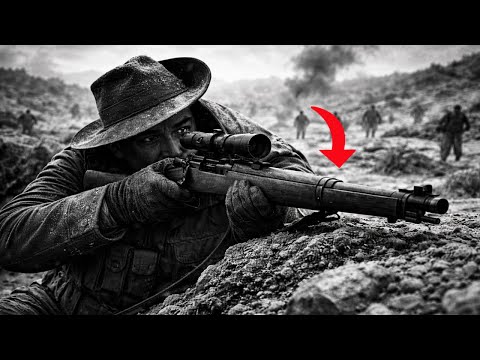
But among the desperate soldiers sat a quiet 23-year-old private named Billy Singh. The son of a Chinese mother and English father, he had grown up on a Queensland farm, hunting kangaroos in the outback. He knew how to stay perfectly still for hours, how to read the land, how to become invisible. While officers argued about honor, Billy saw the truth: this was not a job for artillery or bayonet charges. This was a job for a hunter.
Without asking permission, Billy began building his hide—a low wall of flat stones and scrub brush that looked like natural rubble. He studied the enemy’s daily patterns: water delivery at 6 a.m., shift change at noon, evening meal at 7. He waited, patient as a predator.
On May 5th, he took his first shot. An Ottoman soldier stood up to pass a water bucket. Billy squeezed the trigger. The man fell and did not get up. Billy didn’t celebrate—he stayed frozen for three more hours, then crawled out under cover of darkness. The next day, he killed two more. Within 12 days, he had 12 confirmed kills, and the casualty rate in his sector plummeted.
Major General Bridges took notice. “Find good ground. Stay invisible. Be patient. Shoot straight,” Billy explained. Bridges assigned him a spotter, Tom Shehan, and together they became a devastating team—40 kills in the first month, never once detected. Billy trained 15 more soldiers in his methods, and the sniper casualty rate across the entire beachhead began to drop.
The Ottomans, desperate to stop the bleeding, sent their own legend: Abdul the Terrible, a sniper with 90 confirmed kills. For 11 days, the two hunters stalked each other. Abdul fired 17 shots at Billy’s suspected positions; all missed. On the eighth day, Billy spotted a flicker of movement at 430 yards. He aimed carefully, held his breath, and squeezed. The bullet struck Abdul in the forehead. The legendary Ottoman sniper was dead before he hit the ground.
By October 1915, Billy Singh had 150 confirmed kills—and the Ottoman forces had pulled their frontline trenches back 200 yards just to escape him. He had saved countless Allied lives, all with a standard-issue rifle and homemade camouflage. But his war was far from over. The British transferred him to France, where the muddy battlefields of the Western Front awaited. And there, the ghost of Gallipoli would face his greatest challenge yet.
The Western Front was nothing like Gallipoli. There were no rocky hills to disappear into, no sun-baked scrub to match his hide against. Instead there was mud—endless, sucking mud—and flat fields broken by shattered villages and the black teeth of dead trees. The trenches stretched for hundreds of miles, and the enemy was always close, sometimes only fifty yards away across no man’s land.
Billy Singh arrived in the spring of 1916 and found a war that had ground into a slaughterhouse. The Germans had their own snipers, and they were good—trained hunters who used telescopic sights and steel plates and patience. They killed British soldiers every day, and the British officers, still clinging to the old ways, had no answer.
But Billy had an answer. He always did.
He walked the trenches at night, studying the German lines through his periscope. He noted where the enemy snipers fired from, when they fired, how they moved. The patterns were there, just as they had been at Gallipoli. A glint of light at dawn. A shadow that shifted at dusk. A loophole in a steel plate that never quite lined up the same way twice.
Within a week, he had built a hide in the parapet—a nest of sandbags and rusted corrugated iron, camouflaged with mud and dead grass. Tom Shehan wasn’t with him this time; Tom had been wounded at Gallipoli and sent home. But Billy didn’t need a spotter to do what he did best.
He waited. He watched. And when a German sniper leaned just a fraction too far out of his loophole to scan the British line, Billy put a bullet through his telescopic sight.
The British officers in his sector were stunned. They had assumed the German snipers were untouchable. Billy showed them otherwise. One by one, he eliminated the enemy shooters, and the men in the trenches began to breathe again.
Word spread quickly. “There’s a bloke in the 4th Battalion who can kill a man at 400 yards with iron sights,” the soldiers whispered. “They say he never misses. They say he’s a ghost.”
Billy trained more men—twenty this time, then thirty. He taught them to read the wind by watching the grass, to judge distance by the size of a man’s helmet, to wait for hours without twitching a muscle. He taught them that a sniper’s greatest weapon was not his rifle but his patience.
In the autumn of 1916, during the nightmare of the Somme, Billy’s methods saved hundreds of lives. The German snipers who had once ruled no man’s land were now the hunted. They pulled back their observation posts. They stopped firing during daylight. They learned to fear the invisible shooter in the British lines, just as the Ottomans had feared him at Gallipoli.
By 1917, Billy Singh had become a legend among the Allied forces in France. His kill count was impossible to verify—some said 200, others said more—but the men who served with him knew the truth. They had seen him work. They had watched him disappear into the landscape and emerge hours later, calm and quiet, his rifle cool in his hands.
The British command awarded him the Distinguished Conduct Medal. When officers pinned it to his chest and asked how he felt, Billy shrugged. “Just doing my job,” he said. He didn’t want parades. He didn’t want speeches. He wanted to finish the war and go home.
But the war wasn’t finished with him yet. In the spring of 1918, during the German spring offensive, Billy was caught in an artillery barrage near Villers-Bretonneux. Shrapnel tore through his left shoulder and chest, and he was evacuated to a field hospital, then to England. The doctors saved his life, but his shooting days were over. He could no longer hold a rifle steady enough to hit a man at a hundred yards, let alone four hundred.
Billy Singh spent the last months of the war in a convalescent hospital in Kent, watching the English countryside through a window. He thought about Queensland. He thought about the kangaroos. He thought about the men he had killed and the men he had saved, and he found that he could not separate the two in his mind.
When the Armistice finally came in November 1918, Billy was still in England, still recovering, still learning to lift his left arm above his shoulder. He sailed home to Australia in the spring of 1919 aboard a crowded troopship, standing at the rail for hours and watching the coastline appear out of the morning haze.
He was thirty-one years old. He had spent four years at war. He had killed more enemy soldiers than almost any other Allied sniper in the entire conflict—and he wanted nothing more than to forget every single one of them.
Back in Queensland, Billy tried to rebuild his life. He took whatever work he could find. He worked on farms, did construction labor, drove delivery trucks along the dusty roads he had known as a boy. The pay was poor and the work was hard, but Billy never complained. He had survived. That was more than many men could say.
He rarely spoke about the war. When people asked if he had seen action, he would nod and change the subject. When old soldiers gathered in the pubs to trade stories—the big battles, the famous charges, the generals with their medals—Billy sat quietly in the corner and said nothing.
He had no stories worth telling, he told himself. Only memories worth burying.
Billy married in 1921, but the marriage did not last. The war had changed him in ways that made peace difficult. He woke in the night reaching for a rifle that was not there. He could not sit in a crowded room without scanning the exits, without watching the windows, without calculating distances to the nearest cover. The skills that had kept him alive at Gallipoli and on the Western Front now made ordinary life feel strange and dangerous.
His wife left in 1927. She told him he was a ghost in his own house, present but unreachable. Billy did not argue. He knew she was right.
While Billy struggled in obscurity, his techniques were transforming military practice around the world. The lessons he had taught at Gallipoli and in France were being written into official training manuals. British and American armies studied his methods. They taught new soldiers about patience and concealment, about building hides that looked natural, about reading enemy patterns. Everything Billy had learned hunting kangaroos in the Queensland outback was now standard doctrine for military snipers everywhere.
Army instructors taught recruits about the importance of remaining invisible. They explained how one well-placed shooter could protect an entire section of troops. They showed how primitive equipment and natural materials could be just as effective as expensive technology. They did not always mention Billy Singh by name—most of them had never heard of him—but they were teaching his methods all the same.
The Ghost of Gallipoli had changed warfare forever, and most of the world had no idea he existed.
Billy preferred it that way. He had done his duty. That was enough.
In the 1930s, as another war gathered on the horizon, Billy watched the newsreels with a heavy heart. He saw the marching soldiers, the new tanks, the bombers darkening the sky. He knew what was coming. He had seen it before, in the rocky hills of Gallipoli, in the mud of the Somme. The world had not learned. It never did.
When the Second World War broke out in 1939, Billy tried to enlist. He was fifty-one years old and his left shoulder was a ruin of scar tissue, but he stood in the recruiting line anyway. The medical officer took one look at his old wounds and shook his head.
“Sorry, mate,” the officer said. “You’ve done your bit.”
Billy nodded and walked home. He had done his bit. He had done more than his bit. But it was never enough. It was never, ever enough.
He spent the war years working in a munitions factory in Brisbane, doing his small part for the boys fighting overseas. He was quiet and reliable, and the younger workers liked him without ever knowing why. There was something steady about the old man, something calm. He never raised his voice. He never seemed afraid.
When the war ended in 1945, Billy was fifty-seven years old and tired in a way that sleep could not fix. His health was failing. The old shrapnel wounds ached in the cold weather, and his lungs had never fully recovered from the gas he had breathed in France. He moved into a home for elderly soldiers in Brisbane, a quiet place with a garden and a view of the river.
He spent his last years tending the garden and watching the birds. He liked the birds. They were patient, like him. They waited for the right moment, and then they moved.
On May 19th, 1943, Billy Singh died in his sleep. He was fifty-seven years old. The cause of death was listed as heart failure, though the doctors privately agreed it was simply that his body had given out after years of quiet punishment.
His death received only a small notice in the local newspaper. No crowds attended his funeral. No military honors were given. The man who had killed 150 enemy soldiers and revolutionized modern warfare was buried in a simple grave with only a handful of mourners—a few old soldiers from the home, a nurse who had cared for him, and a priest who had never known his name.
Most of Australia never knew what they had lost.
But Billy’s legacy lived on in ways he never saw. The Australian military continued teaching his methods to every new generation of snipers. They studied his fieldcraft. They practiced his patience. They learned to read terrain the way he had learned from hunting kangaroos in the outback.
Modern Australian snipers still refer to the Singh principles when training. Stay invisible. Learn the ground. Study your target. Wait for the perfect shot. These ideas, which came from a Queensland farm boy with a Chinese mother and an English father, are now fundamental to military doctrine in armies around the world.
The story of Billy Singh teaches us something important about innovation and heroism. The greatest solutions often come from unexpected places. The British colonels at Gallipoli thought they knew how to fight. They relied on artillery and bayonet charges and gentleman’s rules of warfare. None of it worked. Then a short, quiet farmer with no formal military training showed them a better way.
He did not need expensive equipment or complicated strategies. He just needed the skills he already had and the wisdom to apply them differently.
Billy’s story also reminds us that true heroism does not always seek attention. The loudest voices are not always the most important ones. The soldiers who got medals and parades were not necessarily the ones who saved the most lives. Billy Singh killed 150 enemy soldiers and protected thousands of Allied troops. He changed how modern armies fight. And he did it all while remaining almost completely invisible—both during the war and after it.
Today, when military instructors teach young snipers about patience and fieldcraft, they are passing down lessons that began on a kangaroo farm in Queensland. When soldiers build camouflaged hides and study enemy patterns, they are using techniques Billy developed from hunting animals in the Australian outback. The invisible warrior, who wanted nothing but to go home and be forgotten, instead became immortal in the methods he created.
Perhaps that is the deepest truth of Billy Singh’s story. The most deadly warriors are not always the ones who make the most noise. Sometimes they are the quiet ones, the patient ones, the invisible ones—the farmer who became a ghost and saved lives by taking them.
He proved that innovation, courage, and skill matter more than rank or background or expensive equipment. The hunter who changed warfare forever and then disappeared back into ordinary life, content to let his work speak louder than his name ever could.
So here is the question I leave with you: if the greatest heroes are often the ones we never see, how many invisible Billy Singhs have passed us by—and what would it take for us to finally notice them?
Report this article
Select a reason for reporting:






