In 2019, a team of geneticists published a paper in Nature that quietly dismantled something most people assumed they already understood. They had extracted ancient DNA from over 400 individuals buried across Neolithic and Bronze Age Britain—bones pulled from long barrows, chalk tombs, and burial mounds spanning nearly 2,000 years of prehistory. What the genome showed was not a gradual transition. It was not a slow blending of populations, not a cultural exchange that left both sides partially intact.
The genetic signature of the people who built Stonehenge—the people who had organized, sustained, and completed one of the most ambitious construction projects in the ancient world—collapsed to near zero within a few centuries of the monument’s completion. By roughly 2500 BCE, the builders were gone. Not assimilated, not transformed—replaced.
Stonehenge still stands on Salisbury Plain. The people who raised it do not survive in a single living genome. That is the problem this story is about. And it does not get simpler the further in you go.
To understand why that result is so difficult to absorb, you have to start with what the accepted story actually said.
For decades, the dominant model held that Bronze Age Britain changed the way most cultural shifts change—through contact, trade, and the slow movement of ideas across water and land. When Bell Beaker pottery and bronze objects began appearing in the British archaeological record around 2500 BCE, most scholars interpreted this as cultural diffusion: new styles arriving through exchange networks, prestige goods moving between elites, not necessarily mass displacement of the people already living there.
Even after early ancient DNA work in the 2010s began showing steppe-related ancestry appearing in Bronze Age Europeans more broadly, the assumption for Britain was that the transition had involved a moderate degree of demographic change mixed with considerable local continuity. The people who built the monuments, in other words, were presumed to have survived somewhere in the genetic record. Their descendants were presumed to be walking around.
That is what the model predicted. That is what the 2019 data set refused to confirm.
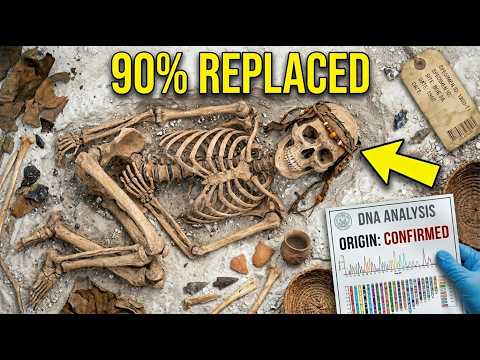
The Olalde et al. study was different in scale and resolution from anything that had come before it: more than 400 ancient genomes drawn from a single island, spanning the full arc of the Neolithic and into the Bronze Age. And what the data showed for Britain specifically was not what it showed for most of continental Europe.
In Germany, in France, in Iberia, Neolithic ancestry declined sharply after the Beaker expansion, but it did not vanish. Populations mixed, genetic signatures blended across generations in a way that left detectable traces on both sides. In Britain, the Neolithic component dropped from essentially 100% to less than 10% within four to five generations.
That is not mixing. That is near erasure.
A population that had been established on the island for roughly 1,500 years—a population that had organized communal burial traditions, managed agricultural landscapes across multiple regions, and sustained multi-generational monument construction projects—left almost no genetic trace in the people who came after them. The speed of the replacement was not predicted by the existing models. The completeness of it was not expected. And the mechanism behind it has not been explained.
To feel the full weight of that question, you first have to understand who these people actually were. The Neolithic British population was not a fragile or marginal group. Genomic analysis shows they descended from Anatolian farmers who had moved westward through continental Europe beginning around 6,000 BCE, eventually reaching Britain across early sea crossings. By the time Stonehenge reached its final major construction form, they had been present on the island for well over a millennium.
Long barrow burials at sites like West Kennet, Hazleton North, and Wayland’s Smithy reveal tightly organized kinship networks—family groups interred together across multiple generations in carefully constructed stone and earthen chambers, suggesting deep territorial roots and a strong sense of communal identity tied to specific landscapes. Isotope analysis of their bones indicates sedentary lives, locally sourced food, locally sourced water—people who did not move far from where they were born.
These were not nomads who could be edged out gradually through competitive land use. They were the civilization that looked at Salisbury Plain and organized the movement of 25-ton bluestones across 200 miles of landscape.
Whatever force ended their genetic presence in Britain had to be capable of displacing a structured, rooted, and organizationally sophisticated society. That is the detail that keeps refusing to fit a story of peaceful, gradual cultural exchange.
The population that replaced them arrived with a fundamentally different genetic and cultural signature. Bell Beaker people carried high levels of Yamnaya steppe ancestry—a lineage traceable to Pontic-Caspian grassland herders from the region north of the Black Sea, the same source population whose expansion had already transformed large parts of continental Europe in earlier centuries. They buried their dead individually rather than communally, placing them in single graves with copper daggers, archery equipment, and personal prestige objects that emphasized individual status rather than collective identity.
Strontium isotope data from some of the earliest Beaker burials in Britain shows individuals whose teeth formed in continental Europe—first-generation migrants who had not grown up on the island. And the speed at which the Beaker genetic signal spread across Britain is difficult to explain through slow demographic drift. Burials bearing the Beaker signature appear across the island within what looks, in the archaeological record, like a compressed and rapid window of time.
This is not what gradual infiltration looks like. The geographic spread and the pace are more consistent with large-scale, possibly organized movement across the island. Whether that movement involved direct conflict, exploitation of a population already weakened by something else, or some combination of both, is where the data reaches its current limit.
The physical record reinforces the discontinuity in ways the genetics alone cannot. Long barrows cease being constructed around 2500 BCE. Causewayed enclosures—the large communal ceremonial sites that had functioned as gathering places and ritual centers for Neolithic British communities—also effectively disappear from the archaeological record at approximately this juncture. The final major construction phase at Stonehenge, the raising of the great sarsen circle, dates to approximately 2500 BCE, almost exactly the moment the genetic replacement signal begins.
After that horizon, there is no resumption of monument building at the organizational scale the Neolithic population had sustained. The Bell Beaker people used the landscape around Stonehenge. They buried their elite dead nearby, but they did not pick up the communal construction tradition and continue it. What survives in the material record from the transition period is not a blended cultural heritage. There is no extended sequence of hybrid burial styles, no prolonged ceramic overlap, no architectural phase that clearly shows both traditions negotiating a shared future.
In continental Europe, Beaker expansion generally left those kinds of traces. In Britain, the transition record is unusually, almost uncomfortably clean.
The most scientifically grounded explanation for what happened involves disease—and the evidence for this is real, coming from ancient DNA. Researchers have extracted early strains of Yersinia pestis, the pathogen responsible for plague, from Neolithic European skeletal material dating to around 3,000 BCE, predating the main phase of Bell Beaker expansion. The hypothesis that epidemic disease devastated Neolithic European populations in the centuries before or during the Beaker migration, opening demographic space for large-scale replacement, has serious scientific support.
But extending this model to Britain specifically requires evidence that has not yet been found. No confirmed Yersinia pestis ancient DNA has been extracted from Neolithic British individuals. The plague hypothesis for Britain is currently an inference drawn from the continental pattern, not a finding extracted from British bone. Researchers working on this question are careful to frame it that way.
And even if epidemic disease reduced the Neolithic British population substantially, the near-zero residual genetic signal still requires more than passive die-off to explain. When populations collapse through disease alone, genetic survivors remain. The British data does not look like collapse followed by recovery. It looks like replacement.
The evidence for organized violence sits at the edge of what can currently be stated. Neolithic Europe was not a uniformly peaceful world. Mass graves at Asparn Schletz in Austria and Talheim in Germany document communities killed in coordinated attacks, with skeletal trauma patterns indicating deliberate, organized violence rather than individual conflict. Bell Beaker culture across Europe was materially associated with weapons—copper daggers, flint-tipped arrows, and wrist guards appear in elite burials with a regularity that suggests martial identity was central to Beaker social structure.
Some skeletal remains from Beaker period Britain show trauma consistent with weapon injuries, but no confirmed large-scale massacre site specifically documenting the Neolithic-Beaker transition in Britain has yet been excavated and published. That absence matters, but it is not the same as evidence that the transition was peaceful. Britain’s soil conditions are poor for skeletal preservation. The proportion of the Neolithic period landscape that has been excavated remains small. A mass grave from 2400 BCE on Salisbury Plain could exist and simply not have been found.
The absence of a massacre site is a gap in the record, not a verdict on what happened.
The monument carries its own strange implication once the DNA findings are accepted. The Amesbury Archer, buried around 2300 BCE in the landscape surrounding Stonehenge, is one of the richest Beaker period burials ever discovered in Britain. Strontium isotope analysis of his teeth shows he did not grow up on the island—the chemical signature points to a continental European childhood, possibly in the Alpine region. He was buried with gold hair ornaments, copper knives, boar tusks, and archery equipment. High-status Beaker individual near Stonehenge, after the builders’ genetic line had ended.
The Bush Barrow burial, another elite interment within the Stonehenge monument landscape, is similarly furnished with gold, bronze, and prestige weapons—and similarly carries no Neolithic genetic ancestry. These people occupied the same ground the monument’s builders had organized their entire civilization around, but there is no strong material evidence they understood what Stonehenge was originally built to do, or that they attempted to continue the ritual tradition it embodied.
The structure remained. The meaning it carried for the people who built it almost certainly did not survive the transition intact.
There is a directly relevant precedent for this kind of revision, and it is worth holding clearly in mind. Before ancient DNA work transformed the field around 2015, the prevailing model of Bronze Age European prehistory held that the period’s cultural transformation was driven largely by the spread of ideas and technologies, not the movement of people at scale. The Yamnaya finding—confirming that steppe ancestry from Pontic-Caspian herders accounts for a substantial proportion of the ancestry of modern Europeans, and that this ancestry arrived through mass migration rather than cultural diffusion—overturned that model at continental scale. The revision was initially contested. It was then confirmed by multiple independent research groups using different data sets. It is now standard in the field and taught as a foundational result of the ancient DNA revolution.
This precedent matters because the tools and methods that produced the Yamnaya finding are the same tools and methods that produced the British Neolithic replacement signal. The field has already demonstrated it can be wrong about population continuity at the largest scales. The uncertainty around how the British Neolithic replacement happened is not evidence that the result itself should be minimized. It is the precise kind of open question that the next generation of ancient pathogen studies, expanded skeletal sampling, and higher resolution genomic analysis may decisively close.
Britain is not an isolated case. Ireland shows a closely parallel pattern, with Neolithic ancestry declining sharply after Beaker expansion and less genetic continuity than most continental comparisons would predict. Iberia, home to some of the most architecturally complex megalithic monument traditions in the ancient world, shows high Neolithic replacement rates following Beaker arrival, though with somewhat more surviving Neolithic ancestry than Britain. The pattern running along the Atlantic facade of Neolithic Europe—from Portugal northward through France, across Britain, into Ireland, and up to Orkney—is geographically consistent in a way that is difficult to attribute to coincidence.
The cultures that built the megalithic monuments along Europe’s Atlantic coast were, as a group, more thoroughly displaced than the Neolithic populations further east. No fully agreed-upon explanation for this geographic disproportion exists. Lower population density on the Atlantic edge, specific disease exposure pathways, geographic constraints limiting population movement and retreat, or some form of structured displacement have all been proposed, and none has been confirmed. What has been confirmed is the pattern itself, replicated across independent data sets. The British case is its sharpest expression, but it is not the only one. Something happened to the monument builders of Atlantic Europe, and it happened across a wide front.
The physical limits of what can currently be known are themselves part of this story. Ancient DNA degrades, and Britain’s wet, acidic soils are among the least favorable environments for its long-term preservation. Many Neolithic British individuals whose skeletal remains have been recovered have not yielded genomic data of sufficient quality to be included in population studies, which means the existing sample, large as it is, remains incomplete. The landscape has not been fully examined, either. The Stonehenge Hidden Landscapes Project, a large-scale ground-penetrating radar and remote sensing survey conducted between 2014 and 2020, identified dozens of previously unknown buried features within the Stonehenge monument complex—structures and deposits that have never been excavated, whose contents and dates remain unknown. Near Durrington Walls, a massive linear arrangement of buried pits was detected during survey work in 2020. Its function is unknown. Its contents have not been examined.
Heritage protection legislation, landowner agreements, and the practical complexity of excavating a protected World Heritage landscape mean that answers to even basic questions about what lies beneath the Stonehenge complex could remain out of reach for decades. The DNA has told us the replacement happened. The ground has not yet finished telling us what the replacement looked like from the inside.
Stonehenge has been measured, surveyed, argued over, and studied more intensively than almost any prehistoric structure on Earth. The literature on it fills entire library sections, and yet the people who built it remain, in the most direct genetic sense, strangers. No one living carries their DNA. They left no written record, no named individuals, no surviving oral tradition that crossed the replacement threshold intact. The cosmological framework that made Stonehenge worth building—the full logic of what it was organized to express across 15 centuries of continuous construction effort—died with the last generation that held it.
What remained was a structure without its authors, standing in a landscape now occupied by people who had not built it and may not have fully understood what it meant. The ground-penetrating radar beneath the monument complex is still returning unexamined signals. The final Neolithic generation that raised the sarsen circle is still being reconstructed from fragments. And the transition itself—whatever combination of epidemic, displacement, or organized force erased the civilization that built one of the most precisely engineered structures in the prehistoric world—has not yet been found in the physical record.
The door is still closed. The question behind it is sharper now than it was before the DNA was read, and the honest answer at the current edge of the evidence is that we do not yet know what is on the other side.
And yet the silence itself is a kind of evidence. A civilization that shaped a landscape for fifteen centuries left no heir, no descendant community, no living memory—only stones arranged with an precision we still cannot fully explain. What survives of the Stonehenge builders is not blood but geometry: the alignment of the sarsen circle to the solstice sunrise, a calendar carved in rock by people whose names, language, and gods vanished with them.
Perhaps that is the real lesson hidden in the genome. Continuity is a story we tell ourselves because it comforts us—the assumption that whoever came before somehow lives on in us. Britain’s Neolithic farmers prove otherwise. Whole peoples can end, and the world barely notices the seam.
So the monument stands, and the question stands with it: if a civilization can build something this enduring and still disappear without a genetic trace, what exactly do we mean when we say a people “survives”?
What do you think happened on Salisbury Plain in those final generations—and does it change how you see the stones? Tell us in the comments.
Report this article
Select a reason for reporting:






