Dr. Sarah Mitchell adjusted her reading glasses, the faded photograph trembling in her hands. The October sun streamed through the dusty windows of the Nebraska Historical Society, but a sudden chill raised the hairs on her arms. She had seen thousands of family portraits in her fifteen years as lead archivist, but something about this one—the Thornton family, 1907—made her breath catch.
She reached for her magnifying glass and focused on the scarecrow behind the family. Its eyes were not burlap and straw. They were human. Alert. Staring directly at the camera. “That’s not possible,” she whispered.
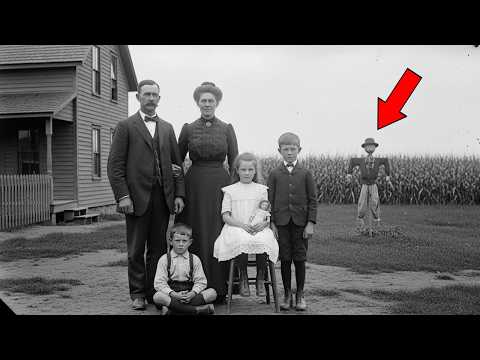
Sarah called her colleague, Dr. James Rodriguez, over. He squinted through the glass, his expression shifting from curiosity to bewilderment. “Those look like human eyes,” he said. “But the photography technology in 1907 couldn’t capture such detail at that distance.” Sarah nodded, pointing to the depth of field. The family was sharp in the foreground, but the scarecrow—crystal clear. Too defined. Too human. Its posture was wrong, too natural, and the clothes were not burlap but heavy cotton work clothes.
The next morning, Sarah drove through the rolling Nebraska plains toward the abandoned Thornton property. The farmhouse leaned precariously, windows like empty eye sockets. She walked to where the cornfield once stood, referring to the photograph. Her phone buzzed—James had found a county record: a hired hand named Thomas Briggs, owed three months’ wages, disappeared in 1907. In the tall grass, Sarah knelt and brushed away dirt to reveal a small metal button, the kind used on work clothes from the early 1900s. Her heart raced. This was physical evidence.
Back in town, at Murphy’s Diner, 83-year-old Martha Henderson studied the photograph. “My grandmother used to tell stories about that family,” she said. “Strange things happened out there. The whole family left town suddenly in 1908.” An elderly man leaned in. “My great-uncle said the Thorntons came asking about train schedules to California—but two weeks after people had already seen their hired man working the field.” Sarah’s pulse quickened. The timeline was wrong.
In the courthouse basement, Sarah found a complaint filed by Martha Briggs, Thomas’s sister, claiming he’d been cheated of wages. The dates didn’t match the Thorntons’ story. She called James. “The scarecrow’s clothes,” he said, “they’re not typical scarecrow materials. And there’s a rope around the neck area.” Sarah’s blood ran cold. She tracked down Linda Walsh, Thomas’s great-great-niece, who produced a letter. In faded ink, Thomas had written: “If you don’t hear from me by month’s end, something terrible has happened.”
Dr. Patricia Yoshida, a forensic anthropologist, met Sarah at the property with ground-penetrating radar. They scanned the field where the scarecrow had stood. A clear rectangular depression appeared on the screen—six feet long, three feet wide. “This is consistent with a grave,” Dr. Yoshida said grimly. Soil analysis later confirmed fabric fragments, metal buttons, and human bone fragments.
That evening, Sarah and James reconstructed the events. Thomas had demanded his wages on October 16th. The family photograph was taken October 18th—Thomas was likely already dead, positioned as a scarecrow to hide the evidence in plain sight. The Thorntons filed a false report about him leaving for California, giving them time to stage the scene. “The scarecrow had eyes because it was Thomas,” Sarah said softly. They had killed him, probably strangled him, and dressed his body in his own work clothes.
Six months later, Sarah stood before a crowd of over two hundred people at the Nebraska Historical Society. Behind her, a newly installed exhibit told the story of Thomas Briggs—not as a missing person, but as a murder victim whose truth had been buried for over a century. Local news crews documented the event, and several university researchers had already expressed interest in studying the case as an example of early twentieth-century labor exploitation.
The exhibit included his letter to his sister, enlarged under protective glass, the family photograph with detailed analysis, soil samples from the Thornton property, and the metal button Sarah had found in the field. Linda Walsh had donated Thomas’s few remaining possessions—his work tools and a Bible—to ensure his memory would be preserved with dignity.
“Photography was meant to capture moments of joy, family, and prosperity,” Sarah addressed the audience, her voice carrying across the silent room. “But sometimes, inadvertently, it captures truth. This photograph held a secret for 117 years.”
Martha Henderson, now eighty-four, sat in the front row with tears in her eyes, flanked by grandchildren who had driven in from surrounding counties. “My great-grandmother always said the truth would come out eventually,” she whispered. “She used to say the prairie remembers everything, even when people try to forget.”
After the ceremony, Sarah walked outside into the Nebraska sunshine. In her hand, she held a photograph of Thomas Briggs’s newly erected headstone in the local cemetery, purchased with community donations. The inscription read: Thomas Briggs, 1879–1907. Honest worker, justice delayed but not denied.
The old photograph now rested in a climate-controlled case, no longer hiding its terrible secret. Thomas Briggs finally had his voice back. But as Sarah looked across the prairie, she knew the work was far from finished. The Thornton family had fled to Oregon in 1908—and somewhere out there, their descendants might still be living with the weight of what their ancestors had done.
She pulled out her phone and dialed James. “I think we need to find out what happened to the Thorntons after they left Nebraska,” she said. “If they sold the farm for less than it was worth, they were running. But from what?”
James was quiet for a moment. “You think there’s more to the story?”
Sarah stared at the photograph in her hand—the headstone, the prairie, the endless golden fields. “There’s always more, James. Thomas Briggs was murdered. But the Thorntons didn’t just kill a man. They killed his future, his family’s future. And somewhere, someone might still be protecting that secret.”
Sarah spent the next three weeks tracing the Thornton family through census records, land deeds, and old newspaper clippings. The trail led to a small town outside Portland, Oregon, where the family had rebranded themselves as respectable orchard owners. “They changed their name,” she told James over the phone, her voice tight. “Thornton became Thorne. Dropped two letters and a century of blood.”
She found a living descendant: Margaret Thorne, 71, a retired schoolteacher with no idea her family’s fortune was built on murder. Sarah drove to Oregon and sat across from her in a quiet café, the photograph between them on the table.
“I’m sorry,” Sarah said. “But your great-grandparents killed a man. And I think you deserve to know.” Margaret stared at the image for a long time, her hands trembling. Then she did something Sarah didn’t expect. She laughed—a hollow, broken sound.
“My grandmother told me once,” Margaret whispered. “She said the family had a curse. Bad luck followed them from Nebraska. She never knew why.” She looked up, eyes wet. “I have great-grandchildren now. What am I supposed to tell them?”
Sarah reached across the table and took her hand. “Tell them the truth. Tell them Thomas Briggs was a man who deserved better. And tell them we’re going to make it right.”
Margaret donated a portion of the family’s estate to fund a labor history scholarship in Thomas’s name. The Nebraska Historical Society added a new panel to the exhibit: The Thorne family has acknowledged the wrongs of their ancestors and pledges to honor Thomas Briggs’s memory.
Sarah stood before the exhibit one last time, the old photograph now a testament rather than a secret. She thought of all the other photographs waiting in dusty boxes, all the silent witnesses to forgotten crimes. The prairie remembers, Martha had said. But someone has to listen.
What would you do if you discovered a terrible truth hidden in your own family’s history—bury it, or bring it into the light?
Report this article
Select a reason for reporting:






