On a cold February morning in 2024, a plain brown package landed on Thomas Harper’s desk at the Smithsonian. He had examined thousands of historical images in his twenty-year career, but when he opened this one—a family portrait from 1854—he stopped breathing. The photograph showed a wealthy Southern family posed before a Greek Revival mansion, all stern faces and stiff finery. But it was what lurked in the background that seized him: two small boys, one white and one black, sitting close together, playing as if the world around them didn’t exist.
Thomas’s pulse quickened. In antebellum photographs, enslaved people were usually rigid at the edges, marked as property. These children were different—shoulders nearly touching, bodies mirroring each other in comfortable equality. This wasn’t just a family portrait. It was documentation of something forbidden.
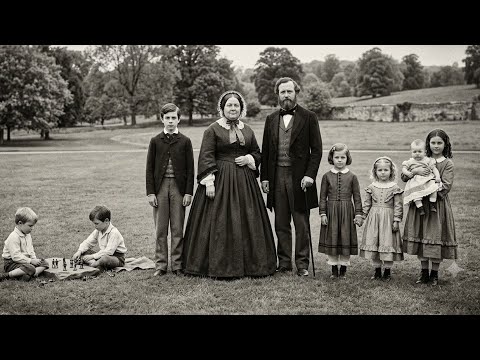
He turned the photo over. A pencil inscription, barely visible: Sam and Joseph, summer 1854, forever friends. His hands trembled. Who were these boys? And why had someone carefully preserved their bond?
Thomas spent three days examining every detail with advanced imaging technology. The white boy, Samuel, wore simple clothes and was barefoot—clearly the family’s black sheep. Joseph, the enslaved boy, wore rough cotton. But his posture struck Thomas: he sat exactly as Samuel did, not crouched in deference. Between them were carved wooden soldiers, arranged for battle. They were playing war games together, sharing toys like any children.
Then Thomas zoomed in on Joseph’s right hand. There, on the small palm, was a scar—distinctive and deliberate. A brand. A mark of ownership applied to enslaved people the way livestock were marked. But this brand was on a child’s hand, a boy no older than seven or eight. Thomas’s stomach turned. This photograph captured something horrific and something tender existing side by side: two friends playing, one wearing the physical mark of being considered property.
Rebecca, his assistant, brought census records. The Harrison family of Riverside Plantation, South Carolina, owned 47 enslaved people in 1850—62 by 1860. The 1860 slave schedule listed a male, age 13, field hand. No name, just a number. That would make him seven in 1854. This could be Joseph, reduced to a line in a government document.
“There’s something else,” Rebecca said quietly. “A Charleston newspaper from 1856 mentions the Harrisons attending a Christmas ball with three children. Three, not four.” Thomas looked up sharply. Samuel’s name never appeared after 1854. He had been erased.
Then they found Sarah Harrison’s leather journal, the mother’s diary. Her elegant handwriting covered 1852 to 1858. Early entries were mundane—parties, weather, the children’s progress. But Samuel’s name appeared less frequently, and the tone was different. March 18th, 1853. Samuel continues to resist his tutors. He shows no interest in the classics or proper comportment. Edward is growing impatient. Thomas saw a pattern: Samuel was different, unwilling to conform. His parents viewed this as failure.
Entries about Joseph began in 1854, though Sarah never used his name—only “the boy” or “the child from the quarters.” April 12th, 1854. Samuel has formed an attachment to one of the younger slaves, the boy Joseph we acquired last year. They spend hours together, and I confess I have allowed it because it keeps Samuel occupied and out of Edward’s notice. Thomas noted the date—months before the photograph. Sarah knew the friendship was transgressive but overlooked it for convenience.
By summer, the bond had deepened. June 3rd, 1854. I watched Samuel and the boy playing by the creek this morning. They have built some sort of fort from branches and are engaged in elaborate games of soldiers and battles. Samuel insists the boy is his best friend, his only real friend. Thomas read that passage three times. Sarah was troubled not because she thought it morally wrong, but because she knew it was socially impossible.
Then came the photograph. August 15th, 1854. The photographer came today for a family portrait. Samuel slipped away during preparations and came back with dirt on his clothes and the boy, Joseph, with him. They had been playing and Samuel refused to send him away. I saw them in the background as the image was taken, still playing their games, oblivious to the formality occurring just feet away.
But the journal’s tone shifted dramatically in September. September 7th, 1854. Edward has finally noticed Samuel’s attachment to the boy. He came upon them today in the library where Samuel was teaching Joseph his letters from a primer. Edward was furious. He struck Samuel and forbade him from speaking to the boy again. Thomas felt his chest tighten. A seven-year-old struck for teaching his friend to read—literacy was dangerous for enslaved people, a pathway to freedom.
Two weeks later, Sarah’s handwriting was shaky. September 28th, 1854. Edward has made a decision that breaks my heart. He has sold the boy Joseph to a slave trader bound for New Orleans. The boy was taken this morning while Samuel was at his lessons. Samuel does not yet know. Thomas had to stop reading. A child had been sold because his friendship with a white child was considered dangerous.
Rebecca appeared in the doorway. “Are you all right?”
“They sold him,” Thomas said, voice rough. “Edward Harrison sold Joseph because Samuel cared about him. A seven-year-old child was sold away from everything he knew because he was someone’s friend.”
Rebecca’s face paled. “Does the journal say what happened when Samuel found out?”
Thomas returned to the desk, though part of him didn’t want to know. September 29th, 1854. I told Samuel this morning that Joseph was gone. Samuel became hysterical. He tried to run from the house saying he would find Joseph and bring him home. Edward caught him and locked him in the cellar. I can hear Samuel crying even now, hours later. He keeps calling Joseph’s name.
Thomas looked up, his eyes meeting Rebecca’s. The story was far from over. Somewhere in the faded ink and brittle paper, the fate of two boys—and the shadow of a nation—waited to be uncovered.
Thomas kept reading through the autumn entries, each one a small knife. October 15th, 1854. Samuel has stopped speaking almost entirely. He takes meals in silence, completes lessons mechanically, and spends hours staring out the window toward the slave quarters as if hoping Joseph will somehow reappear. Sarah noted that Edward insisted the boy would forget quickly. Thomas doubted it.
Rebecca cross-referenced the journals with records from a private Charleston school. Edward Jr. and William appeared on honor rolls. Samuel’s name surfaced only on enrollment lists, beside a headmaster’s note: “Adequate performance, but the boy shows little interest in forming friendships with peers, prefers solitude to society.”
Then came a passage that stopped Thomas cold. November 8th, 1854. I found Samuel in the library today looking at the photograph. He was tracing his finger over the image of the two boys in the background. He asked if Joseph was happy wherever he was now. I said I did not know. Samuel said, ‘He’s not happy, Mother. He can’t be happy without his friend, just like I can’t be happy without mine.’
Thomas set the journal down. The boy had understood something his parents never would.
By winter, Samuel was having nightmares, waking the household with screams. Edward’s solution was to move him to a distant room where his disturbances wouldn’t bother anyone. By January 1855, Samuel refused to eat. The family doctor diagnosed “melancholia” and prescribed exercise, fresh air, and stern discipline. Thomas recognized it for what it was—severe trauma, untreated and unacknowledged.
April 3rd, 1855. I asked Edward today if there was any way to locate Joseph, to perhaps purchase him back. Edward was furious. He said if I continued to indulge Samuel’s attachment to a slave, he would send Samuel away to military academy where such foolishness would be beaten out of him.
Thomas now turned to the second half of the mystery. What had become of Joseph? He contacted colleagues who specialized in slave trade records. A historian at Tulane had digitized ledgers from a New Orleans firm, and in an entry dated October 1854, Thomas found it: Boy, age approx. 8 years, name given as Joseph, purchased from E. Harrison, Charleston, SC. Light scarring on right palm. Sold to sugar plantation, St. Mary Parish, Louisiana. Price, $650.
Six hundred and fifty dollars. Less than the cost of a good horse. Thomas stared at the number, then at the phrase “light scarring on right palm”—the brand, reduced to a line item in a ledger.
He searched Louisiana archives and found a partial 1856 inventory for a plantation owned by Jacques Beaumont. Listed among the enslaved: Joseph, field hand, age approx. 10 years. The boy had survived two years in conditions that killed grown men. But after 1856, the record went silent.
Meanwhile, Sarah’s journal limped forward. September 30th, 1855. Samuel left for military school today. He did not embrace his siblings when saying goodbye. He looked at me once before boarding the train, and I saw in his eyes nothing but emptiness.
The Virginia Military Institute records told the rest. Multiple incidents—refusing orders, fighting a cadet who had made disparaging remarks about the inferior races. In March 1856, the headmaster wrote to Edward that Samuel showed “a dangerous sympathy for Negro slaves that interferes with his ability to accept proper authority.” The school recommended withdrawal.
March 1856. Samuel has been expelled. Edward has declared him a disgrace to the family name. As far as Charleston is concerned, Edward and I now have only three children.
Thomas exhaled slowly. A nine-year-old boy, cast out of his own family because he couldn’t forget his friend.
Sarah’s later entries grew sparse, careful, as if written for an audience. December 25th, 1856. Samuel remained in his room. I found him sitting by the window looking toward the old oak tree where he and Joseph used to play. He is 10 years old today. I had almost forgotten. By February 1857, Edward had banished Samuel to a rural farmhouse with an overseer, declaring manual labor would cure his defects of character.
The final entry mentioning Samuel came in August 1858. I asked if he was happy. He looked at me with eyes much older than 11 years should be and said, ‘I stopped being happy four years ago, Mother. I stopped being happy the day you let Father sell Joseph.’ The journal ended abruptly in March 1859. Sarah died a month later, cause of death listed as fever.
Edward followed in February 1860, and the brothers scattered. Thomas found Samuel’s name in Confederate military records—enlisted at fourteen as a private, assigned to the medical corps. A regimental surgeon’s letter preserved his character: He shows no distinction in his care. He tends to privates with the same attention he gives officers. Wounded at Antietam, his right arm shattered, Samuel refused amputation.
By December 1862, a passenger list placed him on a ship from Richmond to Philadelphia. At fifteen, Samuel had deserted the Confederacy and crossed into Union territory. Quaker archives recorded a wounded youth who wished to honor a childhood friend by teaching freed slaves to read. He spent his life in Freedmen’s schools, training black educators, dying in 1891.
In 1870, Samuel had written to the Freedmen’s Bureau, searching for a man named Joseph, sold from Charleston in 1854, bearing a scar on his right palm. No reply was ever found.
But at Thomas’s 2025 conference lecture, an elderly man named Robert Washington rose, hands trembling, holding an old photograph. “My great-great-grandfather was named Joseph. He survived a Louisiana sugar plantation and became a teacher. He used to tell us about a white boy who taught him his letters and was kind to him.”
The photograph’s inscription read: Joseph Washington, teacher, 1895. In memory of a friend who showed me letters and kindness when I was seven years old.
They never found each other again. But both became teachers, carrying their friendship forward into countless lives. The exhibition label at the Smithsonian reads: This photograph captures a friendship that was not supposed to exist but did.
So here is what haunts me: if a seven-year-old’s forbidden friendship could outlive slavery, war, and a century of silence—what boundaries are we still too afraid to cross today?
Report this article
Select a reason for reporting:






