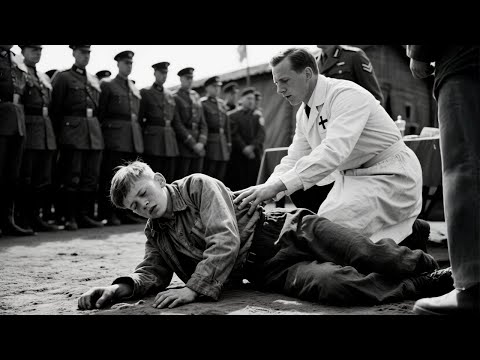
The morning sun burned white against the Alabama sky, already scorching at 6:30 AM as four hundred German prisoners stood at attention on the dusty parade ground. Guards paced the lines, counting, checking faces against rosters. In the third row, a boy swayed, his uniform hanging loose on a frame that seemed to be collapsing inward. His name was Klaus Dietrich. He was seventeen years old. When he hit the ground thirty seconds into roll call, the camp doctor discovered something that would force a complete re-evaluation of everything they thought they knew about him.
Klaus had arrived at Camp Aliceville six weeks earlier, part of a transport of prisoners captured during the Normandy campaign. He had been processed like all the others—medical examination, documentation, assignment to barracks. Nothing about him raised alarm. He was young, yes, but the German forces had been conscripting boys since 1943. Seventeen-year-old soldiers were increasingly common.
The camp held six thousand German prisoners spread across wooden barracks arranged in neat military rows. Klaus shared barracks 47 with forty-nine others. He kept to himself, speaking little, avoiding the social groups that formed naturally among prisoners—men from the same units, the same regions, finding each other and creating small communities within the larger captive population.
Ernst Vber, a sergeant from Bremen who had assumed an unofficial leadership role in the barracks, noticed Klaus’s isolation. He tried several times to draw him into conversation, to include him in the evening card games or discussion groups. Klaus responded with polite deflection, claiming fatigue, language difficulties, preference for solitude.
“The boy is frightened,” Ernst told another prisoner one evening. “He has the look of someone who expects punishment at any moment.”
“Most of us expected worse than we received,” the other man replied. “The Americans are not cruel. He will learn this.”
“It’s more than that. He barely eats. I watch him in the mess hall. He takes his tray, sits alone, pushes food around his plate, returns most of it uneaten. He’s losing weight.”
“Perhaps he is ill. The camp hospital is adequate. He should be examined.”
But Klaus refused all suggestions to visit the medical facility. When Ernst pressed him, he insisted he was fine, just adjusting to captivity, nothing to worry about. His English was surprisingly good, learned from a grandmother who had immigrated from Manchester before the First World War. He used this skill to avoid deeper conversations, deflecting questions with brief answers that revealed nothing.
The heat that summer was relentless. Alabama in August felt like being pressed beneath something hot and heavy. The temperature regularly exceeded 95 degrees. The humidity making air feel thick as syrup. Prisoners worked on camp maintenance details—repairing barracks, tending vegetable gardens, cleaning facilities. The work was not harsh by military standards, but in that heat any physical labor became exhausting.
Klaus was assigned to the garden detail. He worked slowly, carefully, his movements precise but lacking strength. The other prisoners on the detail noticed he took frequent breaks, sitting in any available shade, his face pale despite the sun, his breathing labored.
Corporal Thomas Henley supervised the garden detail. He was thirty-two, a former agricultural extension agent from Mobile, who spoke to the prisoners in simple English, supplemented with hand gestures. He believed in fair treatment and honest work, neither coddling prisoners nor driving them beyond reasonable limits. He watched Klaus with increasing concern.
The boy was clearly struggling. His shirt hung on him like it was draped over a skeleton. His cheekbones were sharp, his eyes sunken, his wrists so thin they looked like they might snap.
On August 14th, Henley pulled Klaus aside. “Son, you need to eat more. You’re wasting away.”
Klaus shook his head. “I eat enough.”
“No, you don’t. I’ve watched you. You take food and don’t finish it. You need strength for this heat.”
“I am fine.” Klaus’s voice was firm, but his eyes showed something that looked like panic.
Henley let it drop, but he mentioned it to Lieutenant David Richardson, the camp medical officer. Richardson made a note to observe Klaus during the next sick call, but Klaus never appeared. He avoided the medical facility entirely, even when other prisoners went for minor complaints—cuts needing bandages, upset stomachs, the various small ailments of communal living.
The morning of August 17th started like any other. The wake-up call sounded at 6:00 hours. Men dressed, made their bunks, filed out to the parade ground for morning roll call. The routine was mechanical, the same every day, designed to maintain order and accountability.
Klaus took his place in the third row. He stood at attention, his posture correct, his face expressionless, but Ernst, standing two positions to his left, noticed his hands trembling. Noticed the sweat on his forehead despite the relative coolness of early morning. Noticed the way he swayed slightly as if fighting to stay upright.
Sergeant Mitchell began the count. First row, second row, moving down the line, calling out numbers, checking faces. He reached the third row, started counting, got to Klaus’s position.
Klaus collapsed.
It wasn’t a graceful fall or a slow decline. His knees simply gave out and he went down like a puppet with cut strings. His head hit the hard-packed dirt with a sound that made several prisoners wince. For a moment, no one moved. Then chaos erupted in controlled military fashion.
Sergeant Mitchell shouted for the medic. Guards converged on his position. Ernst pushed through to kneel beside the fallen boy, checking for breathing, for pulse. Klaus’s eyes were open but unfocused. His breathing was shallow, rapid. His skin felt cold despite the heat already building. Ernst loosened Klaus’s collar, spoke his name, tried to bring him back to consciousness.
The camp medic, Specialist Robert Martinez, arrived within ninety seconds, medical bag in hand. He knelt beside Klaus, checking vital signs with practiced efficiency. Pulse weak and rapid, breathing shallow, skin clammy, eyes responding to light but unfocused.
“Get a stretcher,” Martinez ordered. “We’re taking him to the hospital.”
Four guards carried Klaus to the medical facility—a converted barracks with examination rooms, a small pharmacy, ten hospital beds for serious cases. Lieutenant Richardson was waiting, already alerted by radio.
They laid Klaus on an examination table. Richardson began his assessment, checking breathing, heart rate, blood pressure, temperature. His initial examination revealed severe malnutrition, dehydration, possible shock. But as he continued, pressing gently on Klaus’s abdomen, checking for injuries or internal bleeding, his expression changed. He stopped. He looked at his assistant, Nurse Helen Crawford, who had been recording vitals.
“Get everyone out,” Richardson said quietly. “Now.”
The examination room cleared. Only Richardson, Nurse Crawford, and the unconscious Klaus remained. Richardson continued his examination, more carefully now, his face showing growing disbelief. After five minutes, he stepped back. He looked at Nurse Crawford.
“This prisoner is not male,” he said quietly.
Nurse Crawford stared at him. “What?”
“Klaus Dietrich is female—or more accurately, was registered as male but is biologically female. And she’s pregnant. Approximately five months based on abdominal presentation.”
The silence that followed was profound. Crawford processed this information, the implications cascading through her mind like falling dominoes. A female prisoner registered as male, pregnant, seventeen years old, living in a camp with six thousand men for six weeks.
“How is that possible?” Crawford whispered.
“The initial medical examination when she arrived was conducted by an overworked military physician, processing hundreds of prisoners daily, looking for communicable diseases and immediate health threats, not conducting detailed physical examinations. If she kept her clothes mostly on, if she was careful, if the examining physician was rushed and assumptions were made based on documentation…” Richardson trailed off, the improbability fighting with the evidence before him.
Klaus—or rather, the person documented as Klaus—began regaining consciousness. Her eyes fluttered open, focused slowly on the ceiling, then on Richardson and Crawford standing beside the examination table. For a moment, confusion, then recognition of where she was, what must have happened. What must have been discovered.
Her face crumpled. Tears spilled from her eyes, tracking down into her hair. She turned her face away, her body curling inward protectively.
“It’s all right,” Crawford said softly in her basic German. “You are safe.”
But Klaus shook her head violently. “Nein. Nein. Not safe. Never safe.”
Richardson pulled up a chair, sitting so he was at eye level with her. He spoke slowly in English, knowing she understood. “We need to understand what happened. Why you are here. Why you are registered as male. We need to know your real name.”
She was silent for a long moment. Then in barely audible English, “Clara. My name is Clara Dietrich.”
Richardson leaned forward. “Clara, can you tell us how you came to be registered as a male prisoner of war?”
She closed her eyes. When she spoke, her voice was flat, emotionless. “My brother was Klaus. We were twins. He was conscripted in April 1944. I went with him. I cut my hair. I wore his extra uniform. We looked identical.”
“Why?” Crawford asked. “Why would you do that?”
Clara’s eyes opened, meeting Crawford’s with sudden intensity. “Because I had nowhere else to go. My parents were gone—lost during the bombing of Hamburg. Klaus was all I had.”
“Your brother,” Richardson said. “Where is he now?”
“He fell during the Normandy invasion. June 8th. I was beside him. When he stopped breathing, I took his identity tags, left mine in his pocket. When the Americans captured our position, they took me as him.”
“And the pregnancy?” Richardson asked gently.
Clara’s face hardened. “Not by choice. Before Klaus and I left Hamburg. A soldier.” She stopped, unable or unwilling to continue.
Crawford placed a hand on her arm. “You don’t have to explain.”
Colonel James Morrison, the camp commander, arrived within the hour. He listened to Richardson’s report with an expression that cycled through disbelief, confusion, and bureaucratic dread. “A pregnant seventeen-year-old girl has been living in the men’s barracks for six weeks, posing as her dead twin brother. And no one noticed.”
“Apparently not, sir,” Richardson confirmed.
Morrison nodded slowly. “I’ll contact the War Department, the Red Cross, probably the State Department. This is going to create an inter-agency firestorm. But in the meantime, priority is her health and safety.”
Within a week, color had returned to Clara’s face. The baby, previously quiet, became active. Crawford spent long hours with her, partly as medical supervision, partly as companionship. “I thought I would die,” Clara said one afternoon. “Every day I thought this is the day someone will notice.”
“You must have been terrified,” Crawford said.
“Terror becomes normal after a while. You stop feeling it as sharp emotion and start feeling it as a background hum.”
After two weeks, a decision came from Washington. Clara would remain in American custody until the baby was born. She would be housed with the family of Colonel Morrison. His wife Margaret had been a nurse before her marriage and was willing to provide oversight.
Clara moved into the Morrison home on September 1st. She had her own room, adequate nutrition, medical supervision, and for the first time since before the war, a sense of safety that allowed her to sleep without fear of discovery.
The baby was born on November 17th, 1944. A girl—six pounds, four ounces, healthy despite the prenatal malnutrition. Clara held her for the first time and cried tears of exhaustion, relief, and grief for Klaus, who would never meet his niece.
“What will you name her?” Margaret asked.
Clara looked at the baby’s face, seeing Klaus in the shape of her nose, seeing herself in the curve of her lips. “Anna. Her name is Anna.”
In January 1945, Colonel Morrison received updated guidance. Clara would be allowed to remain in the United States as a refugee under special provisions. After the war’s end, she could apply for permanent residency. The baby, born on American soil, had a clearer path to citizenship.
The war ended in May 1945. The prisoners at Camp Aliceville began the slow process of repatriation. Clara did not go back. She remained in Alabama, living with the Morrisons, caring for Anna, taking English lessons, learning about American society through radio and newspapers and conversations.
In 1948, she applied for permanent residency. The process took eight months. In December 1948, her residency was approved. She became officially a legal resident of the United States. No longer a refugee in limbo, but a person with status and rights.
Anna grew up American. She spoke English natively, German as a second language her mother taught her. She attended public schools in Mobile, made friends easily, showed no obvious scarring from her unusual origins.
Clara never married. The war had marked her too deeply. She focused instead on work, on Anna, on building a life that was stable, if not joyful. She bought a small house in 1955, a two-bedroom bungalow with a garden where she grew vegetables. She became an American citizen in 1956, taking the oath with genuine feeling, recognizing that America had given her what Germany never had—safety, opportunity, a chance to be herself.
Dr. Richardson and Nurse Crawford stayed in touch through letters. In 1960, Richardson wrote: “Your transformation from Klaus the prisoner to Clara the citizen is one of the most remarkable stories I encountered in thirty years of military medicine. You chose life when death would have been easier.”
Clara died in 2001 at the age of seventy-four. Her obituary in the Mobile Register mentioned that she was a German immigrant, a longtime resident, a translator survived by her daughter and three grandchildren. It didn’t mention Klaus or Camp Aliceville or the collapse during roll call that revealed her secret. Those details were known to few, preserved in historical documents and Anna’s memories.
Anna kept her mother’s few possessions—the small leather journal, a photograph of Clara and Klaus together as children, Klaus’s military identification tags worn smooth by years of Clara carrying them, and a letter written by Klaus before the Normandy invasion. Clara had kept it for fifty-seven years, reading it occasionally, drawing strength from her brother’s words.
“Dear Clara, if you are reading this, I am gone. Do not grieve too long. I was not made for this war and I suspect it will end me. But you—you are strong enough to survive. Do whatever you must. Be whoever you need to be. Live for both of us. Promise me you will live. Your loving brother, Klaus.”
She had kept that promise. Clara chose life over and over, in circumstances that made that choice difficult. She chose life for herself, for Klaus’s memory, for Anna’s future. She chose to survive. And that, finally, is the discovery that shocked a camp—not that someone had been hiding, but that someone had fought so hard to live.
What would you have done, in Clara’s place—and would you have had the courage to choose life when every circumstance suggested surrender? Share your thoughts below.
Report this article
Select a reason for reporting:






