There’s a strange kind of silence inside a dead American mall. The escalators still hum out of habit. The fluorescent lights still buzz overhead, and the tile floors still shine with that particular waxy gleam that malls have used since the 1960s. But the stores are gone. The signs above them are outlined only by the dust rings they left behind. The food court smells faintly of chlorine—or maybe of something older that nobody wants to name.
And yet, if you walked through one of these places today, you would notice something quietly astonishing. Behind some of the boarded-up storefronts, above the empty JCPenney wing, tucked behind what used to be a Sears, there are people—actual people—living there, cooking dinner, raising kids, paying rent. In 2026, thousands of Americans are going to bed at night inside the concrete bones of a shopping mall. This is one of the strangest slow-motion transformations happening in the American landscape right now, and almost nobody is talking about it in full.
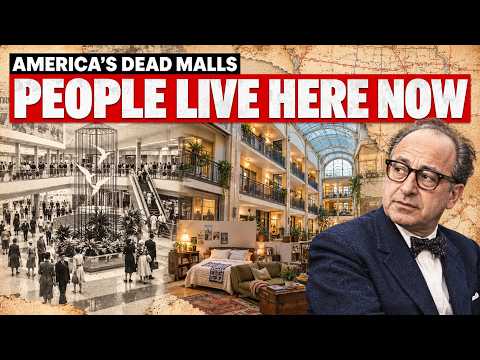
Because the story is not just about failed retail. It is about tax loopholes written 72 years ago. It is about an Austrian refugee who dreamed of Vienna and accidentally invented the suburb. It is about a housing shortage so severe that developers are now looking at 400,000-square-foot commercial ruins and seeing apartment buildings. It is about the biggest real estate rewrite the country has seen since the interstate highway system carved through it in the 1950s.
So sit back, because today we are going to walk through how America built somewhere between 1,500 and 2,500 shopping malls in a single lifetime, watched most of them die, and is now quietly turning the survivors into places where people sleep.
Let me take you back to the beginning, because you cannot understand why people are living inside malls until you understand why the malls were built in the first place. And the answer has almost nothing to do with what you probably think.
The story starts in 1938 in New York City. A young architect named Victor Gruen steps off a boat from Vienna. He is Jewish. He is left-wing. He is a refugee from the Nazis, and he does not speak a single word of English. Within a year, he is designing high-end boutiques on Fifth Avenue. Within a decade, his practice is booming, and he is putting up department stores across the country.
Gruen has a phrase for the shops he designs. He calls them, in his thick Austrian accent, “machines for selling.” He borrows the line from the famous French modernist Le Corbusier, who called a house a machine for living. Gruen believes that a store done properly is an engineering problem.
But Gruen carries something else with him from Vienna. And this is the piece that history keeps forgetting. He grew up wandering the arcades and pedestrian streets of pre-war Vienna. He grew up sitting in cafes, watching musicians play in public squares, watching neighbors argue at outdoor markets, watching an entire civic life play out in shared walkable space.
When Gruen looks at 1950s America—at the endless strip malls, the parking lots, the highways, the drive-ins—he is horrified. In one famous speech, he calls the new American suburbs, and I quote, “avenues of horror.” What he sees is a country that has traded its town squares for asphalt.
So Gruen decides to fix it. In 1956, just a few months after Disneyland opens in California, he completes work on a project called Southdale Center in the Minneapolis suburb of Edina, Minnesota. Southdale is the first fully enclosed, temperature-controlled shopping mall in the United States. Two levels, opposing escalators, a garden courtyard at the center with a fish pond and songbirds in cages. It is meant to feel like a European arcade protected from the brutal Minnesota winters.
Gruen imagines it as a “third place,” a term that sociologists would only invent decades later. He believes people will come to Southdale not just to shop, but to gather, to meet, to live. He has plans for apartment buildings, schools, medical clinics, and post offices around the mall. He is essentially trying to build a walkable city in the middle of a car-dependent suburb disguised as a shopping center.
Almost none of that gets built. The apartments, the clinics, the schools—all of it gets cut in favor of one thing and one thing only: a parking lot. Because in 1950s America, the developers who finance Southdale are not interested in Viennese civic life. They are interested in an entirely different opportunity that Congress had just handed them two years earlier.
And this is where the real story of the American mall begins.
In 1954, Congress rewrites the corporate income tax code. Officially, the goal is to stimulate industrial investment. The economy is in a mild recession, and lawmakers want to encourage businesses to build new factories. So they change one obscure rule about how commercial buildings can be depreciated on tax returns.
Before 1954, buildings were depreciated on what is called a straight-line basis. A building was assumed to have a useful life of 40 years. Each year, the owner could deduct one-fortieth of its value from their taxable income. A $40 million shopping center in the old system gave the owner a $1 million tax deduction every year for 40 years.
But under the new 1954 rule, developers could accelerate that depreciation. They could take a giant deduction in the first few years and smaller deductions later. And here is the thing: nothing said they actually had to use that money for the building. It was just tax-free income.
Even more perverse, a developer could depreciate a building on paper faster than it was actually losing value. In reality, the building was often gaining value because the land underneath it was appreciating. But on paper, for the tax man, it looked like a loss. That paper loss could be used as a tax shelter against other income.
This is the moment that changed everything. Overnight, shopping centers became one of the most lucrative tax shelters in America. Suddenly, it did not matter if a mall was profitable. It did not matter if the stores inside it made money. The building itself, considered as a piece of paper on an accountant’s desk, was a money-printing machine.
The urban historian Thomas Hanchett, who documented all of this in a groundbreaking 1996 paper, wrote that after 1954, quote, “Suddenly, all over the United States, shopping plazas sprouted like well-fertilized weeds.” And Malcolm Gladwell, writing about the same phenomenon, put it more bluntly: suddenly, it was possible to make much more money investing in things like shopping centers than buying stocks.
So money poured into real estate investment companies. This is the actual reason America got malls. Not because Americans wanted them, not because there was some organic consumer demand, but because the United States Congress accidentally turned commercial real estate into the greatest tax dodge of the postwar era.
And when Congress did it again in 1981 under President Reagan, allowing buildings to be written off in 15 years instead of 40, they poured gasoline on a fire that was already burning. From 1981 to 1986, when the loophole was finally closed, the country entered what real estate historians call the era of see-through buildings. Developers in Texas were putting up office towers and shopping malls where you could look straight through the windows because nothing was inside. The buildings did not need tenants. The tax break itself was the product.
By the mid-1980s, the numbers are staggering. Between 1956 and 2005, roughly 1,500 enclosed malls are built across the United States. Some sources place the total number of shopping malls, including strip centers, at well over 20,000.
The country enters an era where the mall is not just a place to buy things. It is where teenagers meet on Saturday nights. It is where families take Christmas photos. It is where couples go on first dates. It is where kids learn to walk and where the elderly go for their morning exercise.
Whole movies get built around them. The Blues Brothers famously drives a police car through one. Back to the Future opens in a parking lot outside one. The Terminator hunts Sarah Connor through one. And in George Romero’s 1978 zombie classic, Dawn of the Dead, the mall itself becomes the setting—a fortress against the apocalypse. Even in fiction, the mall was where America went to hide from the end of the world.
But the end of the world was already inside the walls.
By the mid-1980s, the tax break that built the malls started to disappear. In 1986, Congress passed the Tax Reform Act, which reinstated straight-line depreciation for commercial property. The tax shelter was gone, but the malls were still standing, and thousands more were still under construction—driven by momentum, by anchor-tenant financing models, and by developers who had spent their whole careers riding the boom.
The last mega-mall was completed in 2006. And then almost immediately the industry began to collapse.
You can see the collapse in the numbers, and it is brutal to watch. In 2007, for the first time since the 1950s, no new indoor mall opened in the United States. From 1986 to 2017, according to industry statistics, shopping malls in the United States were closing at a rate of 76.4 per year. An average of 1,170 shopping malls closed each year between 2017 and 2022, depending on how you count them. By the beginning of 2026, mall vacancy rates hit 8.8%. In some markets, they are much higher. And in 2025 alone, 2.6 million square feet of mall space was demolished—reduced to gravel, erased.
But the numbers do not capture the strangeness of what you see if you actually visit these places. Across the American South and Midwest, there are massive concrete structures the size of small towns sitting silent under the sun.
Rolling Acres Mall in Akron, Ohio once boasted 140 stores. In 2008, the electricity got shut off for non-payment. In 2011, a man was electrocuted inside trying to steal copper wire from the walls. The city began demolition in October of 2016. Amazon bought the land and built a fulfillment center on top of it—a nearly 2.7 million-square-foot facility that opened in 2020.
Then there’s Metrocenter Mall in Jackson, Mississippi. As of 2024, it is roughly 97% vacant. Journalists who walked through it in 2025 described mannequin parts scattered across the floor, dead escalators frozen in place, and standing water pooling in the food court. The city of Jackson, which cannot even reliably deliver drinking water to its residents, has no resources to address a 1-million-square-foot rotting building. The mall in Jackson, Mississippi, is not being redeveloped. It is being left to nature.
The pattern is not random. According to detailed analyses of abandoned properties in the United States, 68% of Americans now live within one hour of a dead mall. 40% of Americans live near two or more dead malls. In many small and midsize cities, the mall was the economic anchor of the entire community. And when it collapsed, everything around it collapsed with it. Parking lots emptied. Nearby restaurants closed. Property values fell. The mall did not just die. It killed the surrounding neighborhood.
Now, here is the twist. Because at the exact same time that America was watching its malls die, another crisis was quietly reaching a breaking point—a housing crisis.
According to Zillow’s most recent analysis of United States Census data released in July of 2026, the national housing deficit sits at 4.7 million homes. That is the estimated number of families who are doubling up, living with roommates, adult children stuck at home, siblings crammed into apartments, extended relatives sharing one roof because they cannot find or afford a place of their own. Realtor.com puts the number at 4.03 million as of 2025. The Chamber of Commerce agrees with Zillow’s 4.7 million figure. Freddie Mac estimates 3.7 million. Goldman Sachs places the range at 3 to 4 million.
Whichever number you pick, the picture is the same. The United States is short somewhere between 3.7 and 4.7 million homes, and it has been getting worse every year since the 2008 financial crisis, when home builders stopped building at scale and never fully recovered.
At the same time, in 2024, there were roughly 34 million square feet of empty retail space sitting across the country. Empty, insulated, roofed, plumbed, electrified, accessible by highway, located in most cases on prime suburban land that already had permits, water lines, sewer lines, and stormwater infrastructure baked in decades ago.
You can probably guess what happened next.
Developers looked at those dead malls and they looked at the housing shortage, and someone put the two together. And by January of 2024, according to real estate consulting firm Realogic, at least 192 shopping malls across the United States were in some stage of planning to convert their space into apartments. Dozens of projects were already under construction in California, Colorado, Florida, Arizona, and Texas.
By 2026, the movement has a name: the mall-to-neighborhood pipeline. In Plano, Texas, the old Collin Creek Mall is now a $1 billion district with 2,300 apartments, 500 single-family homes, a hotel, and a 9-acre park. Roughly 6,000 people will eventually live where the food court and Sears once stood.
In Providence, the 1828 Arcade—America’s oldest indoor mall—houses 48 micro-apartments above a food hall. In Milwaukee, residents ride an elevator down to groceries without stepping into a Wisconsin winter. And in Edina, Minnesota, Victor Gruen’s original Southdale is finally getting the walkable civic space he sketched 70 years ago.
Gruen died believing he had failed. He called his malls “bastardized versions” of his vision. He never saw the ending.
But the ending is being written right now—in converted anchor stores, in parking lots turned into parks, in families eating dinner above the tile floor where teenagers once argued about movies. The mall isn’t dead. It just became somewhere to live.
So here’s my question for you: which dead mall in your town would you want to see turned into a neighborhood—and what would you keep from the original?
Report this article
Select a reason for reporting:






