September 14, 1944. Camp Breenidge, Kentucky. The transport truck rolled through the gates, carrying 32 German women—radio operators, clerks, nurses—who had been warned their American captors would show no mercy. They expected brutality. They found lemonade.
Twenty-three-year-old Ursula Becker stepped into the Kentucky heat clutching a wooden box with her only possessions: a family photograph, a prayer book, and a fountain pen. Around her, the women formed a defensive cluster, gray uniforms dusty from days of travel. They had been told Americans were savages. Nothing had prepared them for what happened next.
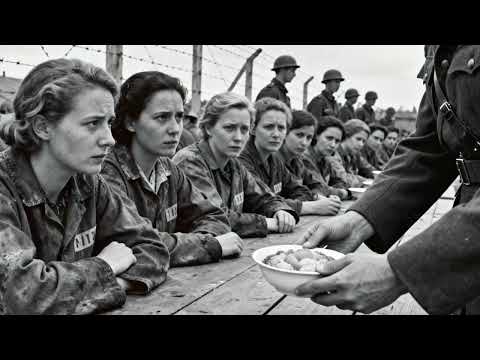
Captain Louise Garrett stepped forward. “You will be treated with dignity,” she said, her English careful and measured. The words seemed incomprehensible. Dignity for enemy prisoners? Ursula exchanged glances with Theres Krauss, a nurse from Hamburg. Suspicion flickered in their eyes.
Then Private Raymond Cooper approached with a cart. “I expect you ladies are thirsty,” he drawled, his Georgia accent thick. Cold lemonade. Real lemonade offered to enemies. Something cracked inside Ursula’s chest.
The mess hall smelled like food—real food. Not the watery soup from France, but meatloaf, mashed potatoes with gravy, green beans that actually looked green. Sergeant Patrick Murphy directed them to clean tables as if serving enemies was routine.
The women sat frozen, staring at their plates. No country feeds its enemies like this. It had to be a trick. Theres, a nurse who had seen too much death to refuse nourishment, picked up her fork. She took a bite—and her eyes widened. One by one, the others began to eat.
Ursula cut into her meatloaf. The flavor exploded—salt, pepper, something sweet. It tasted like Sunday dinners before the war. She blinked back tears. She could not afford gratitude toward her enemies.
Three weeks passed in uneasy routine. The women worked in the laundry, mended uniforms, kept their conversations in German. They maintained distance, speaking only when necessary. Then came October 7th—and everything changed because of dessert.
Private Cooper had convinced Cook Williams to let him try his grandmother’s recipe. By 3:00 PM, the smell drifted across the compound—sweet, buttery, cinnamon. Even the guards stopped to inhale. Peach cobbler.
When Ursula received her bowl, she stared at the golden crust, the bubbling peaches. She hadn’t tasted peaches since 1939, since her grandmother’s farm outside Dresden. She took a bite, and the taste transported her instantly. The sweetness, the tartness, the buttery richness—it was childhood on a spoon.
Around the mess hall, smiles broke across guarded faces. Theres closed her eyes, savoring each bite. Then Hildigard Stein did something unprecedented. She stood, walked to the serving line, and in halting English asked, “Please, may I have more?”
Cooper’s face lit up. “Yes, ma’am,” he said. “I made plenty.” The floodgates opened. Within minutes, half the women lined up for seconds, their carefully maintained distance crumbling in the face of peach cobbler.
Ursula found herself in that line. Part of her screamed betrayal, but the dessert had awakened something she thought the war had killed—a memory of normalcy.
That evening marked a shift. The next morning, Theres approached Sergeant Murphy. “The peach dessert—what is called?” Murphy smiled. “Peach cobbler,” he said slowly. “It’s a southern specialty.”
Theres asked if she could learn the recipe. By afternoon, Private Cooper had organized a gathering in the mess hall. A dozen women watched as he demonstrated—slicing peaches, mixing butter and sugar into crumbly topping. But more than technique was shared. He talked about his grandmother, his Georgia farm, Sunday dinners.
Slowly, the women began to share their own memories. Ing spoke of her mother’s apple strudel. Hildigard described Christmas cookies. Corporal James Watanabi, a Japanese American guard, surprised everyone by describing his mother’s mochi. The irony was not lost—a man whose family likely faced prejudice was sharing his heritage with enemy prisoners.
November brought cold rain—and news that would shatter the fragile peace. The Americans had begun liberating concentration camps. Captain Garrett made newspapers available in the common room. Ursula was the first to find them.
The cover of Life magazine showed skeletal bodies stacked like cordwood. Gas chambers. Crematoriums. Systematic murder on a scale she could not comprehend. Her peach cobbler rose in her throat. She ran to the latrine and vomited until nothing remained but bile and horror.
When she emerged, Theres stood holding the same magazine, tears streaming. Ing sat on the floor, staring at nothing. “We knew,” she whispered in German. “How could we not have known?”
But they hadn’t known. Not really. They had heard whispers about camps, about relocations—but believed the propaganda about work camps and resettlement. They had never imagined this.
Hildigard tried to argue the photographs were Allied propaganda. But her voice lacked conviction. The evidence was too overwhelming, too consistent.
That night, the mess hall felt different. The women picked at food they could barely taste. They had been eating three full meals a day while their countrymen starved innocent people to death. The contrast was obscene.
Private Cooper brought out apple pie, but most could not eat it. The days that followed were the darkest since their arrival. Many stopped eating altogether, guilt transforming every meal into an accusation. How could they enjoy American generosity when their country had committed such atrocities?
Captain Garrett watched her prisoners spiral and made a decision. She arranged a meeting in the mess hall—all 32 women on one side, American staff on the other. The tension was suffocating.
“What your country did was evil,” Garrett said. Ursula flinched. “There’s no other way to describe it. Evil, monstrous, unforgivable.” She paused. “But you are not your country. You are individuals who made choices based on lies you were told. The question now is what you do with the truth you’ve been given.”
Theres stood, voice breaking. “How can you still feed us? How can you treat us with kindness when our country did such things?”
Sergeant Murphy answered. “Because you’re not the ones who built those camps. You’re young women who got caught up in something bigger than yourselves. Maybe the best way to fight evil is to show there’s another way to treat people, even enemies.”
Private Cooper stepped forward. “My grandmother always said, ‘You can’t fight hate with more hate. You fight it by showing folks what decency looks like. By breaking bread together, even when it’s hard.’” He gestured toward the kitchen. “I’ve got stew cooking. Navy bean stew with ham hocks. My mama’s recipe. Sometimes the most important meals are the ones we share when we’re hurting.”
Slowly, the women moved toward the tables. Ursula sat across from Corporal Watanabi. He ladled stew into her bowl. “My family is in a camp, too,” he said quietly. “Not like those camps, but Manzanar, because we’re Japanese. So I understand what it’s like when your country sees you as the enemy.”
November 23rd brought Thanksgiving—a holiday the German women had never heard of. Captain Garrett explained it was a day to express gratitude, to share abundant food, to remember reasons to be thankful. The irony was almost painful. What did enemy prisoners have to be grateful for?
Yet Private Cooper and Cook Williams had been preparing for days. The mess hall was decorated with paper leaves and small pumpkins. Long tables were pushed together—for the first time, the women would eat alongside their captors.
Ursula stood at the entrance, uncertain. Theres took her hand. “We cannot undo what was done,” she whispered. “But we can choose how we live now. Maybe that is all any of us can do.”
The tables were laden with food on a scale the women had never seen. A massive roasted turkey sat at the center, surrounded by cornbread dressing, sweet potato casserole, green bean casserole, cranberry sauce, mashed potatoes, fresh rolls. Hildigard stared with tears in her eyes. “There are people starving in Europe. How can we sit here and feast?”
Sergeant Murphy nodded slowly. “You’re right. There are people starving everywhere because of this war. But starving ourselves won’t feed them. What we can do is remember this moment when the war ends. Remember that there’s enough in this world for everyone if we choose to share it instead of hoard it or destroy it.”
Captain Garrett stood. “In the American tradition, we go around the table and each person says something they’re grateful for. I’ll start. I’m grateful for the courage it takes to face hard truths and to keep going anyway.”
The sentiment passed around. Sergeant Murphy gave thanks for his family. Cook Williams for the ability to feed people. Private Cooper for his grandmother’s recipes. When it came to the German women, a long silence fell.
Finally, Theres spoke, barely above a whisper. “I am grateful that even in captivity, I have been shown what human dignity looks like. I am grateful that my enemies taught me about kindness when my own country forgot.”
Her words opened something. Ing gave thanks for still being alive. Hildigard for the truth, painful as it was. When it came to Ursula, she found herself speaking words she had not planned. “I am grateful for peach cobbler,” she said, and several laughed softly. “I am grateful that food can remind us we are human, that sharing a meal can bridge the distance between enemies.”
As pumpkin pie was served, Ursula realized something profound. She was not just physically full. For the first time since the revelations, the gnawing emptiness inside her had quieted.
December brought news that changed everything. Germany was losing the war. The American military was making plans for repatriation. The women would be sent home once hostilities ceased—returned to a homeland in ruins and shame.
The announcement should have brought relief. Instead, it triggered a crisis. Late one evening, Ursula found herself in the kitchen helping Private Cooper prepare bread. It had become a regular occurrence—informal cooking sessions where barriers dissolved into simple human connection. As she kneaded dough, she finally voiced the question haunting her. “What if we do not want to go back?”
Cooper stopped his own kneading. “You serious about that?”
Ursula nodded, tears streaming into the dough. “What is there to go back to? A country that committed evil? Cities destroyed? Families that may not have survived? Here I have found more humanity than I ever knew in freedom. How can I return to a place that taught me to hate?”
Cooper was quiet. “That’s a big decision, Miss Becker. Staying here means giving up everything you knew. It means becoming something new entirely.”
“Maybe that is what I need,” Ursula replied. “To become something new—someone who builds instead of destroys, who feeds instead of starves, who chooses kindness over hatred.” She looked up with desperate hope. “Is such a thing even possible? Can enemy prisoners simply choose to stay?”
Cooper promised to speak with Captain Garrett. Within days, the question had spread. Ursula was not alone. Theres confessed she had been thinking the same. Ing and Hildigard admitted their terror at returning to a country they no longer recognized. Of the 32 women, 14 began seriously discussing requesting to stay.
Captain Garrett listened with sympathy and concern. The legal complications were enormous. They were prisoners of war, not immigrants. The Geneva Convention required repatriation. There were no provisions for enemy combatants to simply choose to remain.
But Garrett also understood these women had undergone a genuine transformation. She sent urgent communications to her superiors. While they waited, the women who wanted to stay threw themselves into their work with new purpose—helping Cook Williams develop recipes combining German and American traditions, teaching English to other prisoners, volunteering for every task.
Private Cooper became their strongest advocate. He wrote letters to congressmen, military officials, newspapers, arguing that these women represented the best possibility for reconciliation. “If America can transform enemies into friends through simple decency and shared meals, what does that say about the power of our values?”
But they also faced harsh criticism. News leaked to the local community. “How dare Nazi prisoners ask to stay in America when American boys are still dying in Europe?” Some demanded they be sent back immediately. Mrs. Dorothy Green, a church volunteer, organized a counter-petition, gathering signatures from community members who had met the women and seen their genuine remorse.
The decision finally came through in March 1945. 14 German women would be allowed to remain under a special humanitarian provision, reclassified as displaced persons rather than enemy combatants. They would need sponsors, employment, community support—but they would be given the chance to build new lives on American soil.
The transition was not easy. Ursula faced suspicion and hostility. There were people who would never forgive her nationality, never trust her transformation. But the Cooper family stood by her, and Raymond’s patient courtship showed her that the kindness she experienced in camp could extend into civilian life.
Theres became a nurse at a veterans hospital, caring for the very soldiers who had fought against her country. Ing married an American engineer and raised four children who knew both German lullabies and American folk songs. Hildigard became a teacher dedicated to ensuring future generations understood the dangers of hatred and propaganda.
Twenty-five years later, on a crisp autumn afternoon in 1969, Ursula Becker Cooper stood in her Louisville kitchen preparing peach cobbler for Thanksgiving. Her hands moved with practiced ease. But today felt different. Today, her grandchildren would taste the recipe that changed her life.
The wooden box from Dresden sat on a shelf nearby—still containing the photograph, prayer book, and fountain pen. But surrounding it now were other treasures: her American citizenship papers, photographs of her wedding to Raymond Cooper, pictures of their three children, letters from the other women who had made the same impossible choice.
Her granddaughter Emma wandered in, drawn by the familiar smell. “Grandma, why do you always make peach cobbler for Thanksgiving? Wouldn’t pumpkin pie be more traditional?”
Ursula smiled, pulling the child close. “Because peach cobbler reminds me that the smallest acts of kindness can change everything. It reminds me that sharing food is how we tell people they matter, that they belong, that they are worthy of nourishment and care.”
She thought about that moment in the mess hall when she had asked for seconds. How that simple request had been the first step toward admitting her enemies were human, that their kindness was real, that everything she had believed was wrong. Going back for seconds had required more courage than she knew she possessed. It meant acknowledging hunger, vulnerability, and the possibility that she had been lied to about everything that mattered.
But it also meant opening the door to a life she could never have imagined—a life built not on hatred and propaganda, but on peach cobbler, shared meals, and the radical notion that enemies could become family.
Emma studied the golden crust, her small brow furrowed. “So the cobbler was like… a peace treaty?” Ursula laughed, wiping flour from her hands. “The sweetest treaty ever signed,” she said. “No generals, no politicians. Just a young man from Georgia who believed hate could not be fought with more hate.”
Through the window, Raymond crossed the yard, older now but still carrying that same warm smile. Behind him, Theres arrived with her famous strudel—the recipe her mother had mailed from Hamburg after the war, a fragile thread stitching two worlds together. Some wounds healed slowly. Others healed over shared tables.
Ursula pulled the cobbler from the oven, its peaches glistening like small suns. She set it beside the strudel, the mochi that Watanabi’s widow still sent each year, and the pumpkin pie Emma had insisted upon. A table of enemies who had become something else entirely.
She looked at her granddaughter and asked softly, “If a single dessert could turn an enemy into family, what small kindness might you offer someone today?”
Report this article
Select a reason for reporting:






