Before dawn, while the city still slept, a woman entered a 42-room apartment on Fifth Avenue and began to dust. The rooms were exactly as they had been the day before, and the year before, and decades before that. A 30-foot library. Two 40-foot rooms. Silver that had not tarnished because it was polished every morning. Floors that had not known a footstep in twenty years. She worked alone, in silence, for a woman who owned more than $300 million — a woman who at that very moment lay, by choice, in a simple hospital bed across town.
Nothing in that apartment was for sale. Nothing was used. Everything was preserved in perfect condition. And in mansions across America, the same morning was beginning again. For whom was all this? If you have ever wondered what wealth does after it has bought everything, stay with me. Subscribe, and I will take you on a tour through the great houses that stayed alive for no one at all.
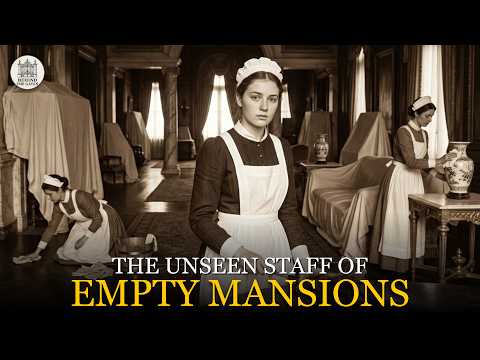
Every great house of that era ran on a number, and that number was meant to stay hidden. It was the ratio of labor to leisure — the count of people required to provide comfort to a very few. The entire art of the Gilded Age, the real art beneath the marble and the music, was making that number disappear. You were shown the gold. You were never meant to see the arithmetic beneath it.
One family sits down to dinner. To move that dinner from fire to table took a cook and her assistants, a butler and his second, a housekeeper and her maids, a laundress who had been working since before dawn. Comfort was the product. People were the machinery, and that machinery was built from the ground up to run in silence.
Begin with what that machinery cost the people caught inside it. Servants in America at the turn of the century earned between $18 and $25 a month. From that, the cost of their food was deducted as a kindness they were expected to feel grateful for. In exchange, they gave their entire days. Fourteen hours was ordinary. Eighteen was not unheard of.
The kitchen maid, lowest in the hierarchy, stood on her feet in the dark to light the fires so the rooms would be warm when the family woke. A year might pass without the people she served ever seeing her once. That invisibility was not an accident of her job. It was the purpose of it.
This world had a structure, a ladder every household knew by heart. At the top stood the butler, who managed the men, and the housekeeper, who managed the women. Together, they governed a small nation. Beneath them came the cook, the lady’s maid, the valet, the footmen — valued for their appearance and their manner. Beneath them again, the housemaids, kitchen maids, and laundresses. And at the very bottom, the lowest kitchen maid and the hall boy, little more than children, given the work no one above them would touch.
The great house was a pyramid, and the wider its base of labor, the grander the family that stood at its narrow, glittering peak. The rules governing that base were harsh. A servant could be dismissed on the spot, without a character, for a minor fault like being seen in a place she should not have been. Without that character, she could not find another position. Holidays were counted in half-days and considered a gift.
The work was hard and endless — hauling coal and water up back stairs, scrubbing stone floors on hands and knees, carrying and fetching from before dawn until the last family member went to bed. The body wore out in that service, and when it did, there was rarely a pension waiting. Only the road.
Most of the people who did this work were not born to it and did not stay in it long. In the cities of the Northeast, the labor fell to immigrant women — especially the Irish, who crossed the ocean to discover that the New World had reserved them a place, and that place was below the stairs of other people’s houses. They came, served a year or two, and moved on to anything that offered more.
Service in America carried a bitterness it had not known in the old country, because a nation that told itself everyone was equal could not accept a class of people paid to be invisible. The newspapers gave this problem a name. They called it “the servant problem,” and in their view, it had no cure. One writer in 1888 described it as the most complicated problem in modern life.
You can watch that complication at work inside a single house. In Chicago, the merchant prince Marshall Field kept six servants in 1870, seven a decade later, and by 1900, only four. Across those three counts, only two of his servants were American-born. The rest were Irish, Scottish, English, Swedish, Norwegian — and they turned over every year or two. A slow river of people passing through a set of rooms. None stayed long enough to belong.
And that was a merchant’s house, modest compared to what waited on the avenue and the shore. In the great cottages of Newport, twenty or more full-time servants was the summer minimum — the floor, never the ceiling. In the mansions of Fifth Avenue and the country estates outside the cities, the numbers ran to thirty, forty, sixty, and more.
The buildings themselves were designed to accommodate the need to hide all these people. There were stairs the family used and stairs the servants used. Corridors behind the walls, doors made to vanish into paneling, entire floors given over to cramped rooms under the roof. The house of this class was two houses, one folded inside the other, and the inner house was kept in shadow so the outer one could shine.
All of this was strange enough when the house was full — when the fires warmed real bodies and the long tables fed real guests. It becomes colder and harder to explain the moment you learn how empty these houses were, and how their vast machinery kept running in the dark with no one there at all.
The house was always hungry. A house of this size was not merely property. It was an appetite. It wanted coal by the ton, candles by the box, linen washed until the water ran clear. It wanted its floors walked, its silver turned, its windows opened to the air — whether or not a living soul slept under its roof. And it did not want these things occasionally. It wanted them every day, without interruption, the way a living creature needs to breathe.
Consider what a single morning of such a house required before the family woke, before any color showed in the sky. Fires laid and lit, grate after grate, room after room, so that heat would be waiting for them as if it had never been lit at all. The great ranges in the kitchen heated to working temperature. The boilers in the cellar fed with coal. Water carried, or pumped, or forced through the new and luxurious pipes that the newest houses boasted of. All of it happening out of sight, by hands that left the rooms before the family entered them, so that comfort would seem to have no cause — to be simply the natural condition of the air the rich breathed.
And a house of this level did not only feed itself. It supported a small resident society inside it. The servants who tended it had to be housed, fed, and clothed in the livery of service. Provisioning the great establishment was a task in itself. A daily movement of ice, coal, meat, milk, and flour arrived at the servants’ entrance, all of it to be received, stored, and recorded by a housekeeper who kept her ledgers like a supply officer.
The kitchens were vast because the demand was vast. The cellars were deep because the appetite was deep. The house was a mouth, and around that mouth an entire economy turned.
Hold on to this next fact, because it is the secret of everything that follows. The house did not care whether anyone was inside it or not. A fire that warms an empty room burns coal exactly as a fire that warms a crowded one. A floor no foot crosses still gathers dust and still needs sweeping. Damp does not wait for anyone to appear. Moth and rust and mildew keep their own schedules, and they are crueler in closed rooms. The house does not know it has been abandoned. It knows only that it is cold, or dark, or dull, or slowly rotting — and it demands to be warmed, lit, polished, and repaired until all of that is gone. And it directs that demand at whoever remains to answer it.
So the machine kept running through every absence. When the family went to the sea in summer, the house did not close its eyes and sleep. A skeleton crew stayed to keep its pulse — to lift and beat the dust sheets, to beat the carpets, to guard the silver, to hold the whole place at the ready for a return that might be months away. And when the family sailed for Europe and stayed a year, the house waited, warm and ordered and clean, for a return that was endlessly postponed.
Readiness was the real product of all that labor. Readiness was the thing every one of those hands was paid, in the end, to make out of empty rooms.
There is a chill in that idea, and the marble was laid there precisely to hide it. We have learned to picture these houses as stages for parties — for the famous balls, for hundreds of guests, for orchids fetched from the glasshouses, for fountains running with champagne. And they were that, for a handful of nights a year. But the party is one night. The house is every night. The truth that the champagne was poured to drown is that most of the great house’s life was not spent in celebration at all. It was spent waiting. It was spent being kept.
Watch the emptiness, then, not the guests. Watch the people paid to fill that emptiness with readiness. Watch the fire lit before dawn in a room no one will sit in that day. Watch the coal carried along a path no guest will ever see. Watch the housemaid moving through a closed and silent wing, dusting a table for a family three thousand miles away — a family that may not come this year, and may not come next.
Once your eye learns the trick of finding it, you will find it everywhere in this era. A house of this size renews itself endlessly in a thousand small ways that never stop. Candles burn down and are replaced by the box. Lamps are trimmed and filled. Cut flowers, fresh, wilt within days — out they go, and in come others. Linen yellows and is bleached, or wears thin and is mended, or is simply thrown away and bought anew. Silver tarnishes the moment it is cleaned, so it must be polished again.
Nothing in such a house stays still. Everything decays on its own quiet schedule, and there is a permanent staff of people whose existence is spent fighting that decay, day after day, in rooms no visitor will ever enter. The family’s comfort, in truth, was a war against decay fought in the lower floors — never won, only managed, at a cost in wages the family barely noticed and in labor it was never meant to see.
And you will find it in its clearest form not in the houses that overflowed with life, but in the houses that stood for weeks, and years, and whole decades almost empty of it. To see this appetite at its sharpest, we must begin where the season lasted six short weeks, while the staff stayed all year. We must begin in Newport, in a house its owners liked to call a cottage — which it was not, at all.
Forty servants for six short weeks. On the third of July, the hall at The Elms stood ready, every surface gleaming, for a family that would stay barely six weeks. The great cottage on Bellevue Avenue had been cleaned from cellar to roofline. The gardens had been brought to the peak of their bloom. The vast machine that ran the place was ticking like a clock — until the coal baron and his family spent the height of summer in the style the season demanded, and then left, and left everything behind.
The Elms belonged to Edward Julius Berwind, and there is a bitter arrangement in that fact. Berwind made his fortune from coal — the very fuel that fed houses like this one, and now his house would swallow that fuel by the ton.
He hired the architect Horace Trumbauer, and between 1899 and 1901, a French château of the eighteenth century was rebuilt in Newport stone. It cost about $1.5 million, in an age when the maid who dusted its rooms earned $20 a month. They called it a cottage — the way only Newport could say such a thing with a straight face and a small cold smile at the joke.
Why spend a fortune on a house meant for six weeks? The answer lay in what Newport was. It was not a place of rest. It was a stage. Every luncheon was a test. Every dinner was a move in a long game of standing. The cottage was not a refuge from that game. It was the board the game was played on, and it had to be magnificent because magnificence was the point.
Now set the two numbers side by side, because the whole story lives in the gap between them. Six weeks of use. Fifty-two weeks of maintenance. Forty servants to bridge the enormous distance between the two. For every week the family lived inside the house, the house lived more than eight weeks without them. And through all those empty weeks, the fires were laid, the silver polished, the wages paid.
There was a ritual to the season that made the emptiness clearer still. In early summer the house was opened, the covers lifted, the windows thrown wide. At the end of August the rites ran backward: covers back over the chairs, valuables locked away, rooms darkened one by one, and the house put to sleep again for ten long months of solitude. The forty who did this work knew the house in a way its owners never could — in its waking and in its sleeping alike.
Those are the accounts the marble was built to hide. And another fact makes the number more chilling still. The forty were not merely numerous. They were meant to be invisible. A guest could arrive at The Elms, dine, sleep, and leave after days without ever glimpsing one of the forty people whose labor made every hour of that stay comfortable. The house was designed to produce that illusion exactly.
To see how a building can swallow forty people whole, you must go beneath the marble, into the parts of the house no guest was ever meant to find. Through the tunnel under the street, coal arrived the way bodies once were carried — out of sight, underground. In The Elms, the fuel that ran the house never reached a door where a guest might see a dirty cart or a sweating man hauling sacks. It came through a tunnel cut from a neighboring street straight into the cellar, so that coal could be supplied, stored, and burned without ever troubling the sight of anyone who mattered.
The house took its meals in secret, underground, and the smoke of its digestion rose from chimneys that seemed to have no visible source. This was not austerity, and it was not mere convenience. It was theater, built into the stone at great expense.
The entire underworld of the house was organized around one stern principle: the labor that produced comfort must never be seen, under any circumstance, producing it. The boilers roared far off in the cellar. The coal slid through its buried passage. The servants moved through their separate stairs and corridors, separated from the family’s rooms by the design of the building itself, so that a servant might cross the house a dozen times at noon and appear to a guest only in the moments he was needed — as if summoned from nothing and about to vanish back into it the moment his task was done.
The house in this sense was a machine for concealment, and building it took real ingenuity. Doors were hidden in the paneling, so servants could pass from the world of service into the reception rooms without seeming to have come from anywhere. The back stairs climbed the length of the house inside the thickness of its walls — hidden passages of plain wood and bare treads running parallel to the luxurious marble the family used, so the house’s inhabitants could move through the same building in the same hour and never once meet.
Bells, and later speaking tubes and telephones, let the family summon a servant from a distant room without the indignity of raising one’s voice. The whole system existed to preserve a single illusion: that comfort in a great house simply happens, and is owed to no one.
Above the grand floors, just under the roof, where summer heat gathered and winter cold bit hardest, lay the quarters of the forty. The servants slept on the third floor in cramped rooms, as far as the house could put them from the cool, spacious areas they spent their waking hours tending. They rose before the family and went to bed after them. The kitchen maid stood before the range in the dark. The housemaids had finished sweeping and setting the formal rooms before their masters opened their eyes.
Every hour of a servant’s day was shaped by the demand that the result of their work be everywhere while their presence itself be absent — so that the family, coming down late into a warm and gleaming house, would meet only comfort, and never once glimpse its cause. Even the machines of the place ran on that same measure of hidden luxury. The garage alone at The Elms ran 125 feet long and 70 feet deep — a building larger than an ordinary family’s entire house, raised for no purpose beyond sheltering the cars of a home its owners used only six weeks a year.
Everything there was vast, and everything there aimed at a summer that came and went in the time it took the garden to bloom and fade. Size was the point. Luxury was the message. And the people who made that luxury possible were hidden where the sight of them could not spoil the message.
And here is the strangest turn of all. The old way did not die with the death of the world that gave it meaning. Long after other houses along the avenue had cut their staffs to the bone and shut their upper floors, Julia Berwind kept The Elms exactly as it had always been. Even in the 1960s she was still running the house in the old manner, keeping forty servants, refusing every modern shortcut that every practical voice around her tried to press on her. She had lived her whole life inside that ratio — forty hands for a few short weeks — and she would not let it go, even as the age that gave it meaning collapsed on every side.
When she finally went, the house passed to the Preservation Society that holds it to this day. And now, in a last turn worthy of the whole story, what visitors most want to see is not the ballroom but the cellar, not the marble but the tunnel — the hidden machinery of a way of life that has vanished entirely from the world.
Which leaves us, at the end, with the question this whole tour has been circling. If you were handed wealth enough for every house you ever wanted, would you keep them all lit and staffed and ready for a day you might return — or would you lock the doors and walk away? Tell me in the comments below.
Report this article
Select a reason for reporting:






