Obergefreiter Klaus Hoffmann had been conditioned to expect brutality from his enemies. So when he sat down at the Mueller family’s dining table in Lethbridge, Alberta, on a Sunday afternoon in 1944—surrounded by three children and the aroma of roast beef and home-baked bread—his first instinct was suspicion. This had to be an elaborate psychological operation, he thought, designed to extract intelligence or identify prisoners who might collaborate.
Hoffmann, a 23-year-old Wehrmacht soldier captured in North Africa and shipped thousands of miles to a prison camp on the Canadian prairies, had been taught that the Allies were monsters. The invitation to share a family meal seemed so incomprehensible within his understanding of warfare that he initially refused, fearing punishment or humiliation. What shocked him most profoundly was the gradual realization over the afternoon that the Mueller family genuinely wanted him there—that they viewed him not as a hated enemy, but as a young man far from home who deserved basic human kindness. Accepting their hospitality required him to question fundamental assumptions about the war, his enemies, and the nature of the conflict that had brought him to their table.
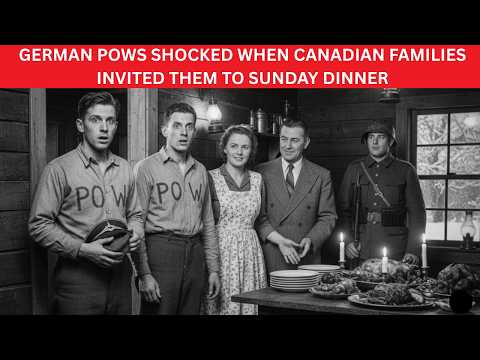
The context for understanding how German prisoners came to dine in Canadian homes begins with the extraordinary treatment standards that characterized POW detention in Canada throughout World War II. By 1945, approximately 34,000 German prisoners of war were held in camps scattered across Canada, with the largest facilities at Lethbridge and Medicine Hat in Alberta designed to hold 12,500 prisoners each—making them the largest POW camps in North America.
Canadian authorities took their Geneva Convention obligations seriously. The generally humane treatment that German and Italian ex-prisoners received from military authorities became something both sides acknowledged in postwar accounts. This commitment to proper treatment reflected not just legal obligations, but Canadian values emphasizing fairness even toward enemies. It manifested in food rations that matched what Canadian soldiers received, recreational opportunities including sports and educational classes, and work programs that employed approximately 11,000 prisoners by 1945 in forestry and agricultural labor—where they interacted regularly with Canadian civilians.
The farmwork programs that brought German prisoners into contact with Canadian families created the circumstances that made Sunday dinner invitations possible—and in some cases, common. Prisoners worked on farms and ranches across prairie provinces, performing agricultural labor that was desperately needed as Canadian men served overseas. The relationship between POW workers and the farming families who employed them varied dramatically based on individual personalities and circumstances, but documented accounts reveal numerous cases where professional relationships evolved into something approaching friendship despite official restrictions.
Rudolph Ree, a German POW who worked on the farm of Joe and Mary Quaiser near Lethbridge, was treated like family. He had his own small house on the farm, didn’t have to return to camp each night, and shared meals with the family. Years later, the Quaiser daughter Bessie recalled that Ree was like one of the family—a relationship that transcended the prisoner-guard dynamic and suggested genuine human connections formed despite circumstances designed to maintain separation between captives and captors.
The practical realities of agricultural work made maintaining strict separation between German prisoners and Canadian families nearly impossible. Farmers who employed POW labor needed workers who could understand instructions, operate equipment safely, and work with minimal supervision during busy seasons when time was critical. These requirements necessitated communication and cooperation that naturally led to relationship development over weeks and months of daily interaction. The physical demands of farmwork created shared experiences of exhaustion, accomplishment, and the rhythms of agricultural life that transcended national boundaries. When harvest season required dawn-to-dusk labor, when machinery broke down and needed immediate repair, when weather threatened crops that represented a family’s livelihood, the artificial boundaries between enemy prisoners and Canadian farmers often dissolved in the face of shared practical challenges.
The decision by Canadian families to invite German prisoners to share Sunday dinner involved complex motivations that included compassion, curiosity, religious conviction, and simple human decency. For families with strong Christian backgrounds, particularly those in rural communities where church attendance remained central to social life, the biblical imperative to show hospitality to strangers resonated deeply. Some families viewed inviting prisoners to dinner as a moral obligation rooted in their faith—a way of practicing the Christianity they professed every Sunday in church. Others were motivated by empathy, imagining how they would want their own sons and husbands who were serving overseas to be treated if captured. Still others felt genuine curiosity about German culture and saw the opportunity to interact with actual Germans as a rare chance to learn about a nation they knew primarily through wartime propaganda and newsreels.
The experiences of German prisoners invited to Canadian homes for meals challenged their preconceptions about their enemies in ways that formal re-education programs could never achieve. Harry Pole, a 19-year-old merchant seaman who was captured and sent to work on a farm near Brooks, Alberta, later recalled being treated with such kindness by the farming family that when he returned to bombed-out Hamburg after the war, he told his new wife he was going back to Canada—and she agreed. Pole knew of at least 36 other former prisoners who returned to southern Alberta, drawn back by memories of treatment that contradicted everything Nazi propaganda had taught them.
The intimate experience of sitting at a family table, being served food prepared with care, watching children interact with their parents, and participating in the mundane rituals of Canadian domestic life created psychological impacts that transcended political ideology and forced prisoners to confront the humanity of people they had been conditioned to view as subhuman or culturally inferior.
The food served at these Sunday dinners represented abundance that shocked prisoners who had experienced years of wartime privation before capture. Canadian farms during World War II operated under rationing systems that constrained what families could serve, but the restrictions were far less severe than those in war-ravaged Europe. Farm families had access to meat, dairy, and fresh produce that many German soldiers had not tasted in years. The sight of children who were well-fed and healthy, the portions that seemed generous rather than carefully measured, and the casual attitude toward food waste that came from living in a land where starvation was not imminent created cognitive dissonance for prisoners whose last years had been characterized by increasing hunger and deprivation. Some prisoners initially struggled to eat normal portions because their digestive systems had adapted to inadequate rations, requiring families to serve smaller amounts and encourage gradual increase in consumption.
The conversations that occurred around dinner tables—when language barriers could be overcome—revealed how individual Germans and individual Canadians processed the moral complexities of a war that pitted their nations against each other while they sat sharing pot roast. Some families avoided political topics entirely, maintaining conversations about weather, crops, and the practical details of farm life that created neutral ground where host and guest could interact without confronting uncomfortable questions about guilt, responsibility, or the justifications for war. Other families engaged in more substantive discussions, with prisoners explaining their experiences and motivations while Canadian hosts shared their perspectives on why they fought Germany and what they hoped would follow victory. These conversations, conducted in broken English and German supplemented by gestures and occasional interpretation by bilingual neighbors, rarely resolved complex questions about warfare and morality—but they humanized both sides in ways that abstract political rhetoric could not.
The children in Canadian families hosting German prisoners often formed attachments that their parents found both touching and concerning. For children raised in rural isolation with limited peer interaction, having a German prisoner working on the farm represented novelty and potential friendship regardless of adult designations about enemies and war. Documented accounts include stories of children teaching prisoners English, prisoners teaching children German words, and relationships developing where youngsters viewed the German soldier more as an older brother figure than as an enemy. Parents struggled with mixed feelings about these attachments, recognizing that the relationships showed their children’s capacity for compassion while worrying about what messages they sent about loyalty and patriotism when Canadian men were dying fighting Germans overseas.
The official Canadian policy toward POW interaction with civilians remained officially restrictive throughout the war, with regulations designed to prevent fraternization and maintain proper separation between prisoners and the Canadian population. Camp administrators and military authorities responsible for POW management faced the challenge of enforcing rules that the practical realities of farm work and rural life made nearly impossible to maintain. The choice facing Canadian officials was whether to strictly enforce regulations that would require removing prisoners from farm work—where they were urgently needed and where violations of fraternization rules were inevitable—or to maintain official restrictions while tacitly accepting that supervision of widely scattered farm workers was impractical. The pragmatic solution involved maintaining official rules while exercising considerable discretion about enforcement, with authorities generally intervening only when complaints arose or when fraternization created security concerns rather than merely violated the letter of regulations.
The perspective of veteran guards responsible for supervising POW workers on farms added another layer of complexity to the dinner invitation phenomenon. The guards—mainly veterans from the First World War who were considered too old to serve overseas in the Second World War—often developed relationships with prisoners that combined professional responsibility with personal regard. These elderly Canadian veterans had fought Germans in the previous war and understood from personal experience that enemies were human beings rather than abstractions, a recognition that informed how they approached supervision of POW workers. Many guards took a pragmatic view of fraternization, understanding that farm families feeding prisoners dinner represented hospitality rather than security threats, and that attempting to prevent such interactions would create resentment among farming communities whose cooperation was essential for agricultural production.
The internal debates among German prisoners about whether to accept dinner invitations from Canadian families revealed divisions between those who maintained rigid loyalty to Nazi ideology and those who recognized that the comfortable treatment they received suggested their indoctrination had been based on lies. Hardcore Nazi prisoners viewed acceptance of Canadian hospitality as betrayal, arguing that socializing with the enemy dishonored German military service and suggested weakness or collaboration. These ideologically committed prisoners sometimes threatened or ostracized fellow POWs who participated too enthusiastically in Canadian life, viewing them as traitors who had forgotten their duty to resist and their loyalty to the Fatherland. Other prisoners rejected this rigid ideology, recognizing that the war was lost, that Nazi promises had proven hollow, and that Canadian treatment offered a glimpse of what life could be like in a society not consumed by militarism and hatred. The dinner invitations became sites of ideological contestation where competing visions of German identity and future played out through individual decisions about whether to accept or refuse Canadian hospitality.
The long-term impact of these dinner experiences manifested in the remarkable number of former prisoners who chose to return to Canada after the war’s end and their eventual repatriation to Germany. More than 6,000 prisoners asked to stay in Canada permanently as soon as the war was over, though the British government requested that all POWs be returned to the United Kingdom for work and gradual processing back to Germany. For men like Klaus Hoffmann, the Sunday dinners were more than meals—they were windows into a world where humanity transcended nationality, and enemies could become friends.
Hoffmann never forgot that afternoon. When he returned to a shattered Germany in 1946, he carried with him the memory of the Mueller table—the warmth, the laughter, the children’s questions. “They treated me like a son,” he later wrote to Bessie Quaiser, decades after the war.
Thousands of former prisoners echoed that sentiment. They wrote letters, sent photographs, and some—like Harry Pole—returned to build new lives on the prairies that had once held them captive. The dinner invitations had done what armies could not: they had turned enemies into neighbors.
Hoffmann eventually brought his own family to Lethbridge in 1972, standing on the Muellers’ porch with tears in his eyes. “This is where I learned that hatred is taught—and so is kindness,” he told the aging couple.
What small act of humanity might you offer to someone you’ve been taught to fear?
Report this article
Select a reason for reporting:






