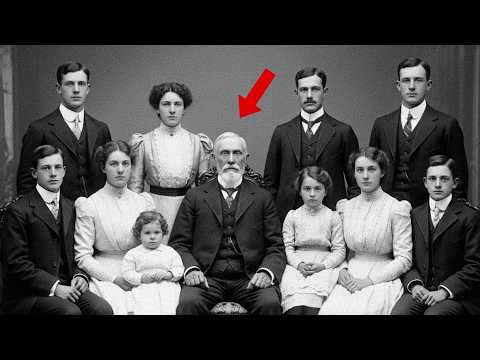
Professor Amanda Rivers had spent eight years cataloging donations at the Philadelphia Museum of American History, but the collection that arrived on that crisp autumn morning would haunt her for months. Among hundreds of early 20th-century photographs, one image seized her attention instantly: a formal family portrait from 1903, captured in what appeared to be a high-end studio. Three generations of a seemingly prosperous family—middle-aged parents, their adult children with spouses, and four grandchildren—posed with practiced elegance. At the center sat an elderly man with a distinctive white beard, dressed in a formal black suit. The family looked happy, affluent, a model of the emerging American middle class. Yet something about the photograph unsettled Professor Rivers, though she couldn’t pinpoint what. The lighting seemed off, and there was an unnatural stiffness in the grandfather’s posture that went beyond the usual formality of the era.
She placed the image under her magnifying glass. The studio stamp on the back read: “Morrison Studio of Photography, Philadelphia, Pennsylvania, October 15, 1903.” She noted to check the studio records, preserved in the city archives. As she prepared to store the photograph, she took one last look. The grandfather’s eyes seemed different—less focused, with a strange glassy appearance that made her uneasy. There was something deeply wrong with this seemingly innocent family portrait, and Professor Rivers was determined to find out what.
The Morrison Studio records revealed meticulous documentation of every session between 1895 and 1920. She found the entry for October 15, 1903: family portrait, Whitmore family, 12 people, special arrangements requested. The note “special arrangements” was unusual. Most family portraits in 1903 were straightforward affairs, but this entry included additional notes in the photographer’s precise handwriting: extended session required, family requested extra time for positioning, paid in full in advance.
Professor Rivers contacted Dr. Michael Chen, a specialist in early photographic techniques at Temple University. When she showed him the photograph, his reaction was immediate and alarming. “The lighting on the grandfather is completely different from the rest of the family,” Dr. Chen observed, adjusting his examination equipment. “Look at how the shadows fall on his face compared to the others. And his eyes—they’re not focusing on the camera lens like everyone else’s.” He pointed out several other technical anomalies. The grandfather’s skin had an unusual waxy texture, and despite the long exposure times required in 1903, he appeared unnaturally still compared to the slight motion blur on the children. “There’s something else,” Dr. Chen continued, studying the image under different lighting. “His clothes seem arranged with extreme precision. See how the jacket sits on his shoulders? That’s not how fabric naturally falls on a living person.”
A chill ran down Professor Rivers’ spine as the implications became clear. She requested the Morrison Studio appointment records from the archive, hoping for more information about the Whitmore family session. The appointment log revealed the session had been booked just three days in advance, with a note that it was for a family emergency. The photographer had charged double his usual fee and had scheduled no other appointments that entire day. Most troubling was a brief entry in Morrison’s personal notes, found in a separate ledger: “Unusual circumstances. Family requested complete discretion. No sample to be displayed in studio window as usual.” The Whitmore family had paid extra for secrecy, and Professor Rivers was beginning to understand why.
City records from 1903 showed the Whitmores were prominent members of Philadelphia society. Samuel Whitmore, the family patriarch, was listed as the founder of Whitmore Textile Manufacturing. His son George and daughter Margaret had married into respected families, and the family resided in an elegant townhouse in Rittenhouse Square. But when Professor Rivers searched death records, she made a shocking discovery. According to the Philadelphia Department of Public Health, Samuel Whitmore had died on October 12, 1903—three days before the family portrait was taken. The death certificate listed the cause as heart failure, signed by Dr. Edmund Foster, a prominent physician who served Philadelphia’s wealthy families. The timing was impossible to ignore. Samuel had died on October 12, yet he appeared very much present in a family photograph taken on October 15.
Professor Rivers contacted the Philadelphia Genealogical Society to research the Whitmore family further. The society’s records indicated that Samuel’s funeral had been unusually private, attended only by immediate family, and not publicly announced in newspapers until weeks later. Local newspaper archives revealed another crucial detail. The Philadelphia Inquirer published Samuel Whitmore’s obituary on November 8, 1903—nearly a month after his actual death date. This delay was highly unusual for a man of his social standing. The obituary described Samuel as a devoted family man who had left detailed instructions for his family’s future. It mentioned that he was deeply concerned with preserving family unity and tradition and had made specific requests regarding family memories.
Dr. Chen’s analysis of the photograph took on greater significance in light of this discovery. “If Samuel Whitmore died three days before this photograph was taken,” he said, “then what we’re looking at is a post-mortem photograph, but disguised as a normal family portrait.” Post-mortem photography was common in the 19th and early 20th centuries, but it was usually clear that the person was deceased. This photograph was different. It was deliberately designed to make Samuel appear alive and present with his family. The question now was: why had the Whitmore family gone to such extraordinary lengths to create this illusion?
Professor Rivers found the answer in Samuel Whitmore’s will, filed with the Philadelphia Orphans’ Court in 1903. The document revealed a complex web of financial arrangements that explained the family’s desperate need to conceal his death. Samuel’s textile business had been facing severe financial difficulties due to increased competition from Southern mills. His will indicated that he had borrowed heavily against the company, using his life insurance policy as collateral. The insurance company required proof that he was alive and well on October 15, 1903, to approve the policy. More critically, Samuel’s largest creditor had demanded a personal meeting with him on October 20, 1903, to renegotiate the company’s debts. If Samuel failed to attend, the creditor had the right to seize all company assets immediately, leaving the family destitute. The family portrait was not just a memento. It was fabricated evidence to support an insurance fraud.
The Whitmore family needed documentation showing Samuel alive and well on October 15 to buy time to arrange their affairs before his death was revealed. Professor Rivers found additional evidence in the financial records of Morrison Studio. The Whitmores had not only paid for the photography session but also for the photographer’s complete silence about the unusual circumstances. Morrison had been compensated generously to ensure the secret was never revealed. The fraud succeeded. Insurance company records showed that Samuel’s life insurance policy was paid in full in January 1904, and the family successfully negotiated a settlement with their creditors that allowed them to retain part of their fortune.
But the psychological cost to the family had been immense. Professor Rivers found evidence in later city records showing the Whitmore family had been deeply traumatized by the experience. George Whitmore sold the textile business within a year and moved his family to California. Margaret suffered what contemporary records described as a nervous breakdown and was treated at a private sanatorium. The children in the photograph, forced to stand beside their dead grandfather and keep the secret, carried the trauma into their adult lives.
James Morrison’s private diaries, discovered among his business papers, revealed the moral conflict he faced when the Whitmore family made their request. As a respected photographer who had built his reputation on honest portraiture, Morrison struggled deeply with participating in the deception. His diary entry from October 13, 1903—two days before the session—showed his inner turmoil. “The Whitmore family approached me with a most unusual request. They wish to create a family portrait that includes their recently deceased patriarch. While photographing the dead is not uncommon, they specifically want the deceased to appear alive and natural. This troubles my conscience greatly.”
Morrison initially refused the commission, but the family’s desperation and the substantial sum they offered eventually convinced him. His technical skills as a photographer uniquely qualified him to create the illusion the family needed. The process was complex and disturbing. Morrison’s diaries described how Samuel’s body had been carefully prepared by a skilled undertaker to appear lifelike for the sitting. Special braces were constructed to hold Samuel’s body in a natural seated position, and his eyes were propped open with small devices used in post-mortem photography. The most challenging aspect was coordinating the family’s expressions and poses to appear natural while sitting beside their dead patriarch. Morrison noted that the young children were terrified by the experience, and several family members became physically ill during the session. The session took four hours to complete. “The family members struggled to maintain their composure, especially when the children were positioned near their grandfather,” Morrison wrote. “Mrs. George Whitmore fainted twice and had to be revived with smelling salts.”
Morrison used advanced lighting techniques to minimize the visible signs of death, carefully positioning Samuel to hide the rigor mortis, and used makeup to restore some color to his skin. The photographer was haunted by guilt over the deception for years. His diaries showed he never again accepted a commission involving post-mortem photography and carried the secret of the Whitmore family portrait to his grave in 1925.
Professor Rivers located descendants of the Whitmore family through genealogy websites, hoping to learn more about how the secret had affected the family in later years. What she discovered revealed the long-term psychological impact of the deception across multiple generations. Thomas Whitmore, Samuel’s great-great-grandson, still lived in the Philadelphia area and possessed family documents never made public. When Professor Rivers contacted him, he was initially reluctant to discuss his family history but eventually agreed to share what he knew.
Thomas explained during their meeting that the family had never spoken openly about Grandfather Samuel’s death, but there had always been whispers and strange behaviors that made more sense once he knew the truth. “My grandmother Margaret never allowed family photographs to be taken,” Thomas said. “She would become extremely distressed whenever anyone mentioned Samuel’s name.” Thomas shared a collection of letters written by family members in the years following 1903. The correspondence revealed deep psychological trauma, especially among the children who had been present during the photograph. Robert Whitmore Jr., who was twelve at the time, wrote to a relative in 1905: “I still have nightmares about that day. Mother says I must never tell anyone about Grandfather’s picture, but it haunts my dreams. I cannot look at photographs of Grandfather without remembering how cold his hand was when they placed us beside him.”
Margaret Whitmore’s medical records, which Thomas had inherited, showed she was treated for what physicians of the era called nervous exhaustion and melancholia for several years after 1903. Her symptoms included an inability to tolerate being photographed and severe anxiety attacks triggered by discussions of death or funerals. The family’s financial situation stabilized after the insurance payout, but the emotional cost was devastating. George Whitmore struggled with guilt for years, eventually becoming an alcoholic. His marriage deteriorated, and he died relatively young in 1919. “This secret poisoned our family for generations,” Thomas told Professor Rivers. “Even those of us born decades later grew up feeling that something terrible had happened, though we never knew what. It’s almost a relief to finally know the truth.”
Professor Rivers decided to investigate whether the insurance fraud had ever been discovered or investigated. She contacted historical researchers at Mutual Life Insurance, the company that had paid Samuel Whitmore’s policy in 1904. The insurance company’s archives revealed they had indeed become suspicious of the claim, but only after several months had passed. An internal memo dated March 1904 noted irregularities in the Whitmore claim and recommended a review. The investigation had been triggered by an anonymous letter received by the insurance company in February 1904. The letter, written in precise handwriting, claimed that Samuel Whitmore had died before the date on his policy renewal document. However, the company’s investigators had been unable to prove the allegations. The insurance investigator’s report, filed in April 1904, concluded that while there were unusual circumstances surrounding the claim, there was insufficient evidence to prove fraud. The family portrait dated October 15, 1903, served as crucial evidence that Samuel was alive and well on the policy renewal date.
Most interestingly, the company’s files included a notation that photographer James Morrison had been questioned as part of the investigation. Morrison insisted the photograph was genuine and that Samuel Whitmore had been present and alert during the session. Morrison’s loyalty to his clients had protected the family’s secret, even under official scrutiny. The photographer had risked his reputation and potential criminal charges to maintain the deception he had helped create. The anonymous letter that sparked the investigation remained a mystery. Someone close to the family knew the truth and tried to expose the fraud, but their identity was never discovered. Professor Rivers suspected the letter came from within the family itself, perhaps from someone who couldn’t live with the guilt of the deception but lacked the courage to come forward openly. The investigation files also revealed that Mutual Life Insurance had quietly changed its policies after the Whitmore case, requiring medical examinations closer to policy renewal dates and implementing stricter verification procedures.
As Professor Rivers pieced together the full story, she struggled with her own ethical responsibilities regarding the discovery. The Whitmore fraud had occurred over 120 years ago, well beyond any legal statute of limitations, but the implications of revealing the truth were complex. She consulted with museum ethics experts and legal scholars about whether to publish her findings. The consensus was that the historical significance of the case outweighed privacy concerns for long-deceased individuals, but sensitivity toward living descendants was essential. Thomas Whitmore, when asked about public disclosure, gave his permission for the story to be told. “Our family has carried this burden for far too long,” he said. “Perhaps sharing the truth will help others understand the terrible costs of deception, even when the motive seems justified.”
Rebecca Whitmore Chen’s letter completed the circle. Among her inherited documents was Margaret Whitmore’s final, unsent letter from 1925: “That photograph still haunts me. Forcing Father to appear alive seemed a violation of his rest. I fear we committed a sin our family could never escape.” The letter also revealed that Margaret herself had sent the anonymous tip to the insurance company in 1904—driven by guilt, yet too afraid to come forward openly.
The Whitmore case became a permanent exhibit at the Philadelphia Museum, titled “Hidden Truths: When Photographs Lie.” It displayed the original 1903 portrait alongside Professor Rivers’ full documentation, Morrison’s diaries, and the family’s letters. Interactive elements taught visitors to spot signs of post-mortem photography and early manipulation techniques.
At the opening, Thomas Whitmore spoke quietly: “This photograph represents our ancestors’ love for one another and their tragic inability to face the truth. By finally sharing their story, we hope to honor their memory and affirm the importance of honesty.”
Professor Rivers stood beside him, watching visitors study the glassy eyes of Samuel Whitmore. The fraud had lasted only months, but its shadow had stretched across a century.
So tell us—was the Whitmore family’s deception a necessary act of survival, or a sin that no amount of time could ever justify?
Report this article
Select a reason for reporting:






