Somewhere over Pakistani airspace, at 2 a.m., six Canadians sat in the back of a Chinook helicopter and watched the fuel gauge tick toward empty. They had just pulled a single computer hard drive out of an al-Qaeda compound—intelligence that nobody back in Ottawa even knew they had gone to get. The pilot’s voice crackled over the headset: two minutes of fuel left. Then one. Then he stopped giving numbers.
They landed in the dark on the wrong side of a border, in a country that had not officially given them permission to be there. And that was the easy part.
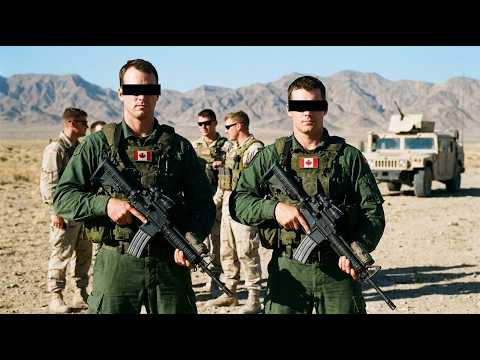
There were forty of them. Forty Canadians in a coalition of 1,300 special operators, working under an American Navy captain in a war their own prime minister had not authorized them to enter. They called themselves Joint Task Force 2—JTF2. Canadians say it the same way Americans say Delta: quietly, and only when they have to.
Their motto, carved on the gate at Dwyer Hill, read Facta Non Verba: Deeds, not words. That was not a slogan. It was an operating constraint. They do not give interviews. They do not write memoirs. They do not show their faces. Out of every operator who has served since 1993, exactly one is publicly named.
The selection process is brutal in a way that is hard to convey. You serve two years in the regular Canadian Forces first. You qualify as a paratrooper. Then you arrive at Dwyer Hill for the assessment phase. On day one, you do a 13-kilometer march carrying 35 kilograms of kit—which you must complete in under two hours and twenty-six minutes. The moment you cross the line with your lungs cooked and your shoulders bleeding, they hand you a rifle and walk you to the edge of a pool. Twenty-five meters. Boots on, uniform on, rifle in hand, no flotation device. Swim.
Eight out of every ten candidates do not make it past that first week. Of the ones who survive selection and finish the seven-month assault course, roughly one in ten earns the badge. Nine out of ten of Canada’s best soldiers fail this. Nine out of ten of the best.
In 2001, the unit operated on something between 25 and 40 million Canadian dollars a year. The American unit they were about to deploy alongside ran on more than a billion US dollars. Twenty-five times more money, same standard, different zip code.
By the autumn of 2001, there were 297 JTF2 operators on the books. And then September 11th happened.
Here is what officially happened next, according to the Canadian government’s own public statements at the time: Canada did not have combat troops on the ground in Afghanistan until February 2002. That is the record. That is what Parliament was told. That is what every newspaper printed.
And here is what actually happened. In early October 2001—weeks before the Canadian public would hear a single word about it—approximately 40 operators from Joint Task Force 2 were placed on a Canadian C-130 Hercules cargo aircraft and flown into southern Afghanistan. Prime Minister Jean Chrétien had not given formal permission. The documentation for that deployment, according to historian Sean Maloney, did not exist in any normal chain of authorization. The men were simply in the air, then on the ground, then operational before the political class understood the question well enough to ask it.
Pay attention to their uniform—the forest green Canadian combat fatigues. Because four months from now, on a tarmac in this same city, that exact color is going to put a defense minister in front of a parliamentary committee.
They joined Task Force K-Bar: seven countries, 1,300 operators. American SEALs, German KSK, Norwegian SOF, New Zealand SAS, Danish, Turkish, and Australian elements. The commander was a US Navy captain named Robert Harward. He had spent his entire career in naval special warfare. His mission was simple to describe and almost impossible to execute: find the Taliban’s senior leadership, find al-Qaeda cave by cave, compound by compound, mountain by mountain. Get the intelligence out. Kill or capture the rest.
Harward needed people who would not need to be supervised. He had been given seven countries’ worth of operators on paper. In practice, he had to find out which of them could be trusted with the door-kicking work and which needed an American holding their hand on the radio.
He found out about the Canadians fast.
Their first joint mission with the US 3rd Special Forces Group was, in Harward’s own words, the first coalition direct action mission since the Second World War. The target was a Taliban command node. A team of Green Berets and a team of JTF2 operators were inserted by Chinook helicopter in darkness into territory that had not been swept, against an enemy whose strength was unknown.
The mission almost died in the first hour. The Chinook carrying the JTF2 element was forced into a hard landing near the target site—in the dark, in active hostile terrain. The team did not abort. They did not call for extraction. They walked out of the wreckage, reorganized on the ground, executed the mission they had come for, and pulled out with the prize: a hard drive in the cargo space. The one the helicopter nearly ran out of fuel carrying home.
That hard drive, according to the Toronto Star investigation that broke this story years later, would feed the hunt for Taliban and al-Qaeda leaders for months.
Now, pay attention to what an American Navy captain learned about Canadians in the space of approximately six weeks. In January 2002, Harward led a reconnaissance mission into a cave complex called Zhawar Kili, 16 kilometers southwest of Khost, four kilometers from the Pakistani border. The Mujahideen had carved the caves out of the rock during the war against the Soviets. The Soviets had failed to take them. Al-Qaeda had been using them as a regrouping point after the bombardment of Tora Bora.
The Canadians went in with them—a platoon from SEAL Team 3, a German KSK element, and a Norwegian SOF team. They spent nine days inside the rock. Seventy caves cleared. Sixty structures cleared. They recovered intelligence in volumes that took weeks to translate, plus weapons in quantities the Pentagon had not anticipated. The Soviet Army, even with multiple full divisions, had not gotten this deep into Zhawar Kili over the course of a decade. Four nations’ worth of special operators did it in nine days.
The Canadians, working in two-man and four-man elements, were carrying out the underground clearance work the doctrine said was the highest-risk task in modern warfare. The Soviets had refused to do it. Most NATO armies would not do it. The Canadians were doing it the way most people would clear a basement.
Then came the mountains. Operation Anaconda, March 2002, the Shah-i-Kot Valley—the largest set-piece battle American forces had fought since Vietnam. JTF2 reconnaissance teams were inserted onto exposed ridgelines above 3,000 meters. They sat in temperatures dropping below minus 15 degrees Celsius after dark. They radioed real-time intelligence to the conventional American forces fighting in the valley below. They held those positions for days without rotation, without resupply.
According to US Navy Commander Kerry Metz, who gave congressional testimony on Task Force K-Bar’s operations, JTF2 reconnaissance teams were operating in the mountains of Afghanistan above 10,000 feet for extended periods without resupply. That sentence is in the United States Congressional Record. Read it again. That sentence is in the record because an American officer was asked under oath how the war in southern Afghanistan was actually being conducted, and his honest answer included a reference to a foreign unit doing a thing his own service was not asking of his own people.
Then came the compound. It was a routine direct action assignment. The location had been confirmed. The number of hostiles inside had been estimated by an American AC-130 gunship orbiting overhead, equipped with thermal sensors and manned by trained crew. The number the gunship called down to the assault element on the ground was 36 people inside. The assault element was 24 JTF2 operators. The ratio was unfavorable. The operation was approved anyway.
They moved on the building in darkness. They breached. They cleared. Nobody fired a weapon. The defenders—every single one of them—surrendered the moment the Canadians came through the wall. The head count when it was finally completed by the operators standing over the bound prisoners was 53. Not 36. Fifty-three. More than double the size of the attacking force.
A US Navy gunship equipped with the most sophisticated thermal optics in the world had undercounted by 17 people in a single small building. 24 Canadians had walked into that building anyway, on the assumption that the gunship’s count was wrong by an unknown margin, and brought every one of them out alive. You do not see that in the Hollywood version of the war. You do not see that in the books. The defenders surrendered to 24 men because the 24 men coming through the wall did not give the defenders the option to do anything else.
That is a different kind of competence. That is the kind of competence that takes a generation of selection and training to build, and that no amount of money on its own can buy.
By the time the unit’s six-month deployment closed in April 2002, the public record tally read like this: 42 confirmed reconnaissance missions, an undisclosed number of direct action engagements, 115 Taliban and al-Qaeda fighters killed, 107 senior Taliban leaders captured. Task Force K-Bar was credited with a 100 percent mission success rate—a figure that traces back to Metz’s congressional testimony. Forty Canadians. 107 captured senior Taliban leaders. The math by itself sounds invented. It is not.
And then came the photograph.
On the 21st of January 2002, an Associated Press photographer named Dario Lopez-Mills was on the flight line at Kandahar airfield when a US helicopter touched down carrying three hooded detainees. Walking the prisoners off the helicopter were four operators in forest green Canadian combat fatigues—faces visible, unit indicators identifiable. The photograph ran on the front page of The Globe and Mail within the week.
In Ottawa, the political class read its own morning newspaper and learned for the first time that Canada had been running combat operations in southern Afghanistan for almost four months. Defense Minister Art Eggleton was summoned before a parliamentary committee. The charge was deliberately misleading Parliament. The operators were already on their way home when the photograph hit the front page. They had nothing to do with how the image got out. They could not have stopped it.
After January 2002, the forest green uniform was never seen on a JTF2 tarmac again. From that month forward, JTF2 deployed in generic tan kit, beards, ball caps, and sunglasses. The recognizable national signature—the thing that made the photograph politically lethal—was simply retired.
Two years later, in December 2004, President George W. Bush awarded the Presidential Unit Citation to the units that had served in Task Force K-Bar. Approximately 40 members of JTF2 were among the recipients. They became the first Canadian unit in the country’s history to receive it. Most of the names were not released. They will never be released.
And then, finally, the sentence. Captain Robert Harward, asked at one point in the published record who he wanted for direct action missions going forward, gave the answer the Canadian government had spent four months trying to keep classified. He said the JTF2 team under his command was his first choice for any direct action mission. His first choice. Not one of his choices. Not among his options. His first choice.
There is exactly one acknowledged JTF2 combat-zone death from the Afghan war. His name was Master Corporal Anthony Klumpenhouwer. He was born in Listowel, Ontario, one of 13 children. On the 18th of April 2007, he was working on a communications tower in Kandahar City when an electrical surge knocked him unconscious and he fell. He was 25 years old. He is the only JTF2 operator from the Afghan war whose name is in the public record.
The 40 men who walked into Kandahar in October 2001—the men Harward asked for first, the men who took 53 prisoners with 24 operators and not a single round fired, the men who held ridgelines at minus 15 for days without resupply—are not named. Their files are sealed. Their service records remain classified 24 years later.
That is, in the end, the point of the unit. The forest green came off the tarmac. The names came out of the public record. What remained was the work. Facta non verba: deeds, not words. The deeds are in the record. The words are classified. The price of being good at this work is that no one will ever know you were the one who did it.
Forty men paid that price in southern Afghanistan in the autumn of 2001, and the only public receipt for what they accomplished is a single American sentence that someone, somewhere forgot to redact.
So here is the question worth asking: if a nation’s most capable soldiers are the ones whose names can never be spoken, whose faces can never be shown, and whose deeds can never be claimed—what does that silence actually protect, and what does it cost?
Report this article
Select a reason for reporting:






