Dr. Elizabeth Carter had spent twenty years conserving photographs at the Smithsonian, but nothing prepared her for the rainy November morning when a simple Victorian family portrait would make her question everything she knew about the past. The image seemed ordinary at first—a stern father, a grieving mother, two boys, and a little girl in a white dress. But something about the girl’s gaze was wrong. Terribly, hauntingly wrong.
Elizabeth’s breath caught as she zoomed in on the girl’s eyes. They were open, yet unfocused, staring through the camera into an endless void. The pupils were dilated, oddly reflective—not quite human. The more she studied the image, the more certain she became: this was no ordinary family photo. It was a memento mori, a postmortem portrait of a deceased child.
The discovery had begun innocently enough. Elizabeth wasn’t even supposed to be working that weekend, but a colleague had asked her to examine a collection of Victorian photographs from an estate sale in Salem, Massachusetts. The house belonged to the recently deceased Margaret Thornton, a 97-year-old woman whose family had lived in Salem since the early 1800s. The mansion was a decaying treasure trove of generations—furniture, books, paintings, and dozens of boxes labeled “Family Photographs, 1850s-1900s.”
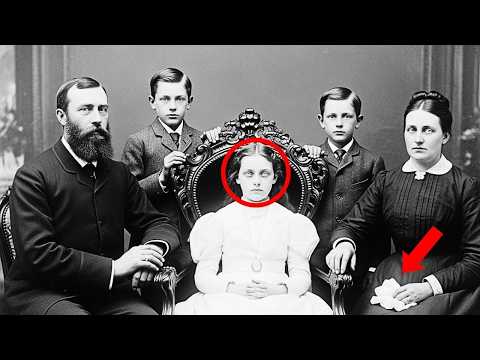
In the library, surrounded by the musty smell of old paper, Elizabeth found it: an 8×10 portrait mounted on thick cardboard, typical of professional studio work from the 1880s. The image showed a family of five in a formal parlor. A bearded father stood on the left, a mother seated on the right, two boys behind an ornate chair. And in the center, seated in that chair, a girl of about six in an immaculate white dress with lace trim.
At first glance, it was a standard Victorian portrait—somber expressions, stiff poses. But something about the composition made Elizabeth pause. She turned the photograph over and found an inscription in faded brown ink: “The Family, September 1883.” Below it, in different handwriting, a pencil notation: “Never forget our angel.”
A chill ran down her spine. “Our angel”—the phrase echoed in her mind. Combined with the girl’s unnatural stillness, it suggested this was no simple family portrait.
Back in her hotel room, Elizabeth examined the digital scan with the careful attention she’d honed over two decades. She adjusted brightness and contrast, zoomed in on each face. The father’s eyes were dark with profound sadness. The mother held a handkerchief, her face turned slightly away. The two boys stood protectively behind the chair, their young faces solemn beyond their years.
But it was the girl who drew her most powerfully. She sat perfectly still, hands folded in her lap, her white dress almost luminous. Her hair was arranged in careful ringlets, a small locket around her neck. Everything about her positioning suggested she was the focal point—the reason this expensive portrait had been commissioned.
Elizabeth zoomed in on the girl’s face, and her breath caught. The eyes were open, but they didn’t focus on the camera or anything in the room. The gaze was fixed and distant, looking through everything into some vast emptiness. The pupils were dilated and oddly reflective, catching the light in a way living eyes don’t.
Victorian children in photographs typically showed signs of fidgeting or slight movement blur—holding still for long exposures was difficult. But this girl was absolutely, impossibly still. Not a single detail showed motion blur. Her hands were positioned with unnatural precision, her head held at an angle that seemed slightly wrong, as if someone had carefully arranged it.
Elizabeth knew what she was looking at. She had seen similar photographs before, though never one so beautifully and elaborately staged. This was a memento mori—a postmortem portrait of a deceased child.
The practice had been common in the Victorian era, particularly in the 1870s and 1880s, when childhood mortality rates were devastatingly high. Photography was still rare and expensive enough that many families had only one or two photographs of their children. Unable to sleep that night, Elizabeth spent hours researching Victorian postmortem photography. What she learned was both fascinating and deeply moving.
In the 19th century, before modern medicine, families faced an approximately 20% chance that their child would die before age five. Diseases like diphtheria, scarlet fever, measles, and pneumonia claimed thousands of children every year. For grieving parents, a photograph of their deceased child was often the only visual remembrance they would have.
Professional photographers developed specialized techniques for postmortem portraits, especially for children. They would position the body carefully, sometimes using hidden stands or supports to keep the subject upright. They would arrange the clothing meticulously, often dressing the child in their best outfit or a special white burial gown. Some photographers would even paint over the eyelids to create the appearance of open eyes, or carefully prop the actual eyelids open and touch up the photograph afterward.
The goal was to create an image that captured the child as the family wanted to remember them—peaceful, beautiful, and in some cases, seemingly alive. Some families chose to pose the deceased child alone, perhaps holding a favorite toy or flower. Others, like the Harrison family, chose to create a final family portrait that showed the entire family together one last time, with the deceased child as the honored center of the composition.
Elizabeth found academic articles and museum collections documenting hundreds of such photographs. She read accounts from Victorian diaries and letters describing the heartbreaking process of arranging these final photographic sessions, usually within a day or two of death before burial. Parents would dress their child with trembling hands, photographers would work with reverent efficiency, and families would gather in the painful, surreal space between death and burial to create this lasting memorial.
The practice was not considered morbid by Victorian standards. Instead, it was seen as a loving act of remembrance, a way to honor the deceased and create a tangible connection to a lost loved one. In an era when most people died at home surrounded by family, death was a more visible and accepted part of everyday life.
Elizabeth understood all of this intellectually and professionally. She had studied Victorian mourning customs extensively. But understanding the historical context didn’t make the photograph any less heartbreaking or the little girl’s empty gaze any less haunting.
The next morning, Elizabeth contacted the estate executor and explained that she needed to examine the Harrison family documents more thoroughly. The executor, a local attorney named James Morrison, readily agreed and arranged for her to spend the following day at the Thornton Mansion going through the family papers.
Elizabeth arrived early on Monday morning carrying her laptop, camera, and archival supplies. James had set up a work area in the library where she had first discovered the photographs. He brought her several additional boxes of documents that had belonged to Margaret Thornton, whose mother had been born into the Harrison family—making Margaret the great-great-granddaughter of the family in the photograph.
Elizabeth spent the morning carefully sorting through letters, receipts, birth certificates, death certificates, property deeds, and other documents spanning more than a century of Harrison family history. Around noon, she found what she was looking for: a family Bible, its leather cover worn and cracked with age, containing handwritten records of births, marriages, and deaths dating back to 1840.
She opened the Bible carefully, her hands steady despite her growing anticipation. The birth record showed that the Harrison family, headed by Robert Harrison and his wife Catherine, had five children. William born in 1873, Charles born in 1875, Sarah born in 1877, and then two more children born in 1885 and 1887—after the photograph was taken.
Elizabeth’s pulse quickened. Sarah would have been six years old in 1883, matching the age of the girl in the white dress. She turned to the death records with a sense of inevitable dread. And there it was, written in careful, grief-stricken script: Sarah Elizabeth Harrison, born April 3rd, 1877, died September 12th, 1883, age 6 years, 5 months. Taken from us by scarlet fever. Our beloved angel has gone to heaven.
Elizabeth sat back in her chair, the Bible open before her, and felt tears prick her eyes. September 1883. The photograph was dated September 1883. The timing meant the photograph had been taken within days of Sarah’s death—perhaps even on the day of her funeral. The beautiful white dress was likely her burial gown. The locket around her neck probably contained a lock of hair or a miniature portrait of her parents.
And the family gathered around her—her grieving father, her devastated mother, her protective older brothers—had assembled one final time to create a lasting memorial of their complete family before Sarah was laid to rest.
Elizabeth continued searching through the documents and found a letter written by Catherine Harrison to her sister in Boston, dated October 15th, 1883, just a month after Sarah’s death. The letter was written in a shaking hand and stained with what might have been tears. Elizabeth read it with a heavy heart, feeling like an intruder on private grief, but knowing this document was crucial to understanding the photograph’s context and significance.
Catherine’s letter provided a window into the devastating loss the family had experienced and the circumstances that led to the creation of the photograph. Elizabeth transcribed it carefully, preserving the original spelling and punctuation, conscious that she was documenting an invaluable historical and human record.
“My dearest sister Elizabeth,” the letter began. “I write to you from a darkness I never imagined possible. Our sweet Sarah, our precious angel, was taken from us on the 12th of September. The scarlet fever came so suddenly, so viciously. She was playing in the garden on Monday morning, laughing and picking flowers. By Tuesday afternoon, she was burning with fever. By Wednesday evening, she complained her throat hurt terribly. By Friday, we could barely recognize her for the rash and the suffering. By Wednesday of the following week, she was gone. Six days from the first symptom to death. Six days to lose the light of our lives.”
The letter continued, describing the funeral arrangements and then explaining the photograph. “Robert insisted we have Mr. Whitmore make a photograph of our family complete one final time before we laid Sarah to rest. I confessed I could not bear the thought, could not imagine sitting for a portrait with my dead child dressed and positioned as if she still lived. It seemed unnatural, even grotesque in my grief-maddened state. But Robert was insistent, and his mother supported him, saying we would regret not having this remembrance. She said that in years to come, we would treasure having Sarah in a family photograph, that it would help us remember her face when memory begins to fade.”
Catherine described the painful process of preparing for the photograph. “We dressed Sarah in the white gown I’d made for her to wear at her cousin’s wedding next spring. She never got to wear it in life, so she wears it now in death. I placed her grandmother’s locket around her neck and arranged her beautiful golden curls as I had done every morning of her life. Mr. Whitmore came to our home, rather than having us bring Sarah to his studio, a kindness we greatly appreciated. He was respectful and gentle, treating Sarah with as much care as if she still breathed.”
The letter revealed details about how the photograph was taken. “Mr. Whitmore positioned Sarah in my mother’s chair, the one with the carved back that Sarah always loved. He used a device behind the chair to help support her, keeping her upright and positioned naturally. He arranged her hands in her lap just as she often sat when listening to stories. Then he asked us to gather around her. Robert stood behind her with his hand on the chair, protective even in death. Our boys, William and Charles, placed their hands on the chair as well, and I sat to the side, unable to look directly at the camera or at Sarah without dissolving completely.”
Catherine described the photographer’s technique. “Mr. Whitmore took great pains with Sarah’s eyes. He opened them gently and used some substance to keep them from closing. Then, afterward, he said he would touch up the photograph to make them look more natural. He promised us it would appear as if she were simply sitting quietly, perhaps a bit sleepy, not as if she had passed from this world. I’m not certain whether I find this comforting or disturbing, but I trust it was done with loving intent.”
Intrigued by the mention of Mr. Whitmore, Elizabeth began researching Victorian photographers in Salem during the 1880s. She found references to Edmund Whitmore, who had operated a photography studio on Essex Street from 1875 to 1895, and who had developed a reputation for his sensitive handling of memorial photography.
Elizabeth discovered that Whitmore had advertised his services specifically for memorial and mourning portraits in local newspapers, and that he had written several letters to photography journals of the era describing his techniques and philosophy. Through the Salem Historical Society, Elizabeth was able to access digitized copies of these letters, which provided remarkable insight into how Victorian photographers approached the delicate task of postmortem portraiture.
In a letter published in The Photographic Times in 1884, just a year after the Harrison portrait, Whitmore had written: “The photographer who undertakes memorial portraiture must approach the work with the utmost reverence and sensitivity. We are not merely creating an image, we are providing grieving families with their final and often only photograph of a beloved family member. This is particularly true when photographing deceased children, where the parents’ anguish is beyond description.”
Whitmore described his technical approach. “For a seated pose, I employ a specially designed support system that attaches discreetly behind the chair, providing invisible assistance in maintaining an upright and natural posture. The deceased’s clothing should be arranged with meticulous care, and the hands positioned gently in poses that reflect the individual’s character in life. For children, I often suggest holding a favorite toy or flower, or simply folding the hands in peaceful repose.”
The most revealing passage addressed the question of the eyes. “The matter of the eyes is perhaps the most sensitive aspect of memorial photography. Some photographers prefer to photograph the deceased with eyes closed, suggesting peaceful sleep. Others, at the family’s request, will carefully open the eyes and use various methods to keep them in that position during the exposure. I have found that families often prefer the appearance of open eyes as it creates the impression of the loved one still present and engaged with the family. However, it requires considerable skill in the subsequent development and touching up to make the eyes appear natural rather than merely open. I use fine brushwork to add light and depth to the eyes in the final print, creating an appearance of life where life has departed.”
Whitmore also addressed the emotional dimension of his work. “I confess that photographing deceased children affects me deeply, no matter how many times I perform this service. To see parents holding their composure through sheer force of will, to arrange the small body of a child who should be running and playing, to capture in silver and paper the last visible evidence of a young life extinguished too soon. This work requires not just technical skill, but emotional fortitude. Yet, I consider it perhaps the most important service I provide. These photographs become treasured family heirlooms, handled with reverent care and passed down through generations. They serve as proof that the deceased lived, was loved, and is remembered.”
Elizabeth sat back from her laptop, deeply moved by Whitmore’s words. He had clearly understood the profound importance of what he was doing—not creating a macabre spectacle, but providing a genuine service to grieving families in an era when such photographs were often the only visual record of a loved one’s existence.
As Elizabeth continued to research the Harrison family, a more complete picture emerged of who they were and how Sarah’s death had affected them. Through census records, city directories, property deeds, and newspaper archives, she traced the family’s history before and after that terrible September in 1883.
Robert Harrison had been a successful merchant in Salem, operating a dry goods store on Washington Street. The family lived in a comfortable three-story home in a prosperous neighborhood. By all accounts, they were respected members of the community, active in their church and various civic organizations. Catherine came from a similarly respectable family and was known for her charitable work with the Salem Female Charitable Society, which provided assistance to widows and orphans.
The family’s two sons, William and Charles, had both survived to adulthood—itself a fortunate outcome in an era when childhood mortality claimed so many. William had gone on to become a lawyer, and Charles had followed his father into the merchant business. Both had married and had children of their own, and Elizabeth found evidence that both men had remained in Salem throughout their lives.
But Sarah’s death had clearly affected the family profoundly. Elizabeth found a newspaper article from 1884, a year after Sarah’s death, reporting on a generous donation the Harrisons had made to the Salem Hospital, specifically to support research into childhood diseases and to establish a ward for children suffering from contagious illnesses. The article quoted Robert Harrison as saying, “If our loss can prevent other families from suffering as we have suffered, then perhaps some meaning can be found in our tragedy.”
Catherine had become even more involved in charitable work after Sarah’s death, particularly with organizations supporting children. Elizabeth found records showing that Catherine had helped establish a free school for poor children in Salem and had been a founding member of the Salem Children’s Aid Society. It seemed Catherine had channeled her grief into helping other children, perhaps finding some comfort in protecting and nurturing children who still lived when her own daughter could not be saved.
Elizabeth discovered something else significant in the family papers: a diary kept by William Harrison, Sarah’s older brother, started when he was fifteen in 1888—five years after Sarah’s death. Several entries referenced his lost sister and the photograph that had been taken after her death.
In an entry dated September 12th, 1888, the fifth anniversary of Sarah’s death, William wrote: “Five years today since we lost Sarah. Mother brought out the photograph this morning as she does every year on this date. I can barely look at it. I know why father insisted on having it made, and I understand that it brings mother some comfort to see us all together one last time. But I remember that day too clearly—the awful stillness of Sarah’s body, the terrible pretense of arranging her as if she were merely sitting quietly. I remember the photographer’s gentle voice as he positioned her, and I remember mother’s silent tears throughout the entire process. The photograph captures our family, yes, but it also captures our grief frozen forever in silver and paper.”
Elizabeth knew that to properly understand and present the Harrison family photograph, she needed to place it within the broader context of Victorian mourning customs and postmortem photography practices. She spent several days researching academic studies on the subject and consulting with colleagues who specialized in 19th-century cultural history.
What she learned reinforced that the Harrison family’s decision to commission a memorial photograph of Sarah was not unusual or morbid by the standards of their time, but rather a common and accepted practice rooted in the realities of Victorian life and death.
In the 1880s, childhood mortality in the United States remained tragically high despite advances in medicine and public health. Scarlet fever, which had killed Sarah, was one of the leading causes of childhood death, along with diphtheria, measles, whooping cough, and pneumonia. Families of all social classes faced the very real possibility of losing one or more children.
The emotional impact was devastating, but Victorians had developed elaborate mourning rituals and customs to help families navigate their grief. These customs included specific mourning clothing worn for prescribed periods, memorial jewelry made from the deceased’s hair, death masks, and memorial photographs.
Photography itself was still relatively new in the 1880s. The daguerreotype process had only been introduced in 1839, just forty-some years earlier. While photography had become more common and affordable by the 1880s, it was still expensive enough that many families, especially those of modest means, might commission only a handful of photographs in their entire lives. For families with young children, this often meant that a postmortem photograph might be the only photograph they would ever have of a deceased child.
Elizabeth found statistics that were both illuminating and heartbreaking. Historical studies estimated that between 30 and 40% of all photographs taken in the Victorian era were postmortem portraits. The practice was so common that many photography studios kept special props, furniture, and backdrops specifically for memorial portraits. Some photographers, like Edmund Whitmore, even specialized in this type of work.
The practices varied depending on regional customs, family preferences, and the age of the deceased. Infants were often photographed being held by their mother or lying in a cradle, sometimes with flowers arranged around them. Older children might be photographed alone, seated in a chair or lying on a bed or sofa, often dressed in white or in their best clothing. Some photographs showed the deceased with eyes closed in peaceful repose, while others, like Sarah’s portrait, showed them with eyes open, creating an eerie semblance of life.
Family portraits including the deceased member, like the Harrison photograph, represented a particular subset of memorial photography. These portraits were often commissioned when a family wanted to create one final image showing the family unit complete before burial separated them forever. Such photographs required considerable emotional fortitude from the living family members, who had to maintain their composure while posing alongside the body of their deceased loved one.
Elizabeth also learned about the technical challenges photographers faced in creating these images. Bodies had to be photographed relatively quickly after death before decomposition made the process impractical. Rigor mortis had to be worked through to position the body naturally. Photographers used various props and supports to maintain natural-looking poses, and they employed considerable skill in lighting, composition, and post-processing to create images that appeared peaceful rather than obviously depicting death.
After weeks of research, Elizabeth had compiled a comprehensive understanding of the Harrison family photograph, its historical context, the family’s story, the photographer’s techniques, and the cultural practices that made such images both common and meaningful in Victorian America. She knew this photograph, with its detailed documentation and compelling human story, would be valuable for education and historical understanding.
Elizabeth prepared a detailed proposal for a small exhibition at the Smithsonian focused on Victorian mourning photography and childhood mortality, with the Harrison family portrait as the centerpiece. She presented her proposal to the museum’s curatorial board in January 2025, including the photograph itself, her research findings, and an explanation of why this particular image was historically and educationally significant.
The board’s response was mixed and reflected the sensitivity surrounding postmortem photography, especially of children. Some members were enthusiastic about the educational value of the exhibition, arguing that understanding Victorian attitudes toward death and mourning was important for comprehending 19th-century American life. Others expressed concern about displaying what some visitors might find disturbing or disrespectful, particularly an image of a deceased child.
After considerable discussion and debate, the board approved the exhibition with specific guidelines. The photograph would be displayed with extensive contextual information explaining Victorian mourning customs, childhood mortality rates, and the cultural significance of memorial photography. Warning signs would inform visitors about the sensitive nature of the content. The exhibition would emphasize the historical and cultural education aspects, while treating the Harrison family and little Sarah with appropriate dignity and respect.
The exhibition, titled Remembered in Light: Victorian Memorial Photography and Childhood Loss, opened at the Smithsonian in April 2025. Elizabeth had designed it to guide visitors through a careful educational journey, starting with information about Victorian childhood mortality and public health, then explaining mourning customs and rituals, and finally presenting several examples of memorial photographs, including the Harrison family portrait.
The Harrison photograph was displayed in a dedicated alcove with subdued lighting. The wall text told Sarah’s story based on Elizabeth’s research—her birth in 1877, her death from scarlet fever in 1883 at age six, her family’s grief, and the creation of this memorial photograph as a lasting remembrance. The text included excerpts from Catherine Harrison’s letter and William’s diary entry, providing the family’s own voices and perspectives. A timeline showed the progression of the photograph from its creation in 1883 through its preservation in family collections to its rediscovery in 2024.
Elizabeth had also prepared an educational pamphlet explaining Victorian postmortem photography practices in detail, including technical information about how such photographs were created, statistics on childhood mortality in the 19th century, and scholarly articles on Victorian mourning culture. The goal was to help visitors understand that what might appear morbid to modern sensibilities was, in its historical context, an act of love and remembrance.
The exhibition opening drew significant media attention, with coverage ranging from thoughtful historical pieces to more sensationalized headlines about “creepy” Victorian death photographs. Elizabeth had anticipated this range of responses and was prepared to address both the genuine historical interest and the tendency toward morbid fascination that postmortem imagery could sometimes provoke.
In interviews with journalists and historians, Elizabeth emphasized the human story behind the photograph. “This isn’t about shock value or macabre curiosity,” she explained to a reporter from the Washington Post. “This is about understanding how our ancestors dealt with loss, particularly the devastating loss of a child. The Harrison family’s photograph is heartbreaking, yes, but it’s also a testament to their love for Sarah and their desire to preserve her memory. They wanted future generations to know that Sarah existed, that she was loved, and that her brief life mattered.”
The exhibition attracted diverse visitors with varying reactions. Some found the content deeply moving, standing before the Harrison family portrait with tears in their eyes as they absorbed the story of a family’s loss more than 140 years ago. Parents in particular often responded with intense emotion, imagining their own children in Sarah’s place and understanding viscerally why the Harrison family had commissioned this photograph despite the pain of creating it.
Other visitors expressed discomfort or confusion about the practice of photographing the dead, particularly children. Elizabeth and the museum docents were prepared for these reactions and used them as opportunities for education, explaining how Victorian Americans had a very different relationship with death than most modern Americans do—living in an era when death occurred primarily at home and when most people would see deceased family members prepared for burial, rather than having death sanitized and hidden away in funeral homes and hospitals.
School groups visited the exhibition as part of units on 19th-century American history and public health. Teachers used the Harrison family photograph as a focal point for discussions about childhood mortality, advances in medicine, changing cultural attitudes toward death, and the importance of historical empathy—understanding that people in different times and places had different customs and values that made sense in their context.
Several descendants of the Harrison family contacted Elizabeth after learning about the exhibition. Among them was David Harrison, a great-great-great-grandson of Robert and Catherine Harrison, living in California. David had known about Sarah’s death—it was part of the family history passed down through generations—but he had never seen the memorial photograph.
“Reading my ancestors’ words about losing Sarah and seeing this photograph that meant so much to them has given me a profound connection to family members I never knew,” David told Elizabeth during his visit to the exhibition. “I understand now why they held onto this image for so long, even though looking at it must have been painful. Sarah was not forgotten. She was remembered and loved.”
Elizabeth had arranged for the Harrison family portrait to be professionally digitized at the highest possible resolution, with the original photograph then carefully preserved in climate-controlled archival storage. The digital version was made available through the Smithsonian’s online collections, accompanied by the full context of Sarah’s story and the extensive research Elizabeth had conducted.
The photograph quickly became one of the most viewed items in the museum’s digital archives, generating discussions about Victorian culture, mourning practices, and childhood mortality across social media platforms and educational websites. Not all the online attention was thoughtful or respectful. Some users shared the image without context, treating it as merely creepy or disturbing content. Elizabeth worked with the Smithsonian’s digital team to ensure that the photograph could not be easily separated from its historical context and educational information, though she acknowledged they couldn’t control how people shared or discussed the image once it entered the public sphere.
As the exhibition continued through the summer and fall of 2025, Elizabeth reflected on what the project had taught her about history, memory, and the power of photographs to connect us across time. “The Harrison family portrait began as what appeared to be a simple family photograph,” she told an audience at a symposium on Victorian material culture. “For decades, even centuries, people who saw it probably didn’t notice anything unusual. But once you know what you’re looking at, once you see little Sarah’s distant gaze and understand that this is a memorial portrait created days after her death from scarlet fever, the photograph transforms from a curious historical artifact into a deeply human story about love, loss, and remembrance.”
She continued: “Sarah Harrison lived only six years, but her family’s decision to include her in this final family portrait ensured that she would be remembered more than 140 years later. We know her name, we know how she died, we know that her mother arranged her golden curls and dressed her in a white gown made for a wedding she would never attend. We know that her father stood behind her protectively, even in death, and that her brothers placed their hands on her chair in a final act of brotherly care. And we know that her loss devastated her family and motivated them to help other children through their charitable work.”
Elizabeth concluded her talk by addressing the tension between historical education and sensitivity to distressing content. “There’s always a question when presenting material like this: Is it appropriate? Is it respectful? Does it serve an educational purpose, or is it merely exploiting tragedy? I believe strongly that the Harrison family photograph, presented with full context and with deep respect for Sarah and her family, serves an important educational purpose. It helps us understand not just Victorian mourning practices, but the universal human experience of loss and the ways people throughout history have sought to remember and honor those who died too soon.”
The photograph that had seemed so innocent for so long—just a Victorian family sitting for a formal portrait—had revealed its heartbreaking secret when historians finally noticed the little girl’s distant gaze and understood what they were truly seeing. Sarah Harrison’s memorial portrait had become a window into the past, teaching new generations about history, mortality, and the enduring power of love to transcend even death.
In the years following the exhibition, the Harrison family photograph became a frequently cited example in studies of Victorian mourning culture and memorial photography. It appeared in textbooks, was featured in documentaries about 19th-century American life, and inspired additional research into the experiences of families who lost children during the era of high childhood mortality. Sarah’s story, preserved in that single photograph taken in September 1883, continued to touch hearts and educate minds more than 140 years after her brief life ended.
The photograph remained in the Smithsonian’s permanent collection—a testament to the Harrison family’s love for their daughter, to the Victorian practice of memorial photography, and to the power of historical research to reveal stories hidden in plain sight for generations. And somewhere in that image, if you looked closely enough at little Sarah’s peaceful face and distant gaze, you could almost imagine that she knew her family’s act of love would ensure she would never truly be forgotten.
Elizabeth returned to Salem one last time, in the autumn of 2026, to place a single white rose on Sarah’s weathered headstone. The inscription had softened with moss, but the words remained legible: “Our beloved angel has gone to heaven.”
She stood in the quiet, listening to wind move through the old trees, and thought of the family who had gathered around that chair, holding still for a photograph that would outlive them all.
Later, at the Thornton Mansion, James Morrison handed her a small envelope found while clearing the attic. Inside was a lock of golden hair, tied with faded white ribbon, and a note in Catherine’s hand: “For whoever finds our Sarah—know she was loved.”
Elizabeth placed the lock of hair in the archives beside the photograph, completing a story that had waited 143 years to be told.
What would you have done, standing in that parlor in 1883—turned away, or held still for the photograph?
Report this article
Select a reason for reporting:






