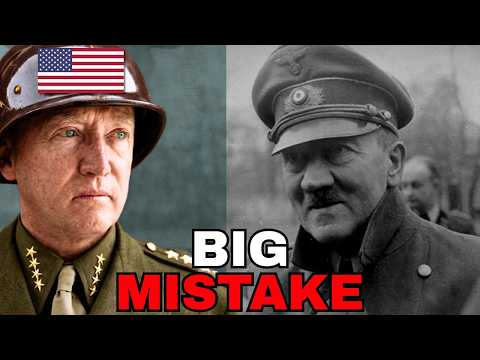
Just before midnight on September 18, 1944, an American outpost near the French village of Laisy heard the unmistakable clank of heavy tracks in the dark. They called for artillery, and the night fell silent again. But the silence was a lie. At dawn, Captain William Dwight drove straight into the rear of a German tank column, swallowed by thick Lorraine fog. He radioed his commander, Lieutenant Colonel Creighton Abrams: 42 Panther tanks were out there, and behind them, an entire German Panzer army personally assembled by Adolf Hitler to stop George Patton.
Speed is easy to admire when nobody is hitting back. The real test of a commander is what he does when the other side finally lands a punch. For Patton, that moment was Arracourt—the biggest tank-versus-tank fight the US Army had in Western Europe until the Battle of the Bulge.
On September 12, Patton was ordered to go on the defensive if he couldn’t cross the Moselle River in strength by the 14th. He crossed anyway, and on the 16th, he handed out objectives: his 12th Corps would race to the Rhine, spearheaded by the 4th Armored Division. But the 4th Armored’s commander, Major General John Wood, warned that supplies were a major problem. “This will not be a very fast operation, no blitz,” he said. Those words would prove prophetic.
That same week, Hitler picked General Hasso von Manteuffel to lead the Fifth Panzer Army, cobbled together from shattered units. Manteuffel protested that his force was too weak, but he was told to attack on the 18th—the same day Patton planned to advance. Two plans were racing toward each other, and they collided near Lunéville.
German Panthers hit the American cavalry south of Lunéville. American shells bounced off the German armor, and three assault guns were destroyed in minutes. The squadron commander was killed, and Colonel Read was severely wounded. Yet the official history notes that neither Patton nor his corps commander was greatly concerned. The attack toward the Rhine stayed on the books.
That night, Combat Command A of the 4th Armored, under Colonel Bruce Clark, was spread thin around Arracourt. Captain Richard Lamason’s tank company sat out front at Lezey. At midnight, Manteuffel phoned his corps commander with orders to attack in the morning and threats of severe punishment if they failed.
The column Dwight ran into was the 113th Panzer Brigade—42 Panthers pushing through heavy fog. The fog hid the German tanks from American planes, but it also forced them to fight up close where the Panther’s long-range gun gave no advantage. South of Lezey, two Shermans destroyed three Panthers at 75 yards. Dwight went back out with four tank destroyers; three were knocked out, but they took seven German tanks with them. Lamason raced four Shermans to a ridge and knocked out eight Panthers in two engagements.
The second German brigade never showed up—a patriotic French farmer had sent it the wrong way. In the afternoon, two companies of the 37th Tank Battalion hit the Germans in the flank, destroying nine Panthers for three of their own. That evening, Patton came down from headquarters and sat with General Wood. Instead of digging in, they agreed Combat Command A would resume its push east the next morning.
By its own count, Combat Command A had destroyed 43 German tanks and lost six men killed. What makes this unusual is not that Patton held his ground—it’s that he spent the whole battle trying to leave it.
The next morning, his columns were already driving northeast when German tanks hit Arracourt again. Colonel Clark had to turn his entire command around to clear the area once and for all. On the German side, Manteuffel begged to call off the attack. He got a reprimand for lacking the offensive spirit.
On the 21st, Hitler used the failure as an excuse to fire the army group commander, General Johannes Blaskowitz. The purge only tightened the leash on Manteuffel, who was now expected to salvage something from a plan already in ruins.
On the 22nd, the fog came back. German patrols laid white tape right up to the American cavalry lines, and their tanks followed it in—some to within 75 yards before anyone saw them. Then the sun came out. American P-47s flew in, and Abrams counterattacked. From a hill looking down into the valley, his tanks and the artillery destroyed 14 German tanks. The German brigade commander, Colonel Heinrich Bronzart von Schellendorf, was mortally wounded.
Manteuffel begged the Luftwaffe for help. Nobody answered. By nightfall, the 111th Panzer Brigade—the unit that had opened the battle at Lunéville—had seven tanks and 80 men left.
On the 23rd of September, the order Patton had been sure he’d never need arrived anyway. Bradley told him the Third Army was going on the defensive. The supplies were going north to the Allied push into Holland. Patton called it one of the bad days of his military career. But he obeyed, and his forward units pulled back to a line they could hold.
The Germans kept coming for another week because Hitler refused to cancel the attack. On the 26th, when the 4th Armored pulled its line back slightly under the defensive order, Manteuffel reported his troops’ uncontested entry into two empty villages as victories. The last big fight came on Hill 318, where Germans crept up through old trenches from the First World War. By the 29th, they pulled back for good. The Fifth Panzer Army was finished as an attacking force.
So, the number everyone argues about: how many German tanks were lost at Arracourt? Online, you’ll find 285. You’ll find approximately 200. You’ll find 86 destroyed and 114 damaged. Some timelines even have American planes breaking the attack in the fog on day one. The official history is more careful. The fog protected the German tanks from the air. The big P-47 strikes came later. And on German losses, the official historian wrote that they cannot be accurately determined.
What he could say was that two Panzer Brigades had been wrecked as fighting units, and the Fifth Panzer Army got no closer to the Moselle. Sometimes the most honest number is the one nobody can give you.
So what did George Patton do when Hitler sent a Panzer Army after him? On the first day, he barely noticed. After the fog battle, he ordered his spearhead to keep going east. When his own side ordered him to stop, he called it a bad day—and pulled back.
Remember what he believed on September 12: no German reserves. He was wrong. Hitler found a whole Panzer Army. But in open country against the 4th Armored Division, that army broke.
And John Wood’s two words? No blitz. Wood was right. Arracourt was a slugging match in fog and rain, one hill at a time.
The last word goes to the other side. The ground Patton gave up wasn’t taken by German tanks—he gave it up because his own side sent the supplies north. And the German general who lost the battle called it a victory.
Three months later, Manteuffel and the 4th Armored Division would meet again in the Ardennes. Different fog, same two opponents.
So tell us—when the fog rolls in and the plan falls apart, do you keep pushing east like Patton, or do you dig in and wait?
Report this article
Select a reason for reporting:






