Major General Richard Caldwell was a man who knew war. Two stars on his collar, armor commands in Korea, doctrine penned at the Command and General Staff College—he had earned the right to be certain. So when he stared at a reconnaissance photo of Australian soldiers in their slouch hats, pinned up on the left side, camouflage patterns that looked wrong, equipment that made no sense, he said the words that would haunt him for the rest of his career.
“Look at those stupid hats.”
The operations tent at Long Binh fell silent. His intelligence officer shifted uncomfortably. Outside, the war in Phuoc Tuy Province was going badly—American patrols walking into ambushes with mathematical regularity, kill ratios trending in the wrong direction. And yet the Australians, with their ridiculous hats and incomprehensible tactics, were reporting enemy kills at a rate of 35 to 1.
It was impossible. It had to be a lie.
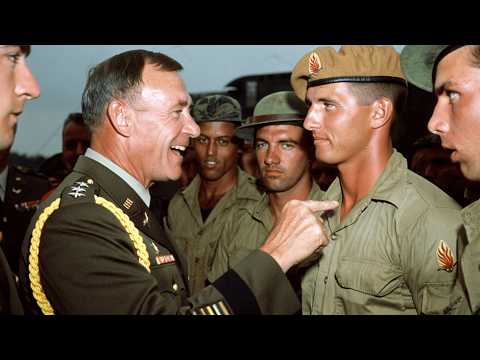
Caldwell was determined to see for himself. He requested a liaison visit, expecting the Australians to roll out the red carpet for a two-star general. Instead, Brigadier O.D. Jackson read the request, lit a cigarette, and let it burn halfway down before speaking. “Tell the Americans they’ll deploy with our patrols. Full field conditions. No special accommodation.” It was a polite way of saying no. Caldwell accepted within two hours.
Three weeks later, he would sit across a jungle clearing from an Australian SAS patrol commander and apologize so completely, so abjectly, that the Australian would actually look embarrassed for him. But that moment was still three weeks away.
At Nui Dat, Caldwell stepped off a Caribou transport into heat that hit like a physical force. He was met by Captain Morrison, who saluted and informed him he’d be deploying with an SAS patrol the next morning—deep insertion, no fire support, ten days in the Long Hai hills. Then a quartermaster sergeant looked at his American jungle boots and said, “Those won’t work, sir. They’ll make too much noise. The SAS won’t take you into the field in those.”
Caldwell felt his jaw tighten. He was a two-star general being lectured about footwear. But the sergeant’s expression didn’t change. “Your noise is their noise. Your mistake is their death.”
The tent went quiet. Caldwell took a breath. “What do you recommend, Sergeant?”
An hour later, his American kit was gone—replaced by Australian boots, a collapsible canteen, and an L1A1 rifle he’d never fired. That night, he lay on a cot inside the SAS compound, field-stripping the unfamiliar weapon by touch, listening to the jungle hum with insect noise and distant artillery. He slept badly.
At 0430, a hand shook his shoulder. “Time, sir.”
The briefing tent was lit by a single red lens. Six men sat on ammunition crates. None stood. None saluted. The patrol commander, Sergeant John McKay, gestured to an empty crate. “Have a seat, General. I’ll be running this patrol.”
McKay laid out the mission: ten days, reconnaissance only. Locate and map enemy caches. Avoid contact. “We’re not here to fight. We’re here to watch.” Then he turned to Caldwell. “Can you move silently for extended periods? Can you go twelve hours without talking? If I signal you to freeze, can you stop midstep and hold that position for thirty minutes?”
Caldwell hesitated. “I’ll do my best.”
“Your best could get us killed, sir. I need a yes or a no.”
“Yes.”
McKay studied him for a long moment. Then he nodded. “We move out in twenty minutes. Eat something now. Once we’re in the field, we don’t cook. Cold rations only.”
At 0455, the patrol stepped through the wire and into the tree line. Caldwell had spent a year in Vietnam. He had run patrols. But thirty seconds into the jungle with the Australian SAS, he understood that he had never actually been in the jungle at all.
The Americans moved through the jungle like they were trying to prove they owned it—cutting trails, talking on radios, calling in firepower to back up their noise. The Australians moved like they were trying to become the jungle. McKay’s pace was glacial. Three steps, pause, listen. Three more steps, pause. The intervals were irregular—sometimes five seconds, sometimes two minutes. Caldwell strained to hear what McKay was hearing and heard nothing but insects and birds.
After twenty minutes, they had moved maybe three hundred meters. Caldwell’s legs burned from the controlled, deliberate stepping. American patrols covered three kilometers in that time. Davies, the man in front of him, stopped midstep, hand up in a fist. Caldwell froze. His right foot was in the air. He held it. Five minutes passed. His thigh began to scream. Sweat ran into his eyes. He did not move.
McKay’s hand dropped. The patrol moved again.
At 0730, McKay found a position behind a fallen tree and signaled the patrol down. They dropped into cover so smoothly that Caldwell barely saw them move—one second upright, the next disappeared into the jungle floor. Caldwell lowered himself more clumsily. McKay was beside him instantly, mouth next to his ear, the whisper almost subliminal. “You’re moving too loud. Your pack’s shifting. Tighten the straps.”
Caldwell adjusted the pack. McKay nodded and melted away. They stayed in that position for three hours. The jungle sounds changed around them—birds quieted, insects shifted frequency. At 10:15, Caldwell heard voices. Vietnamese, speaking quietly but clearly, maybe fifty meters north.
The SAS did not move. The voices came closer. Four men in black pajamas carrying AK-47s, talking casually. One laughed. They passed within thirty meters of the Australian position and saw nothing. The SAS did not engage. They barely breathed. The voices faded. McKay waited another hour before signaling movement.
They continued north, the pace unchanged. Every fifty meters McKay stopped and listened. Once he backtracked two hundred meters because something about the terrain ahead did not feel right. At 1400 they stopped for water. Each man drank silently from collapsible canteens that made no noise. Caldwell understood now why the sergeant had insisted on Australian kit. Every piece of American equipment would have announced their presence like a brass band.
They made camp at 1830 in a position McKay selected after thirty minutes of reconnaissance. The site was invisible from any direction unless you were standing directly in it. No fire, no hot food. They ate cold rations in silence and settled into defensive positions as darkness fell.
McKay materialized beside Caldwell. “First night’s always the hardest. You did well.”
“We barely moved.”
“We moved exactly as far as we needed to without being detected. That’s the job, General. We’re not here to cover ground. We’re here to survive long enough to bring back intelligence.”
Caldwell wanted to argue. He had written papers on patrol tactics. But lying in the jungle darkness, he could not find the words. McKay continued, “Tomorrow we move deeper. The terrain gets worse. If you need to abort, tell me now. No shame in it.”
“I’ll keep up.”
“We’ll see.”
The night was endless. Caldwell took a two-hour watch from 0200 to 0400, staring into darkness so complete he could not see his hand in front of his face. He heard movement everywhere—animals, wind, the jungle breathing. He had no idea which sounds were dangerous. At 0400, Davies relieved him without a word.
They moved out at first light, the pace even slower than the previous day. The jungle thickened. McKay spent twenty minutes studying a section of trail before signaling a wide detour. Caldwell saw nothing unusual. Later, Davies would explain that McKay had spotted scuff marks indicating recent Viet Cong movement and did not want to risk using the same route.
On the third day, they found the first cache.
McKay froze midstep. His hand came up—not the routine halt, but contact. Davies moved forward like liquid shadow and returned five minutes later. The patrol advanced to a position overlooking a clearing that was not natural. Trees had been cut and repositioned for camouflage. Underneath, barely visible, were stacked wooden crates—ammunition, rice, medical supplies. A full battalion cache.
McKay photographed it from six angles, sketched the position, recorded coordinates. Fifteen minutes, then withdrawal. “We’re not destroying it?” Caldwell whispered. McKay’s look was withering. “We’re six men in enemy territory. We photograph it, map it, extract, and call in an air strike next week after we’re long gone. Patience, General. Patience is how you survive.”
By the fourth day, Caldwell understood the method. The SAS were not hunting the Viet Cong—they were mapping the invisible infrastructure of the enemy. On the sixth day, they made accidental contact. A sentry saw them at the same instant McKay saw him. Four seconds of violence—three Viet Cong dead, no Australian casualties—but the patrol was compromised. They broke contact and moved through the night, finally crawling into a drainage ditch choked with thorns.
At dawn, the Viet Cong searched. A soldier walked along the ditch’s edge, his AK-47 at the ready, looking directly at the vegetation hiding them. He saw nothing. The patrol had become part of the landscape.
They extracted two days early. Back at Nui Dat, filthy and eight pounds lighter, Caldwell faced Brigadier Jackson. “I need to apologize, sir. Three weeks ago I said, ‘Look at those stupid hats.’ I was wrong.” He turned to McKay. “Sergeant, I owe you my life several times over.”
“You kept up, sir. That’s more than most can say.”
Caldwell wrote a thirty-page report that became foundational to American special operations doctrine. The photograph stayed on his desk until he died—six mud-covered men, slouch hats, and the jungle that had hidden them from an enemy who never saw them coming. The slouch hat was not stupid. It was genius. And the lesson Caldwell learned in eight days would outlive the war itself.
Have you ever had a belief shattered by firsthand experience? Share your story below.
Report this article
Select a reason for reporting:






