The mess hall door swung open, and the smell hit first—smoke and char and something sweet underneath. Mesquite wood had been burning low and slow since dawn, and now it wrapped around the room like a secret. Thirty-seven German women sat at long tables, staring at their trays. The beef glistened with a sauce the color of rust. They had refused meat for three days.
Lieutenant Sarah Mitchell watched as Greta Hoffman, the woman who had organized the food protest, lifted a rib to her mouth. The silence that followed held transformation.
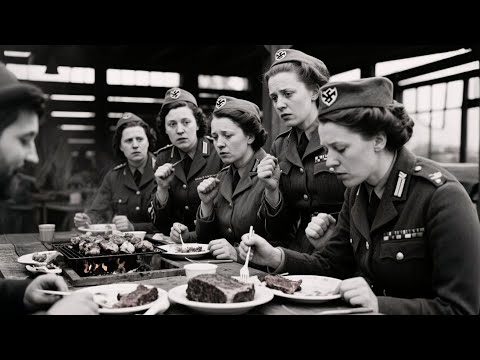
Camp Swift, Texas. August 1944. The women had arrived from a facility in New Mexico, transferred to this sprawling camp outside Austin where mesquite and cedar grew thick and summer heat felt like punishment. They were an unusual group—German military auxiliaries captured in North Africa, clerical workers and communication specialists and medical assistants swept up when Axis resistance collapsed in Tunisia.
Greta Hoffman was thirty-two, from a farming village outside Stuttgart. She had joined military service in 1941 when her husband was conscripted for the Eastern Front. “We cannot eat this meat,” she had told Mitchell three days earlier. “In Germany, animals are gone. Eating beef feels wrong when our families starve.”
Mitchell had consulted Captain William Foster, the camp commander. The Geneva Conventions required proper feeding but didn’t specify how to handle prisoners refusing food for ethical reasons. They agreed to provide vegetarian meals temporarily, with medical monitoring. But the women ate without pleasure—food as fuel, not sustenance.
Margarite Klene, a twenty-eight-year-old nurse from Berlin, understood the protest intellectually but struggled emotionally. She knew the women needed protein. She also knew that what you ate connected you to identity and values. El Fischer, the oldest at forty-one, thought the whole thing foolish but participated from solidarity. She had managed supply logistics for the Africa Corps and knew American abundance wasn’t theft from German scarcity.
The breakthrough came unexpectedly through Sergeant James Caldwell, a guard from Lockhart, Texas, whose family had been barbecuing beef for three generations. “Ma’am,” he said at a staff meeting, “I think maybe they just haven’t had good beef. German cooking is different from ours. Maybe they don’t know what Texas barbecue is.”
Mitchell was skeptical. Beef was beef. But Caldwell persisted. “Texas barbecue isn’t just food, ma’am. It’s culture. It’s tradition. It’s respect for the animal and the craft.”
She approved an experiment—partly from curiosity, partly because conventional approaches weren’t working. Caldwell spent that Saturday at the camp’s outdoor pit area, arriving before dawn with a beef brisket he’d purchased with his own money. He started the fire while stars were still visible, let the wood burn down to glowing coals, seasoned the meat simply with salt, black pepper, and cayenne. He placed it on the grate, closed the pit, and waited.
By noon, the smell had spread across the camp—mesquite smoke carrying notes of beef and spice so rich it was almost tangible. Prisoners and guards alike stopped what they were doing. Margarite lifted her head from a bandage she was changing and felt her mouth water despite her vegetarian commitment.
At hour seven, Caldwell opened the pit. The brisket had formed a dark, crisp bark. The fat had rendered into gelatin. A smoke ring was visible when he tested a slice. He wrapped it loosely, let it rest, then carried it to the mess hall.
The invitation went out: Any prisoner wishing to observe traditional Texas barbecue preparation may attend presentation in mess hall at 1700 hours. Attendance voluntary. No obligation to eat meat, just opportunity to learn about American regional cuisine.
Seventeen women attended. Greta among them. She had organized the protest, felt obligated to maintain it, but curiosity pulled her forward. They filed into the mess hall and found Caldwell standing beside a table with the brisket, knives, and cutting boards. The smell was overwhelming.
Caldwell spoke through a translator, a German-speaking corporal from the Texas Hill Country. He explained barbecue’s history, its roots in multiple cultural traditions, its evolution in Texas where cattle and mesquite and cultural mixing had created unique cuisine. He described the overnight smoking, the attention to temperature and timing, the respect for meat that required patience and skill.
Then he sliced the brisket. His knife parted the meat into sections that revealed the smoke ring and rendered fat, texture that had transformed from tough muscle into something that fell apart at a touch. He arranged slices on plates with pickles and onions and white bread.
“If you’d like to try this, please do,” he said. “If you prefer not to eat meat, I understand. This is just sharing my culture with you.”
The women looked at each other, uncertain. Several declined politely. But Greta, after a long moment of internal debate, reached for a plate. She lifted a slice of brisket, examined it—so different from the boiled beef of German necessity—and took a small bite.
The taste was revelation. Rich, smoky, complex. The meat was tender enough to pull apart without chewing. The smoke flavor was subtle, complementing rather than overwhelming. She chewed slowly, swallowed, and felt something in her chest loosen—some knot of tension she’d been carrying without realizing its weight.
Around her, other women were trying the barbecue with similar reactions—surprise giving way to pleasure, resistance dissolving in the face of something that challenged their categories. This wasn’t meat consumed thoughtlessly or wasted casually. This was craft, culture, tradition that honored the animal in the cooking process.
El Fischer ate three slices and said in German, “This is what abundance makes possible—time and care and attention to craft that scarcity eliminates. We couldn’t make this in Germany because we didn’t have the time or fuel or meat, but that doesn’t make it wrong. It just makes it different.”
That evening, Greta wrote in her diary: Today I ate beef for the first time in captivity. An American guard spent the entire day cooking it in traditional Texas-style—slow smoking over mesquite wood, a process that seemed almost ceremonial in its attention and care. The result was unlike anything I’d expected. I realized my refusal had been partly about guilt. But refusing good food when it is offered doesn’t help anyone suffering elsewhere. It just adds our suffering to theirs without reducing their burden.
Margarite wrote to her sister in Berlin: I’m questioning everything now, Katherine. Not just about food, but about what we were told and what’s actually true. It’s uncomfortable, but necessary.
Over the following weeks, the food dynamic transformed. The women gradually reintroduced meat to their diets, though not to pre-war German levels. Sergeant Caldwell became something like an ambassador through cuisine. Greta became his most dedicated student, asking questions about wood selection, temperature management, timing. She saw parallels to German meat preparation traditions—the attention to craft, the respect for ingredients, the patience required for quality results.
Different cultures, she realized, could achieve excellence through different methods without one being superior to the other. That recognition challenged propaganda’s insistence on German superiority and American inferiority in all domains.
But not everyone approved. Some camp personnel thought the barbecue events were too lenient. Sergeant Williams, a guard from Boston who’d lost his brother at Normandy, was vocal: “We’re treating them better than they deserve. They’re enemy combatants who supported a regime that started this war.”
Captain Foster defended the program: “Our job isn’t revenge. It’s maintaining security and complying with Geneva Conventions while demonstrating American values. Treating prisoners with dignity shows strength, not weakness.”
The debate revealed broader questions about what victory should look like, about how to treat defeated enemies, about whether showing mercy constituted weakness or demonstrated the values that made one’s own cause worth fighting for.
By December 1944, the women’s letters home had changed notably. Greta wrote to her husband, assuming he was alive, assuming mail would reach him: I’m managing. I’m learning. I’m trying to understand what we were told versus what’s actually true. When this war ends, we’ll need those lessons for rebuilding.
Christmas brought a collaborative menu—German potato salad and red cabbage alongside Caldwell’s slow-smoked brisket. The combination was symbolically powerful: cultures coexisting on the same table, neither dominating but both respected.
Greta stood before the meal and felt tears prick her eyes. She was a prisoner of war, three thousand miles from home, her husband’s fate unknown. But she was also part of something unexpected—a community that transcended nationality, a shared meal that honored multiple traditions.
She took portions of German potato salad and Texas brisket, placing them side by side on her plate. The visual was clear: cultures could coexist, could learn from each other, could create something richer through combination than either achieved alone.
She ate slowly, savoring both, thinking about what this meal meant for a future that felt less hopeless than it had months earlier.
The war ended in May 1945, and repatriation began that summer. Greta was in the first group of women repatriated, sailing from New York in June, traveling back across the Atlantic to Bremen and making her way through occupied Germany to whatever Stuttgart had become. Her husband had survived—barely, wounded multiple times, captured by Soviets and released after Germany’s surrender. They reunited in September in Stuttgart’s ruins.
She told him about Texas, about Camp Swift, about barbecue that had challenged her understanding of American culture. He listened with the exhaustion that came from surviving the Eastern Front, from Soviet captivity, from witnessing Germany’s complete defeat. He couldn’t quite grasp why barbecue mattered, why food tradition seemed significant after everything they’d both endured.
But Greta persisted. “It mattered because it showed me enemies can be decent. That abundance doesn’t require taking from others. That cultures can respect each other rather than requiring domination. We’ll need those lessons for rebuilding, Michael. Germany needs to learn cooperation rather than conquest, to create prosperity through production rather than extraction.”
She kept the recipes from Texas—Caldwell had written them down for her, translating measurements into metric, explaining techniques she could adapt with whatever resources Germany’s reconstruction made available. She never quite managed to replicate Texas barbecue properly. Mesquite didn’t grow in Germany, and postwar fuel scarcity made slow smoking impractical. But she tried, and the attempts became teaching moments for children born in the 1950s—lessons about how cultures could learn from each other.
Margarite returned to Berlin in August 1945 and resumed nursing in hospitals desperately short of medical personnel. She applied knowledge gained from American medical facilities—organizational systems, supply management, patient care protocols—to German reconstruction. Her colleagues sometimes mocked her American methods as enemy techniques, but Margarite persisted. “Good ideas don’t belong to nationalities. If Americans developed better hospital procedures, we should learn from them rather than reject them from pride. That’s how we rebuild—by taking the best from everyone rather than insisting our way is the only way.”
The smoke dissipated decades ago. The meat was consumed at Christmas 1944. But the lesson persists: that food can be more than nutrition. That culture can be a bridge rather than a barrier. That enemies can become—if not quite friends—then at least people who respect each other’s traditions and recognize shared humanity beneath political divisions.
Sometimes that’s enough. Sometimes that’s everything.
Sometimes twelve hours of patient craft over mesquite coals can teach what years of combat couldn’t: that the other side is human too. That their culture has value. That winning a war is different from winning the peace. And that the latter requires skills the former rarely teaches.
Years later, a granddaughter in Stuttgart would ask why Mutti kept a worn recipe card in English, stained with something dark and sweet. Greta would smile and say, “Because a man I was supposed to hate taught me that smoke can carry respect across an ocean.”
She would tell the story—the refusal, the dawn fire, the first trembling bite—and the child would listen, wide-eyed, as if it were a fairy tale. But it wasn’t. It was war, and hunger, and a brisket cooked with patience when the world had none.
The recipe card would pass from hand to hand, a strange inheritance of mesquite and memory. And every time it did, the smoke rose again—faint, stubborn, impossible to forget.
So tell me: what small act of grace once crossed your own battlefield and changed how you saw the other side?
Report this article
Select a reason for reporting:






