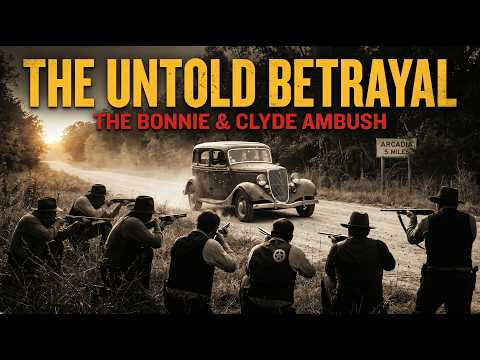
The morning of May 23, 1934, dawned thick with Louisiana humidity, the kind that clung to the skin and made the air feel like a held breath. Six men lay hidden in the brush along a back road south of Arcadia, their eyes fixed on a single point: a battered truck parked on the shoulder, one wheel removed, a perfect imitation of a breakdown. They weren’t waiting for just anyone. They were waiting for Clyde Barrow, and they knew exactly what would make him stop.
If Ivy Methvin’s truck was sitting there with a wheel off, Clyde would pull over. That was a certainty, not a guess. It was the kind of loyalty that had kept the Barrow gang alive for twenty-one months—and now, it would be the thing that killed them.
But the trap wasn’t sprung by chance. It was the culmination of a deal made in desperation, a father’s gamble to save his son from a life spiraling toward a violent end. Henry Methvin, the gang’s newest and most reckless member, had been an afterthought in the Eastham prison break—Clyde had come for Raymond Hamilton, not him. Yet Methvin had ridden with them for months, robbing banks, stealing weapons, and even bringing his own father into the fold. Clyde’s code was simple: if you were part of his crew, your family was his family. That code had driven him to drive Methvin to visit his folks in Louisiana, a gesture of loyalty that would soon be turned into a weapon.
The killings at Grapevine and Commerce had changed everything. Before, Bonnie and Clyde were wanted criminals; after, they were cop killers. The noose tightened, and Frank Hamer, a Texas Ranger with a legendary reputation, was hired to bring them down. Hamer had spent 102 days tracking them, and now he had something better than a trail: a traitor.
Henry Methvin’s father, Ivy, was terrified. He had watched his son get pulled deeper into a life that could only end one way. Through a chain of contacts, Ivy struck a deal: he would provide the location and timing of Bonnie and Clyde’s return, and in exchange, Henry would receive a pardon for any Texas crimes. The deal said nothing about Oklahoma, where another murder charge loomed.
On the night of May 22, the posse got word: Bonnie and Clyde would be driving that stretch of highway the following morning. Six men took their positions—Hamer, his partner Manny Gault, deputies Bob Alcorn and Ted Hinton, Sheriff Henderson Jordan, and Deputy Prentice Oakley. Ted Hinton had known Bonnie years earlier, when she was just a waitress in Dallas, before she ever met Clyde. Now, he was waiting to ambush her.
As the sun rose, Ivy Methvin parked his truck and removed a wheel, staging the breakdown. The posse knew Clyde would stop to help a gang member’s father. They had discussed whether to offer a chance to surrender, but the Texans vetoed it. The gang’s history was to shoot their way out of every confrontation—Joplin, Platte City, Dexfield Park. Every single time.
Then, at 9:15 a.m., the Ford V8 came down the road. Clyde was driving in his socks, a habit from his prison days when he had cut off his own toe to avoid work detail. The car was loaded with an arsenal: three Browning automatic rifles, two sawed-off shotguns, ten pistols, two revolvers, and roughly 3,000 rounds of ammunition. And Clyde’s saxophone, a strange symbol of the man behind the gun.
Deputy Oakley fired first, without orders, hitting Clyde in the head and killing him instantly. The rest opened fire. Bonnie reportedly screamed. The car drifted into a ditch, and in twelve to twenty seconds, it was all over.
But the story doesn’t end with the ambush. The aftermath was a circus of souvenir hunters and gawkers, and the fates of those involved—especially Henry Methvin—would unfold in unexpected ways. The deal that saved his life would haunt him, and the betrayal would echo for years to come.
Within minutes of the last shot, the silence on that back road was broken by the sound of engines. Word had traveled fast—too fast, some would later say—and cars began arriving from Arcadia and beyond. By noon, the population of the small town had swollen from two thousand to twelve thousand, a tide of humanity drawn by headlines and morbid curiosity. They came by car, by horseback, even by plane, landing in fields to get a glimpse of the dead outlaws.
The scene quickly turned grotesque. One woman produced a pair of scissors and cut locks of Bonnie’s hair, then snipped pieces of her dress to sell as souvenirs. A man climbed onto the car and tried to sever Clyde’s trigger finger with a pocket knife. Another was reaching for Clyde’s left ear when the coroner finally arrived and drove the crowd back, furious and sickened.
Ted Hinton, who had known Bonnie when she was a young waitress at Marco’s Cafe in West Dallas, returned to the scene and was appalled by what he saw. The woman he remembered—bright, restless, barely out of her teens—had become a spectacle, her body picked over by strangers before it had even grown cold.
The only cash found on Clyde’s body was $505, later handed to his father. That was the entire financial legacy of a twenty-one-month crime spree that had dominated front pages across the country. Five hundred and five dollars, against a trail of bodies and broken families.
Henry Methvin’s pardon came through, but it covered only Texas. Oklahoma had its own charge waiting—the murder of Constable Cal Campbell in Commerce—and the deal Ivy Methvin had struck said nothing about it. Henry was extradited, tried, and convicted. He was sentenced to death.
The sentence was later commuted to life, and in 1942 he walked out on parole. Prison had nearly killed him first: he survived a stabbing that many believed was tied to his role in setting up Bonnie and Clyde, a debt some inmates were eager to collect.
After his release, Henry ran a restaurant near Minden, Louisiana, then took a job at a munitions plant. He kept his head down, but the past had a long memory. On April 19, 1948, at thirty-six years old, Henry Methvin was struck and killed by a train at a railroad crossing while intoxicated. His father, Ivy, had died sixteen months earlier in a car accident. Both deaths were whispered about as suspicious; neither ever produced evidence of foul play.
Bonnie Parker’s funeral drew forty thousand people. Ten thousand filed past Clyde as he lay in state. Flowers arrived from across the country, including arrangements allegedly sent by Pretty Boy Floyd and John Dillinger. The two had asked to be buried side by side, but the Parker family refused—Bonnie’s mother wanted to honor her daughter’s last wish to come home, yet the mob surrounding the house made that impossible.
The car itself, bought by Ruth Warren for $835 in Kansas, sat in a ditch riddled with bullet holes and blood. People paid a dollar to sit inside it, and they kept paying for decades. In 1988, a Las Vegas casino bought it for $250,000. Today it sits behind glass at the Primm Valley Resort in Nevada, alongside the shirt Clyde was wearing when he died.
Frank Hamer later offered his own summary of the ambush: “I hate to bust the cap on a woman, especially when she was sitting down. However, if it wouldn’t have been her, it would have been us.” It was probably true. But two former Texas Ranger captains had once been offered that same job and answered the question differently. Their answer had been no.
What those captains understood—and what Hamer chose to set aside—was that the ambush on that back road wasn’t a gunfight. It was an execution dressed up as one. The posse never called out. Never gave the pair a chance to surrender, never let them step out with their hands up. Deputy Oakley’s first shot tore through Clyde’s skull before anyone had spoken a word, and the rest followed in a ragged volley that left the Ford V8 riddled like a tin can at a county fair.
Twelve to twenty seconds. That’s all it took to end a legend. But legends, as it turned out, were easier to kill than to bury.
While the crowd swarmed the death car, a quieter reckoning was already underway. The men who had hidden in the brush that morning began to understand what they had bought with their ambush. They had traded the code of the Ranger—the refusal to shoot a woman, the refusal to fire without warning—for a clean kill. And the public, which had spent two years devouring every scrap of news about the Barrow gang, now turned its appetite on them.
Hamer’s phone rang for weeks. Letters arrived at the Texas prison system, some praising the posse, others calling them murderers. One wrote that the six men in the brush had done what no jury in America would have sanctioned: they had passed sentence and carried it out in the same breath. Lee Simmons, the superintendent who had hired Hamer, publicly stood by the operation. Privately, the questions gnawed at him.
And then there was Ted Hinton, the deputy who had once poured coffee for a restless young waitress in West Dallas. He returned to the scene not once but twice, and the second time he brought a camera. He photographed the car, the blood, the bullet holes—not as souvenirs, but as evidence of something he couldn’t quite name. Years later, in a memoir written with his son, Hinton would describe Bonnie as a woman who had chosen her fate, and Clyde as a man who had never been given a fair chance to choose his.
But the most troubling figure in the aftermath was the one who wasn’t there to defend himself. Henry Methvin had walked into a diner outside Shreveport on May 19 to buy sandwiches, and in doing so had set in motion the chain of events that ended with his partners dead in a ditch. He had not intended it. Clyde had driven off without him—standard protocol—and Methvin had hitchhiked to his parents’ place in Ruston, where his father was waiting with a deal already half-made.
What Henry knew, and what his father knew, was that the gang was a sinking ship. Thirteen bodies already. Cop killers on the run. Frank Hamer closing in. Ivy Methvin had watched his son get pulled into a life that could only end one way, and he had decided to trade the lives of his son’s partners for his son’s life. It was, depending on who you asked, either the act of a desperate father or the coldest betrayal in the annals of American crime.
Henry took the pardon and disappeared into the anonymity of prison, then parole, then a restaurant near Minden, then a munitions plant. He never spoke publicly about the ambush. Those who knew him said he carried it like a stone in his chest. And when the train struck him on that crossing in 1948, drunk and alone at thirty-six, some said it was justice arriving late. Others said it was simply a man who had stopped looking both ways.
His father had died sixteen months earlier, in a car accident on a Louisiana road. No evidence of foul play. No charges. No answers. Just two deaths, close together, that left the story of the betrayal hanging in the humid air of Bienville Parish like a question no one wanted to ask out loud.
The car went to a casino. The shirt went behind glass. The flowers from Pretty Boy Floyd and John Dillinger—if they were real—withered and were swept away. And the six men who had hidden in the brush went back to their lives, carrying with them the knowledge that they had done what two better men had refused to do.
Frank Hamer’s summary of the ambush would be quoted for generations: “I hate to bust the cap on a woman, especially when she was sitting down. However, if it wouldn’t have been her, it would have been us.” It was a sentence that explained everything and nothing. It was the sound of a man who had made his choice and would spend the rest of his life living with it.
But there was one detail that never made the headlines, one thread that the souvenir hunters and the newspapermen and the memoirists all missed. In the days after the ambush, a package arrived at the Barrow family home in Dallas. It was postmarked from Louisiana and contained no letter, no signature—only a single item wrapped in brown paper.
It was Clyde’s saxophone.
The saxophone sat in the Barrow parlor for years, unplayed, a silent witness to a life that had once filled dance halls and dusty roads with music. Nobody in the family could bring themselves to touch it. Some said it was Ivy Methvin who mailed it back—a final, wordless apology from a father who had traded one son’s partners for his own boy’s life. Others swore it was Henry himself, drunk and weeping in some Louisiana post office, trying to give back the one thing the gang had never pawned.
No one ever confirmed it. The postmark faded. The paper was thrown away. And the saxophone gathered dust beside photographs of a boy who had once dreamed of being a musician before the Depression and a prison farm and a woman named Bonnie turned him into something else entirely.
Maybe that’s the real ending—not the bullets, not the souvenirs, not the glass case in Nevada. Just a battered instrument coming home to a family that had already buried its son twice: once to the legend, and once to the ground.
So here’s the question that keeps the story alive, nearly a century later: if loyalty was the weapon that killed Clyde Barrow, what does that make the father who used it—a traitor, or just a man who loved his son more than he loved the code?
What do you think? Was Ivy Methvin a villain, a victim, or something harder to name? Let us know in the comments below.
Report this article
Select a reason for reporting:






