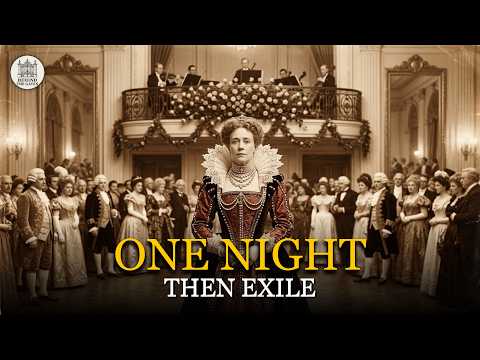
The Waldorf Hotel stood silent on Fifth Avenue, its lower windows boarded up, its grand ballrooms transformed into a Versailles of flowers and electric light. Inside, hundreds of guests in the costumes of dead kings and queens danced beneath a ceiling of orchids, while outside, police held back a crowd of onlookers in the cold February night. It was February 10, 1897, and the Bradley Martin ball was about to become the most talked-about party in American history.
But this was not just a party. It was a declaration of war—a war between old money and new, between the pulpit and the ballroom, between a city struggling through depression and a family determined to buy its way into the inner circle. Before the night was over, the Martins would be both celebrated and condemned, and within two years, they would flee America forever.
The story began not with the Martins, but with a quiet man named Isaac Sherman. When he died in 1881, New York society was stunned to discover that the retired merchant—a man who had made his fortune in barrel staves, of all things—was worth far more than anyone had guessed. Estimates placed his estate at five to seven million dollars, a sum that passed entirely to his only daughter, Cornelia.
Cornelia had married Bradley Martin, a lawyer from a respectable Albany family. Before the inheritance, the Martins lived quietly, entertaining little and keeping to themselves. But the money changed everything. In Gilded Age New York, fortune demanded visibility, and visibility meant navigating the rigid hierarchy ruled by Caroline Astor, the undisputed queen of society.
Cornelia Martin had the means to approach that gate, but not the right to be let in. So she began a campaign that would span sixteen years—each move calculated, each entertainment grander than the last. She joined committees, gave lavish dinners, and built supper rooms over her backyard when her house proved too small. She understood that in New York society, memory was everything, and each evening had to outshine the one before.
By the mid-1890s, the Martins had climbed high. Their daughter had married an English earl, they had leased a Scottish Highland estate, and they moved among the families who mattered. But they had not yet given the one night that would make their name permanent—a night the whole city would talk about for decades.
That opportunity came in the winter of 1897, during the fourth year of a devastating depression. At a breakfast table on West 20th Street, Bradley Martin remarked on the hard times. What followed—a suggestion, a debate, a decision—would set in motion a chain of events no one could have predicted.
Cornelia Martin proposed a costume ball, announced at such short notice that guests would have to buy their costumes from American dressmakers rather than ordering from Paris. It would be, she argued, a gift to the city’s struggling trades. A charity disguised as extravagance. A patriotic act that happened to require a ballroom.
The invitations went out—twelve hundred of them—and the city erupted. Ministers thundered from their pulpits. Newspapers printed itemized bills of what the ball would cost. Letter writers debated whether such display was an insult to the poor or a boon to business. Overnight, the Martins became the most talked-about family in America, and not entirely by choice.
The Waldorf, meanwhile, prepared for the onslaught. Florists named Small and decorator A.W. Merritt took over the building for two days, turning corridors into woodland bowers and ballrooms into hothouses. More than five thousand roses and three thousand orchids were hauled through the service entrances, while workmen boarded up the lower windows so ordinary hotel guests could not peer into the spectacle.
George Boldt, the hotel’s relentless manager, had reason to smile. Four years earlier, during the panic’s darkest summer, he had kept 970 servants on payroll while only 40 guests rattled through the halls. Now the building ran at full strength—about seven hundred of its workers assigned to a single family for a single night.
On the evening of February 10, the police closed West 33rd Street from Fifth Avenue to Broadway. Carriages began arriving around half past nine, but the guests did not come through the famous front doors. They entered through a private door in Boldt’s own residence, crossed a bridge corridor, and rode the elevators up into the hotel’s heart—a secret passage that kept New York society out of sight of the crowd.
The receiving line lasted ninety minutes. Cornelia Martin stood beneath a balcony banked with American Beauty roses, dressed as Mary, Queen of Scots, her bodice glittering with diamonds. Row upon row of diamonds hung from her neck. Beside her, Bradley Martin wore the court suit of a French king.
Caroline Astor arrived in blue velvet trimmed with old lace, her jewels said to be worth a fortune. Oliver Belmont came in gold-inlaid armor valued at ten thousand dollars. Anne Morgan appeared as Pocahontas. Men wore diamond buttons worth thousands; women carried heirlooms that had crossed the ocean in family chests. One witness later claimed the jewels in that room could have funded the debt of Spain.
At midnight, a trumpet sounded. John Jacob Astor IV—son of the very woman whose ballroom had defined society for a generation—led Cornelia Martin out for the opening quadrille. The mirrors along the grand ballroom’s northern wall, garlanded with orchids and asparagus vine, doubled every dancer, making the room seem to hold an entire court.
Supper was served from midnight at 125 tables of six, each banked so high with roses that guests seemed to eat from the top of a flower bed. The menu ran to nearly thirty dishes—lobster, terrapin, canvasback duck, quail in aspic, a dozen sweets—and the champagne was a Moët & Chandon of 1884.
Below stairs, in kitchens the hotel’s own historian admitted were badly designed for such loads, an uncounted brigade of cooks sent the plates up in waves. Waiters in gold-embroidered livery carried them through corridors dressed as garden paths, past electric bulbs glowing like morning glories through the vines.
At two or three in the morning, Elisha Dyer Jr. led the largest cotillion ever danced at a private ball in New York—perhaps two hundred couples, with favors of silver matchboxes, herald’s bugles, and miniature sedan chairs handed out between figures.
They danced until the electric lights reflected from diamonds grew pale at daybreak. The Martins themselves left around six, as a few curious onlookers still waited in the gray cold. The police had kept the street closed until the very end.
Within hours, the morning papers were on the street, and the counting began. The Sun declared that half a million dollars would not cover the expenditures. The labor papers counted hardest, calling it the grossest exhibition of the arrogance of wealth America had ever witnessed.
Cornelia Martin had called her ball a gift to the city’s trade. The city had called it an insult to its poor. Both sides counted, and neither ever agreed on the sum.
Six weeks later, on the 27th of March, the Martins sailed for Liverpool aboard the Campania. Two parlor suites had been filled with orchids and American Beauty roses for the woman who had stood beneath a balcony of the same flowers. With her traveled her husband, her mother, two maids, and a valet.
On the face of it, this was an ordinary spring. The Martins had kept their Highland estate for more than a decade. But something had shifted. In London, their daughter was a countess; their grandson, born that very year, would one day be an earl. The family’s affections, Frederick Martin later wrote, were now implanted in the old world.
New York, however, was not finished with them.
On the 27th of May, 1899, New York’s Board of Tax Commissioners made its decision public. Three wealthy citizens who had taken up residence abroad would have to pay their taxes just the same as persons living in this country. William Waldorf Astor was assessed on two million dollars of personal property. The Bradley Martins, on two million more. Cornelia’s mother, Mrs. Isaac Sherman, on two million three hundred thousand.
The sums came to about fifty thousand dollars from the Martins, fifty thousand from Astor, sixty-two and a half thousand from Mrs. Sherman. More than one hundred sixty thousand dollars claimed by a city from people who had gone to live in England.
Frederick Martin’s account of this quarrel is the angriest passage he ever wrote about his brother’s life. The authorities promptly raised my brother’s taxes quite out of proportion to those paid by anyone else, he wrote, and the matter was only settled after a very acrimonious dispute.
Bradley and his wife resented intensely the annoyance to which they had been subjected, and they decided to sell their house in New York and buy a residence in London. That sentence is the true root of everything that followed. In the family’s own telling, the city answered the ball with the tax office, and the tax office drove them out.
They sold the house on West 20th Street—the two houses Cornelia’s inheritance had joined into one, the house of the supper room built over the yard. From 1899, the Martins made their permanent home in England.
Their London house stood at number four Chesterfield Gardens in Mayfair. Their daughter, the Countess of Craven, lived next door at number three. At some point she had the interior walls knocked through so that her house opened directly into her mother’s—mother and daughter living as though in a single house on a London street.
That was the family’s answer to New York, and it was a quiet one. They joined themselves wall by wall to the country that had not counted them.
But the place Bradley Martin loved most was nineteen miles of shore on Loch Ness. Balmacaan was a large ivy-covered stone house with an uninterrupted view for twelve miles across the water to Bonaferry Castle. For Bradley Martin, his brother wrote, it was exactly that—the happiest place on earth. There was nothing he liked better than shooting, and he was never so happy as when in the Highlands.
The estate covered some sixty-five thousand acres. Around forty local people held permanent work there as gamekeepers, gardeners, and domestic servants. The great Highland families—the Lovats, the Frasers, the Macintoshes—always came to the covert shoots. Among the guests, local history records, was Grand Duke Michael of Russia.
A lawyer from Albany and a stave merchant’s daughter from Buffalo were entertaining Scottish clan chiefs and a Russian grand duke in a house on Loch Ness.
The Martins ran the estate by their own rules. Bradley Martin banned work on the estate on Sundays. Frederick put on treats for the village—a scramble for money thrown to the children, food, fireworks. The Martins funded the Glen Urquhart public hall, which opened in 1906 and still stands in the village of Drumnadrochit.
In New York, their spending had been denounced from the pulpit as an insult to the poor. In Glen Urquhart, the same family’s money built a hall for the whole community to use. The contrast says something about both places. In New York, the Martins were one rich family among many, competing for position in a society that watched every dollar. In the Glen, they were the great house, and the great house was expected to spend.
For thirty-five years, the Martins fed Balmacaan, and it gave them in return the one thing New York would not give. It made them welcome.
In London, the other half of their life went on at Chesterfield Gardens. Frederick, the younger brother, went on writing. In 1911, he published a book called The Passing of the Idol Rich. In it, he wrote about his own class with unusual frankness. I know society, he wrote. I was born in it and have lived in it all my life. It was the magic of gold, he wrote. It was the poison of idol wealth.
He wrote of cigarettes rolled in a hundred-dollar bill. Of a dog banquet at which the owner decorated his dog with a diamond collar worth fifteen thousand dollars. Of a monkey attended by a valet at a cost of ten to fifteen thousand a year. Each of those stories could have been told by the preachers of 1897. Now they were told by a Martin.
Yet in that whole book about the follies of the rich, he never once mentioned his brother’s ball. When he came to write about it two years later in his memoir, he defended it to the last line.
The Highland years ran on, season after season, the shoots and the house parties and the view across the loch. Bradley Martin had turned seventy. In the winter of 1913 in London, he caught influenza.
On the 5th of February, 1913, his son and his brother sailed from New York on the Carmania to reach him. They were too late. That same day in London, Bradley Martin died. A Washington paper carried the news on its front page. Victim of pneumonia in London, the headline said. Son and brother sail.
The ball was sixteen years in the past, almost to the week. He died on the 5th of February, 1913. The ball had been held on the 10th of February, 1897.
When the New York papers wrote his obituary, they wrote about almost nothing else. The Evening World told the story of the night as though it had happened last season. Hundreds of columns of newspaper print concerning it were published, the paper wrote. Preachers used it for a topic in a thousand pulpits. It repeated the old claim that the jewels worn that night could have funded the debt of Spain.
A man’s entire life, seventy-one years of it, had been folded into a single night.
In May 1913, the Times reported the value of his New York estate: $1,277,341. Nothing taxable, however, as former social leader called London home. Fourteen years after the commissioners ruled he could not escape by going to London, the city finally agreed that he had.
Cornelia outlived both brothers by seven years. She died in October 1920, and was buried at Greenwood Cemetery in Brooklyn—the same cemetery where her eldest son Sherman had been laid to rest twenty-six years earlier. The woman who had left New York, who had been counted and taxed and mocked until she chose London, came back to New York in the end to lie beside her son.
The Waldorf itself closed its doors in May 1929. Demolition began that October, and on May 1, 1931, the Empire State Building opened on its ground. The ballroom where Cornelia Martin received her court, the mirrors that doubled her dancers, the kitchens and service stairs—all went down together. Some of it went into a fire. Some of it went to the bottom of the Atlantic.
What survives is small enough to hold: a miniature of Cornelia as Mary, Queen of Scots, painted on ivory in the New-York Historical Society. A pink silk gown with a Madison Avenue dressmaker’s label in a museum in New Canaan. A granite obelisk by a road in the Scottish Highlands, raised in admiration, gratitude, and affection. And a house in Mayfair that now teaches Londoners about Egypt.
She had wanted the city to remember her night, and it did—in sermons and editorials and tax rulings and obituaries for the rest of her life and long after. The building that held it is at the bottom of the Atlantic and beneath the Empire State. The family that gave it is scattered across two countries and a century. What endures is the memory of one February night and of a woman who sailed away from it six weeks later in two parlor suites full of orchids.
If you had been invited that February, knowing what the city was saying, would you have gone to the Waldorf or sent your regrets?
Report this article
Select a reason for reporting:






