Dr. Sarah Chen had examined thousands of Civil War-era photographs, but something about the hands in this one made her blood run cold. The image arrived at the Virginia Museum of History in a cedar box, wrapped in yellowed silk, its silver surface still gleaming after more than a century and a half. Five members of the Harrison family stared back at her—a prosperous white family from Richmond, Virginia, 1860. The patriarch sat stern-faced, his wife beside him, three grown sons arranged around them. It was a portrait of wealth and respectability, following every convention of Victorian photography.
But the hands were wrong. In formal portraits, hands rested naturally or clasped together. Here, each family member held their fingers in deliberate, unusual configurations. The father’s index and middle fingers were crossed, his thumb extended outward. The mother’s hand on his shoulder mirrored a similar strange gesture. Each son’s hands were posed differently, but all seemed intentionally arranged.
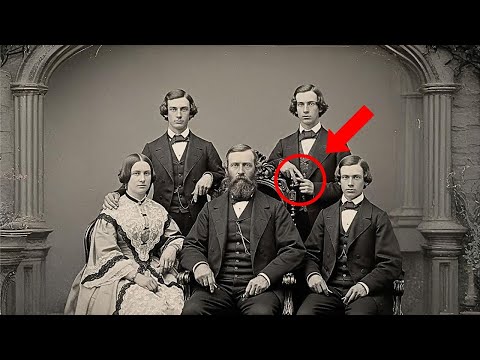
Sarah’s heart raced as she pulled up her research files on abolitionist signals and Underground Railroad codes. The father’s crossed fingers meant “safe passage.” The mother’s gesture indicated “shelter available.” Each son’s hand position corresponded to different coded messages she’d seen documented in Underground Railroad communications.
But this made no sense. Richmond, Virginia, in 1860 was the heart of slave territory. Why would a wealthy white family in the future Confederate capital pose for a photograph displaying Underground Railroad codes?
She called the donor, an elderly woman named Mrs. Patterson, who revealed that her ancestors had left Virginia during the war and never returned. “Family stories say they weren’t welcome in Richmond anymore,” Mrs. Patterson said. “Something about their sympathies being unpopular.” When Sarah asked about Underground Railroad activities, the silence stretched long. Finally, Mrs. Patterson whispered, “How did you know?”
Two days later, Sarah stood in Mrs. Patterson’s basement, staring at a leather-bound trunk that hadn’t been opened in decades. Inside were stacks of letters, ledgers, and journals. The first letter, dated April 1859, described “merchandise arrived safely. 23 pieces in total.” Sarah explained that “merchandise” was code for escaped slaves. The Harrison family had been running an Underground Railroad station in the heart of the Confederacy.
As she read further, the full picture emerged. The father, Robert Harrison, had been a textile merchant whose warehouses provided perfect cover for hiding escaped slaves. His journal revealed a gradual awakening after witnessing a slave auction in 1856. His wife Katherine shared his revulsion, and together they built a sophisticated network. Their three sons took on specific roles: Thomas managed warehouse operations, James served as lookout and messenger, and William—just 19—traveled to plantations posing as a fabric buyer, arranging escapes.
Then Sarah found the entry describing the photograph itself. Katherine had proposed the idea: a family portrait incorporating their hand signals as coded messages to other conductors. To anyone who understood the codes, the Harrisons would be recognizable as allies. To others, they’d appear as merely another prosperous Richmond family.
But Robert’s tone suggested a deeper purpose. He ordered five copies of the photograph, understanding that discovery was inevitable. “If we are discovered, this photograph will be our legacy. Proof that we existed, that we resisted, that we chose our principles over our safety.”
The journal ended abruptly in December 1860, the day South Carolina seceded. Sarah searched through the remaining documents, finding letters from Katherine and Thomas that revealed the family’s fate. In August 1861, Robert and Katherine were arrested on charges of aiding escaped slaves. Thomas’s letter described their conviction and sentencing—15 years hard labor for Robert, 10 for Katherine. The sons escaped north with 17 people they’d been sheltering.
Sarah contacted the Library of Virginia and found prison records from Castle Thunder. Robert died there in March 1863, never living to see Union victory. Katherine survived until the war ended, released in April 1865, but her health was destroyed. She died in Philadelphia in December 1866.
But Catherine’s obituary in a Philadelphia abolitionist newspaper revealed the scale of their achievement: “She and her husband Robert saved an estimated 200 enslaved persons.” Two hundred people. Sarah sat back, overwhelmed. For three years, in the most dangerous possible location, the Harrisons had operated a rescue network that saved 200 human beings from slavery.
She called Mrs. Patterson and read the obituary aloud. The elderly woman wept openly. “My ancestors saved 200 people, and I never knew. My whole life I never knew.”
Sarah returned to the trunk and found letters from the sons after the war. Thomas had become a textile merchant, haunted by survivor’s guilt. James had become a teacher, dedicating his life to educating formerly enslaved people. William had become a vocal abolitionist speaker, traveling throughout the North giving speeches about his family’s Underground Railroad activities.
One speech from 1875 described the photograph: “My father knew our work might cost us everything. He wanted proof that we’d existed, that we’d chosen the right side of history. The photograph was his way of saying we were here. We resisted. We did what was right, even when it was dangerous.”
Sarah found one final document: a ledger William had kept, attempting to track down every person his family had helped. It contained names, dates of passage through the Richmond station, and information about their subsequent lives. Of the approximately 200 souls, William had traced 73. All were living in freedom.
At the end of the ledger, William had written: “This is my parents’ legacy, not their suffering, but the lives they saved and the freedom they made possible.”
Sarah spent three months preparing an exhibition about the Harrison family. The Virginia Museum of History devoted an entire gallery to their story, with the 1860 photograph as the centerpiece. She invited Mrs. Patterson and tracked down descendants of people the Harrison family had helped.
The exhibition opened on a humid Virginia evening. Over a hundred people filled the gallery. Mrs. Patterson arrived with four generations of Harrison descendants. But Sarah’s most powerful moment came when she introduced Mrs. Patterson to Marcus Johnson, an elderly black man from Philadelphia. Marcus held a worn photograph of his own—his great-great-grandfather, Samuel, the same Samuel mentioned in William’s ledger.
“Your family saved my ancestor,” Marcus said, his voice breaking. “Samuel and Rose and their three children, December 1860. They escaped from a plantation in Virginia, made it to Richmond, and your family hid them in a warehouse and transported them north, hidden in fabric shipments.”
Mrs. Patterson clasped his hands, both of them crying. “I didn’t know,” she whispered. “I lived my whole life not knowing what my family had done.”
“Well, now you know,” Marcus said. “And now I can thank you. My great-great-grandfather became a carpenter. He built a life in freedom. He had six children. Today, there are over 60 people in my family tree. All of us alive because your ancestors risked everything to help slaves they’d never met.”
Sarah watched as more descendants met each other—Harrison family members connecting with the descendants of people their ancestors had saved. The gallery filled with tears and embraces, with stories shared and gaps in family histories finally filled.
During her speech, Sarah addressed the crowd. “This photograph was taken in March 1860, one year before the Civil War began. Five members of the Harrison family posed with their hands positioned in coded signals. To casual observers, it was just another family photograph. But to abolitionists who knew the codes, it was a message: Here is a safe house. Here is shelter. Here is passage north.”
She paused, looking at the image projected behind her. “What makes this photograph extraordinary isn’t just the coded signals. It’s what happened after. The Harrison family could have stopped their Underground Railroad operations. They could have protected themselves. Instead, they continued their work in the most dangerous possible environment, and they paid a terrible price.”
Sarah described Robert’s death in prison, Katherine’s years of hard labor, the sons’ escape north. “But here’s what matters most: They saved approximately 200 people from slavery. 200 human beings who lived free because this family chose courage over safety.”
She gestured to the descendants in the audience. “In this room tonight are Harrison family members who never knew this history and descendants of the people they saved who never knew who helped their ancestors. This photograph, this image that’s been sitting in archives for over a century and a half, has finally brought you together.”
The exhibition ran for six months and became the most visited display in the museum’s history. News coverage spread nationally, and scholars began researching other possible coded photographs from the Civil War era. Sarah received dozens of messages from people asking her to examine family photographs for similar signals.
But the most meaningful impact was personal. Mrs. Patterson created a family history website documenting everything Sarah had discovered. Harrison descendants from across the country reached out, many of them shocked to learn about their ancestors’ abolitionist activities. “I grew up in Virginia,” one distant cousin wrote. “I was always told we had to leave the state because of some family scandal. I assumed it meant we’d been Confederate sympathizers who’d done something shameful. Learning the truth—that we left because we were abolitionists who got caught helping escaped slaves—has completely changed how I understand my family and myself.”
Marcus Johnson organized a gathering of descendants from the people the Harrison family had helped. Sarah attended the event in Philadelphia, held in a church not far from where Thomas, James, and William had settled after fleeing Richmond. Over 200 people came, descendants of Samuel and Rose, of Martha who’d gone to Canada, of dozens of others whose names appeared in William’s ledger.
They shared stories that had been passed down through generations. One woman described how her great-great-grandmother had told her grandchildren about the white family in Richmond who hid us in their warehouse and saved our lives. Another man brought a quilt his ancestor had made in freedom, incorporating a pattern that resembled the fabric the Harrison family had imported—a deliberate memorial to the people who’d helped her escape.
Sarah stood before the photograph one last time before the exhibition closed. She’d spent months studying every detail—the studio backdrop, the Victorian clothing, the serious expressions. But now she saw it differently. She saw five people making the conscious choice to create evidence of their resistance. Robert and Katherine, knowing they might not survive, but determined to leave proof of their principles. Thomas, James, and William, young men who could have protected themselves by doing nothing but instead risked everything.
The hand signals weren’t just codes. They were declarations. Quiet acts of defiance captured in silver and glass, preserved through time, waiting to tell their story to anyone who learned to read the language.
Mrs. Patterson stood beside her. At 83 years old, she’d spent the past six months learning everything she could about her ancestors. “Sarah,” she said quietly, “I’ve been thinking about what Catherine wrote in her letter from prison—about how ordinary people can resist extraordinary evil, about lighting candles in the darkness.”
“It’s a powerful metaphor,” Sarah agreed.
“It’s not a metaphor,” Mrs. Patterson said. “It’s a challenge. She wasn’t just talking about herself. She was talking about every generation that comes after, asking us: When you face injustice, what will you do? When doing the right thing is dangerous, will you stay silent or will you resist?”
Sarah looked at the photograph again. Those five serious faces, those deliberately positioned hands. “What do you think they’d want us to know?”
Mrs. Patterson smiled, tears in her eyes. “I think they’d want us to know that we’re capable of more courage than we imagine. That ordinary people—merchants, teachers, students, parents—have the power to change history. That taking a stand costs something. Sometimes everything. But the cost of staying silent is higher.”
She gestured to the exhibition materials around them. “This photograph sat in an archive for 150 years. All that time, their story was hidden, waiting. Now it’s out in the world again. And look what happened. Families reunited. History corrected. People understanding that resistance has always existed, even in the darkest places.”
Sarah nodded. “Your family story is going into textbooks, Mrs. Patterson. Students will learn about the Harrison family, about Underground Railroad operations in Confederate territory, about white allies who paid the ultimate price for their principles.”
“Good,” Mrs. Patterson said firmly. “Because we need those stories. We need to know that people have always fought back against injustice, even when it seemed hopeless. Especially when it seemed hopeless.”
The photograph would be permanently installed in the museum’s Civil War Gallery. Future visitors would see Robert, Katherine, Thomas, James, and William Harrison frozen in their 1860 portrait, hands positioned in coded signals that once meant safety, shelter, passage to freedom.
But the photograph was more than a historical artifact now. It had become a mirror, reflecting questions back at everyone who viewed it. What would you risk for your principles? What cost are you willing to pay to resist injustice? When doing the right thing is dangerous, what will you choose?
Five people in a Richmond photography studio in 1860 had answered those questions with their hands, their lives, their sacrifice. Their message, encoded in gesture and preserved in silver, had finally been read and understood. And it would continue speaking to future generations—a permanent testament to the power of ordinary people who refused to accept evil, no matter the cost.
Months later, a package arrived at Sarah’s office with no return address. Inside was a single photograph—a family of five, hands posed in familiar, deliberate configurations. On the back, in pencil: “We read about the Harrisons. We are still here. Are you?”
Sarah turned the image over, heart pounding. The signals were unmistakable: safe passage, shelter available, northbound route. Another family, another generation, still speaking the language of resistance.
She pinned it beside the Harrison portrait and stepped back. The candles, it seemed, had never gone out. They had simply passed from hand to hand, waiting for someone to read the light.
So now the question turns to you, reading this in your own moment of history: when the cost is real and the danger is near, what will your hands say?
Report this article
Select a reason for reporting:






