You are eighteen years old. You stand at an open door. Three thousand feet of empty air between you and the jungle below. No armor, no cover. Just you, a machine gun, and every enemy soldier on the ground aiming his rifle directly at your chest.
This is the story of the helicopter door gunner in Vietnam. The most exposed man in the most exposed war. By the end, you’ll understand why door gunners said they felt safer on the ground than in the air.
Vietnam wasn’t supposed to be a helicopter war. In the early 1960s, helicopters were just transport and logistics—moving supplies from point A to point B. No one thought they’d become the backbone of American combat operations.
But the jungle changed everything. Dense canopy, no roads, rivers cutting through mountains, and Viet Cong hiding in villages that looked like any other village. The U.S. needed speed, mobility, and the ability to insert troops into combat zones faster than the enemy could react. So they turned to the helicopter.
And the helicopter became a target.
At first, there were no door gunners—just pilots and crew chiefs trying to land in clearings while taking fire from every direction. The Viet Cong figured that out quickly. Helicopters flew low. Helicopters flew slow. Helicopters couldn’t shoot back.
So they started setting ambushes at landing zones, waiting between tree lines, hiding in tall grass, letting the helicopter approach, rotors kicking up dust, troops about to jump. Then they opened fire.
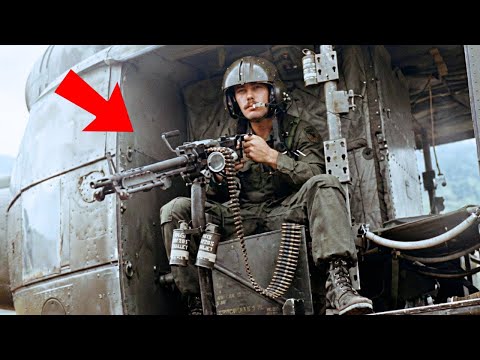
The first door gunners were improvised. Crew chiefs grabbed whatever machine gun they could find and started shooting back. Volunteers stood at the open door with an M60, hoping to see the muzzle flash before the bullet hit them.
By 1965, it was official. Every Huey carried two door gunners. One on each side. Standing in the wind. Scanning the jungle. Waiting for the world to explode.
The primary weapon was the M60 machine gun. 7.62mm. 550 rounds per minute. Effective range up to 1100 meters if you could hold it steady while standing in a metal box shaking and flying through the sky.
The M60D was the aircraft version. Spade grips instead of a stock. Mounted on a bungee cord system that let the gunner swing it almost anywhere. Because there were mechanical stops built into the mount to keep you from shooting your own rotor blades, hitting the tail, or puncturing the fuel tank right behind your head.
But many gunners hated the official rules. Too restrictive. Too slow. So they improvised their own systems. Bungee cords tied to the ceiling. Free-swinging rigs that let them lean out past the skids and fire straight down at targets passing below. Getting into the thick of the fight. It gave them more range of motion. It also meant one mistake could drop you 300 feet into the jungle.
Most gunners wore simple safety harnesses. A thin strap around the waist attached to the airframe inside. Not designed to hold much. Not designed to keep you from falling during a sharp turn or violent maneuver. But it was all you had.
Here’s what you need to understand. A door gunner wasn’t like a bomber crew at 30,000 feet. Wasn’t like a tank crew behind layers of steel. Wasn’t even like an infantryman who could dive into a foxhole when the shooting started. A door gunner had no protection. No armor on the doors. No bulletproof glass. The floor of a Huey was thin aluminum. The kind of metal that dents if you step on it wrong. So gunners sat on their body armor. Didn’t wear it. Sat on it. Because the biggest threat wasn’t from the sides. It came from straight below. AK-47 rounds punching through the floor, tracer fire from heavy machine guns tracking the helicopter in the sky, RPGs screaming toward the engine cowling, and you standing there in the open watching it all come at you.
The worst part was the landing zones. Hot LZs. When the Viet Cong knew you were coming, the helicopter slowed and began to descend. The rotor wash kicked up a cloud of red dust that blinded everyone on the ground and in the air. Pilots couldn’t see. The troops in back couldn’t see. But the door gunner had to see. Because somewhere inside that dust cloud, somewhere at the tree line a hundred meters away, there were men with rifles, men with machine guns, men with rocket launchers. And they were all aiming at your aircraft.
Your job was simple. Suppress the enemy. Put enough lead into them to keep their heads down long enough for the infantry to jump out and run for cover. But you did this while standing in the open door of the helicopter. While the helicopter bucked and shuddered. While the M60 shook in your hands and spent casings clattered against the metal floor. While the pilots screamed over the radio. And the man next to you prayed out loud. Because the last helicopter in the formation had been hit and went down burning.
You didn’t aim. You didn’t have time. You just pointed the gun toward the tree line and squeezed the trigger.
The North Vietnamese Army wasn’t stupid. They studied American tactics. They captured training manuals. They drew diagrams of helicopters with red circles around the most vulnerable points. The engine, the transmission, the cockpit. One NVA field manual instructed soldiers to aim one and a half helicopter lengths ahead of a moving Huey to lead the target and hit the engine before the aircraft even realized it was under fire.
They knew the landing zones. There were only a few clearings in the jungle big enough for a helicopter to land. The NVA mined them, planted rotor-triggered explosives, and positioned machine gun teams in overlapping fields of fire. Both the Viet Cong and the regular North Vietnamese forces used these tactics. Different organizations, but the lethal threat from the ground was the same.
They called it the “wall of lead.” Entire platoons lying on their backs in the grass, rifles pointed straight up, firing continuously as the helicopters passed overhead. Hundreds of bullets filling the air. You couldn’t dodge. You couldn’t evade. You just flew through it and hoped to survive.
But the real nightmare was the heavy machine gun. The 12.7mm. Soviet-made, mounted on a tripod or bunkered in a defensive position, firing rounds the size of your thumb. One hit could tear through the transmission. One hit could sever a hydraulic line. One hit could take your leg off at the knee.
During the siege of Khe Sanh, NVA gunners placed 12.7mm platforms on the hills surrounding the airstrip. Helicopters couldn’t land normally. They had to dive from 3,000 feet, drop like a stone, then pull up at the last second in what pilots called a “controlled crash.” Door gunners held on tight, watching the ground rush up at them, praying the pilots didn’t miscalculate.
Then there were the RPGs. Rocket-propelled grenades. Shoulder-fired, fast, and deadly. You’d see the flash from the tree line, a trail of white smoke, and you had maybe two seconds to scream a warning before impact. Most of the time they missed. But when they hit, the helicopter came apart in the air, rotor blades shearing off, airframe disintegrating, fire spreading through the cabin. If you were lucky, you died instantly. If you weren’t, you rode it down, burning, screaming, watching the jungle rush up to meet you.
The Viet Cong adapted to everything. Door gunners used colored smoke grenades to mark targets for gunships. Purple smoke meant enemy position. Yellow smoke meant friendly troops. So the Viet Cong started carrying their own smoke grenades. A door gunner would throw purple smoke to mark a machine gun nest. Seconds later, three more purple smoke grenades popped in different locations. The gunships no longer knew which target to hit. And while they circled trying to figure it out, the real machine gun kept firing.
This wasn’t a rare occurrence. This was daily life. It was a psychological war. Designed to make you doubt everything you saw.
Every morning started the same way. You woke in a tent or a hooch. The humid air already heavy with heat. The drone of mosquitoes never stopping. The smell of fuel and sweat and mildew. You checked your gear. M60, ammunition, extra belts, smoke grenades, and your body armor that you sat on instead of wore. And you thought about the odds.
Thousands of helicopters were destroyed in Vietnam. Crew casualties made up a significant portion of American losses in the war. You did the math in your head. But those were just averages. At a hot LZ, the odds were worse. Much worse.
The worst part wasn’t your own fear. It was watching the other helicopters. You were in a formation, six Hueys in a staggered line, all heading to the same landing zone, loaded with troops, all hoping to get in and out before the shooting started. Then you saw it happen. A trail of smoke. The lead helicopter wobbled, spun, and started to fall. You watched the gunner at the door try to hold on. You watched him realize it was over. You watched the helicopter disappear into the jungle and explode in a ball of orange flame. And you knew, you knew that could be you in 30 seconds.
But it wasn’t just fear of death. It was what you had to do to survive. They called it “reconnaissance by fire.” Shooting at villages before you even knew if the enemy was there. Shooting at tree lines, at huts, at anything that moved. Some gunners were eighteen years old. Farm boys from Iowa, kids from Brooklyn, teenagers who had never fired a shot before boot camp. Now they stood at the door with a machine gun, making life-or-death decisions in half a second. Anyone running was Viet Cong. That’s what some were told. And when you’re scared and the adrenaline is pumping and you’ve seen three of your friends die in the past week, you squeeze the trigger. Later, you lay awake in your bunk wondering: Were they soldiers? Were they farmers? Did I just kill a child? You’d never know. And that not-knowing would follow you home.
But there were also moments of extraordinary courage. Larry Colburn was a door gunner flying with Warrant Officer Hugh Thompson during a routine reconnaissance mission over a village called My Lai. What they saw below made them sick. American soldiers killing unarmed civilians, women, children, and elderly villagers being executed in ditches. Thompson landed his helicopter between the soldiers and the civilians. “Cover me.” Colburn aimed his M60 at the American infantry, not at the enemy, but at his own countrymen. “If they shoot these people, shoot them.”
A tense standoff followed. American soldiers with their rifles, an American door gunner with an M60, and Vietnamese civilians huddled behind them. No one fired. Thompson evacuated the survivors. Colburn kept his weapon trained on the men who were supposed to be his brothers in arms. It was the right thing, but it haunted him for years because that’s what the door gunner war did. It put you in impossible situations where there were no good choices, only survival.
Let me take you inside what a hot LZ actually felt like. You’re the fourth ship in a six-ship formation, an assault helicopter company. Your radio call sign is “Slick 2-4.” The LZ is five klicks west of the A Shau Valley. Intelligence says the area is secure. Intelligence is wrong most of the time.
You’re at 1,500 feet. The crew chief taps your left shoulder and points down. You lean into the wind and scan the jungle. Nothing but green canopy. A few clearings that could be LZs or kill zones. Static on the radio. Two minutes out.
You pull the charging handle on your M60, chamber a round, run your hand along the belt—2,000 rounds in a custom box you built yourself from spare parts and duct tape. The lead ship starts its descent. You follow. The formation tightens. Another door gunner looks at you and gives a thumbs-up. You nod.
The jungle rushes up. “Get ready!” the crew chief screams over the rotor wash. You brace against the door frame, feet on the skids, harness tight, M60 pointed at the tree line.
Muzzle flashes. “Taking fire from the left!” Tracers stream toward the jungle. You swing your M60 right, searching for targets. There—movement at the tree line. You squeeze the trigger. The gun roars, the vibration runs up your arms, spent casings fly past your face, the smell of cordite and hot metal fills your nose.
The rotor wash kicks up dust now, red dirt rising. You can’t see anything. You’re firing blind, aiming where you think the enemy is. Then you hear it. Ping. Ping. Ping. Rounds hitting the airframe. The pilots scream. “Going down! Going down!”
You feel the helicopter tilt, nose up, tail down. The skids touch the ground and the infantry in back are already jumping. You keep firing, sweeping the tree line left to right. The M60 is so hot the barrel is starting to glow. More muzzle flashes. You only think about getting them out. Just get them out alive.
The last soldier jumps and the pilot pulls pitch. The helicopter leaps upward, still firing, the jungle falling away beneath you. “Safe! Safe! We’re safe!” You release the trigger. Your ears are ringing. You look at the LZ. Black smoke rising from the tree line where your rounds hit. The infantry are already taking cover. And behind you, Slick 2-5 is starting its approach. Straight into the same hell you just left.
Back at base, you step off the helicopter. The crew chief inspects the airframe for damage. Twelve holes in the fuselage. A round punched through the floor exactly between where you were standing. If you’d shifted six inches to the left, you’d be dead. You sit on sandbags. Light a cigarette. Hear the rotors of the next flight spinning up. Thirty minutes until you’re back in the air. Thirty minutes until it all happens again.
You take a drag and stare at the distant jungle. Tomorrow, you’ll do it again. And the day after that. And the day after that. Until your tour ends. Or until your luck runs out.
Thousands of helicopters served in Vietnam. Many were destroyed. Crew members were killed in numbers comparable to the heaviest combat units. These are the pilots, crew chiefs, and door gunners. Men who were supposed to fly above the war but ended up in its worst battles.
The nature of their injuries was catastrophic. Amputations, burns, traumatic brain injuries from crashes. The kind of wounds that change you forever. But the wounds you can’t see were just as bad. PTSD, survivor’s guilt, moral injury.
A door gunner named Jim Chancellor later described having to throw men off an overloaded helicopter during an evacuation. “Too heavy, too heavy, we’re going down.” He grabbed a man and threw him off while firing his M60 with the other hand. The helicopter rose. The man he threw was captured and killed. Chancellor carried that burden for the rest of his life.
Ask any door gunner what they remember most. Not the firefights. Not the medals or the missions. It’s the sound. The sound of Huey rotors. That rhythmic thump that meant help was coming. It meant you might make it home. To the infantry on the ground, the helicopter was a lifeline. To the gunner at the door, it was a flying coffin with open doors. But they climbed aboard anyway. Every day. Because someone had to.
The door gunners of Vietnam were the vanguard of a new kind of warfare. They turned the helicopter from a transport into a weapon system. They mastered aerial gunnery under the worst possible conditions. They wrote the manual that every modern aerial gunner still uses. Today’s special operations pilots owe everything to those young men who stood at the doors of Hueys over the jungles of Vietnam. But the price they paid was unimaginable. Many never came home. And many who did never really left Vietnam.
The door gunner’s war was unique in military history. They weren’t protected by distance like bomber crews. They weren’t protected by armor like tank crews. They weren’t even protected by fortifications like the infantry. They stood in an open door 300 feet above enemy jungle, armed with nothing but a machine gun and a strap that might not hold. And they did it knowing every LZ could be their last. Every mission could end with their helicopter falling toward the trees.
In most wars, soldiers look for cover. They dig foxholes, build bunkers, hide behind walls. But the door gunner had no cover by the nature of his job. Because his job wasn’t to hide. His job was to be seen, to draw enemy fire away from the troops on the ground. To stand at that door and fight. Some jobs in war don’t give you cover. They make you the target.
So here’s the question I’ll leave you with: if you were eighteen, standing at that open door, with nothing but a machine gun and a prayer between you and the jungle below—would you have climbed aboard?
Report this article
Select a reason for reporting:






