When Franz Vber first stepped onto the sun-bleached sand of an Australian beach near the Harvey internment camp in early 1942, he was flanked by guards who handed him swimming trunks and told him he had two hours to enjoy the ocean. His immediate instinct was to scan the dunes for hidden machine guns or guard towers—surely this apparent kindness was an elaborate trap. Vber had survived the sinking of the German raider Kormoran after its deadly battle with HMAS Sydney, spending weeks adrift in lifeboats before rescue and capture. Nazi propaganda had conditioned him to expect brutality from his enemies, and wartime cruelty had taught him that kindness could be a prelude to violence.
What shocked him—and his fellow German prisoners—over the months that followed was the gradual, bewildering realization that the Australians genuinely intended to treat them according to the Geneva Convention. That included recreational opportunities, decent food, and living conditions that seemed almost absurdly comfortable compared to the combat zones they had left behind.
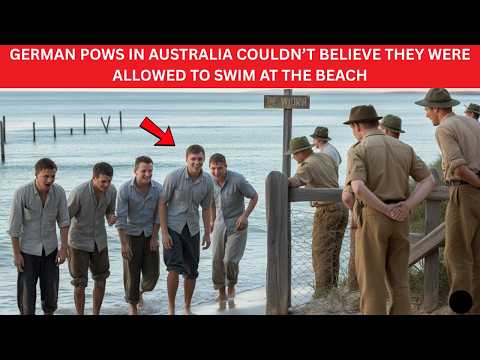
The sight of enemy prisoners swimming in Australian waters while guards sat on the beach smoking cigarettes represented a fundamental challenge to everything these men had been taught about warfare, captivity, and the nature of their enemies. “It felt surreal,” Vber later recalled, “as if the normal rules of warfare had been suspended and we had entered a parallel reality where enemies treated each other like guests at a resort.”
But how did this happen? The story begins with the circumstances that brought them there. After the November 1941 battle between HMAS Sydney and the German raider Kormoran—a clash that sent both ships to the bottom—survivors from the Kormoran were rescued from lifeboats and rubber rafts by various vessels and brought to Australian ports. The German sailors were initially transferred to Fremantle for treatment and interrogation, with nineteen requiring hospitalization. Others were distributed between detention barracks and the internment camp at Harvey, eighty-seven miles south of Perth.
These marine prisoners represented the largest single group of German POWs to arrive in Australia during the early war years, and their treatment would establish patterns that would characterize Australian policy throughout the conflict. Additional German prisoners arrived later, captured in various theaters and transferred to Australia for detention—far from any possibility of return to German forces.
The Australian government took its Geneva Convention obligations seriously. Both German and Italian ex-prisoners were unanimous in their praise of the generally humane treatment they received from military authorities. This commitment reflected a combination of legal obligation, moral conviction, and practical calculation. Australia had its own servicemen held prisoner by Germany and Japan, and maintaining high standards for enemy prisoners helped ensure reciprocal treatment for Australians in enemy hands. The government also recognized that proper treatment reduced escape attempts and made managing prison camps more efficient.
Perhaps most significantly, the decision to treat prisoners well reflected Australian national identity and values that emphasized fairness—even toward enemies. This concept would manifest in unexpected ways, including beach excursions that German prisoners found incomprehensible given their expectations of harsh confinement.
The beach swimming privileges granted to German POWs were not universal across all camps or all periods of the war, but they occurred frequently enough to become a memorable aspect of internment that numerous former prisoners mentioned in postwar accounts. The logistics required coordination between camp administrators, guards, and security personnel who had to ensure prisoners did not attempt escape while also allowing genuine recreational freedom. Guards would transport groups of prisoners to beaches, issue swimming attire, establish boundaries beyond which prisoners were not to venture, and then essentially allow unsupervised swimming for designated periods.
The trust implied by this arrangement astonished German prisoners who had anticipated prison life involving constant surveillance, harsh discipline, and minimal privileges. “We kept waiting for the catch,” one former prisoner remembered. “But it never came.”
German and Italian prisoners of war compared their conditions to being on a holiday relative to German and especially Japanese POW camps. This assessment, while perhaps exaggerated, reflected genuine shock at the quality of treatment. Prisoners received adequate food rations, lived in reasonable accommodations, and had access to recreational activities that included not just beach swimming, but also sports leagues, theatrical productions, and educational classes. The climate in many parts of Australia—particularly Western Australia, where several camps were located—offered pleasant weather that contrasted dramatically with the harsh conditions many prisoners had experienced in North African or European campaigns.
The combination of decent treatment, recreational opportunities, and environmental comfort created an imprisonment experience that bore little resemblance to the suffering prisoners had been conditioned to expect. The psychological impact of receiving humane treatment from an enemy created complex emotional responses among German prisoners. Some experienced guilt about their comfortable circumstances while knowing that German forces were committing atrocities against prisoners and civilians in occupied territories. Others felt profound confusion as Nazi propaganda narratives about Allied brutality collided with the reality of Australian guards who treated them with basic decency—and even friendliness.
Initially, the local Australian population was apprehensive when the first escapes took place. But over time they became more relaxed when they realized the Germans were not going to murder them in their beds. This gradual normalization of prisoner presence in Australian communities reflected both effective camp management and the recognition that German POWs, despite being enemy combatants, were individuals who responded to humane treatment with generally cooperative behavior.
Many recaptured POWs told of locals giving them the Australian “fair go”—or sporting chance—such as being given food and directions and told they had eight hours before they must be reported, or given work on farms. These interactions revealed something distinctive about Australian culture that German prisoners found remarkable. The concept of the fair go extended even to enemy prisoners who had escaped, with locals showing a kind of sporting attitude toward recapture that prioritized fairness over vindictiveness.
This cultural characteristic manifested in various ways throughout the prisoner experience—from beach privileges to work opportunities to the general tenor of guard-prisoner relationships that, while maintaining necessary boundaries, lacked the cruelty that characterized prison camp experiences in other contexts.
The escape attempts that occurred despite relatively comfortable conditions revealed the complex motivations driving prisoner behavior. Prisoners escaped from working parties using clever ruses, dug tunnels, and employed great ingenuity in their escape efforts. But for the most part, none got very far or were at liberty for long. The decision to attempt escape, despite good treatment, reflected military duty, boredom, desire for freedom, and in some cases, commitment to Nazi ideology that demanded resistance regardless of circumstances. Their escape preparations did not need to be as well thought out or equipped as their counterparts in Europe or Asia who could possibly be shot if caught. This lower risk of lethal consequences for failed escapes paradoxically made attempting escape more attractive, as prisoners understood that recapture would result in punishment but not execution—creating conditions where escape could be viewed as an adventure or test of ingenuity rather than a life-or-death gamble.
The internal dynamics within camps reflected tensions between different groups of German prisoners. No matter how well they were treated, there was the sheer frustration of being a POW in a strange country almost on the other side of the world with no news from the fatherland or their loved ones. With prisoners crowded together with differences of opinion on many issues—especially between Austrians and Germans, Nazi and non-Nazi—these ideological and national divisions created camp politics that sometimes turned violent, with hardcore Nazis attempting to maintain ideological discipline among prisoners who showed signs of adapting too readily to Australian conditions. The beach swimming privileges and other recreational activities became contested terrain in these internal struggles, with some prisoners viewing participation as innocent recreation while others saw it as fraternization that dishonored German military service.
The long-term impact of beach privileges and humane treatment extended beyond the immediate wartime period to influence postwar relationships between former enemies. German prisoners who experienced Australian hospitality often maintained positive feelings toward Australia after repatriation, and some chose to return to Australia as immigrants once restrictions were lifted. The memory of being treated with unexpected kindness by an enemy created lasting impressions that complicated narratives about warfare and national enmity.
Franz Vber, the Kormoran survivor who had approached his first beach visit with such suspicion, later immigrated to Australia, married an Australian woman, and built a life in the country that had held him prisoner—a trajectory that would have seemed impossible during his early days of captivity when he still expected harsh treatment, or worse.
The contrast between Australian treatment of German prisoners and German treatment of prisoners in German camps became increasingly apparent as the war progressed and information about Nazi atrocities emerged. German prisoners in Australia lived in relative comfort while millions of Soviet prisoners died in German camps from starvation, exposure, and deliberate murder. The cognitive dissonance created by this disparity forced some German prisoners to confront uncomfortable questions about the regime they had served and the moral bankruptcy of Nazi ideology.
For others, the compartmentalization remained complete—prisoners enjoying Australian hospitality while maintaining belief in Nazi principles or refusing to accept information about German war crimes. The beach swimming privileges in this context became not just recreational opportunities but sites of ideological confrontation where the reality of humane treatment challenged propaganda narratives in ways that formal education or propaganda could not.
The administrative decisions that enabled beach privileges reflected a pragmatic Australian camp management philosophy that viewed recreation as essential for maintaining prisoner morale and reducing security problems. Camp administrators recognized that idle prisoners were more likely to cause trouble, attempt escape, or develop psychological problems than prisoners who had constructive activities and occasional privileges. The beach visits served multiple purposes simultaneously: providing exercise and mental health benefits, demonstrating to prisoners that cooperation would be rewarded with privileges, and creating opportunities for guards and prisoners to develop relationships that facilitated camp management. The success of this approach was evidenced by relatively low rates of serious discipline problems and escape attempts that, while they occurred, never threatened security or required massive resource diversion to address.
The photographic record of German prisoners at Australian beaches—while limited—provides visual documentation that confirms written accounts of these remarkable privileges. Images show German prisoners in swimming attire on Australian beaches, sometimes playing in the surf or lying on the sand, with guards visible in the background but maintaining relaxed postures that suggest supervision rather than oppression. These photographs, preserved in Australian archives and occasionally in private collections of former prisoners, offer tangible evidence of a prison camp experience that diverged dramatically from stereotypical conceptions of wartime captivity. The images also reveal the strangeness of the situation from another perspective, showing young German men who weeks or months earlier had been trying to kill Allied servicemen, now enjoying recreational swimming at beaches on the far side of the world, their war effectively over while their comrades continued fighting in distant theaters.
Looking back at the phenomenon of German POWs swimming at Australian beaches provides insight into how nations choose to treat captured enemies and what such choices reveal about national values and military philosophy. Australia’s decision to maintain high treatment standards and provide privileges like beach swimming reflected confidence in military victory, commitment to international law, and cultural values that emphasized fairness. “They treated us like human beings,” Vber said, “and that changed everything.”
What does this forgotten chapter of wartime history reveal about the power of decency—and how might our world be different if such humanity were the rule rather than the exception? Share your thoughts in the comments below.
Report this article
Select a reason for reporting:






