Jennifer Walsh was inventorying estate auction items when she found the framed photograph tucked behind others in the attic of Mrs. Catherine Miller’s Charleston home. The old woman had died at 98, leaving behind a house full of family memories that none of her living relatives could identify. “Most of this stuff belonged to my aunt,” explained Patricia Adams, Mrs. Miller’s neighbor, helping Jennifer sort through the belongings. “Catherine never married and had no children, but she kept everything from her family’s past.”
Jennifer examined the formal 1922 family portrait carefully. A couple in elegant clothing stood behind an ornate chair where a woman in her sixties sat holding an infant. Two young children, perhaps eight and ten, stood on either side. Everyone wore their finest, suggesting a special occasion. “Beautiful family,” Patricia remarked, looking over Jennifer’s shoulder. “Catherine used to say this was taken at their farmhouse, but she never talked much about those days.”
Jennifer studied the photo more closely with an appraiser’s expert eye. The composition was typical of formal 1920s portraits—stiff poses, serious expressions, expensive clothing indicating wealth and status. But something about the baby caught her attention. While everyone else looked directly at the camera with calm expressions, the infant’s face was turned at a strange angle, and there seemed something unusual about its features. “Patricia, do you have a magnifying glass?” Jennifer asked slowly. “There’s something strange about this baby.”
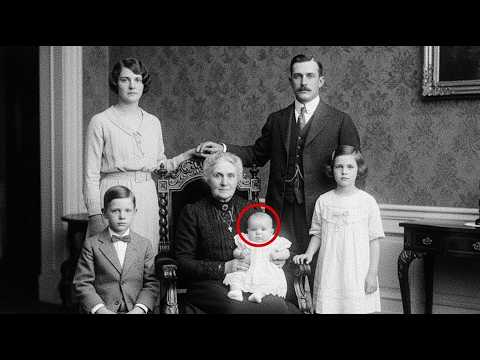
Patricia brought a small lens from Catherine’s sewing basket. When Jennifer placed it over the baby’s face, she felt a wave of nausea. The infant’s face showed clear signs of severe bruising—dark marks around the eyes and cheeks that couldn’t be shadows or photographic defects. “My God,” Jennifer whispered. “This baby has been severely beaten.”
Dr. Michael Harrison, a forensic photographer at the University of South Carolina Medical School, adjusted his high-resolution scanner to examine the 1922 photograph. Jennifer had brought it to his lab, unable to shake the disturbing image. After analyzing the paper composition and printing techniques, Dr. Harrison confirmed: “The photo is definitely original. It’s a silver gelatin print, consistent with professional photography in 1922. The aging patterns and chemical signatures all match that time period.”
Jennifer leaned forward anxiously. “But what about the baby’s injuries?” Dr. Harrison placed the photo under his strongest magnification equipment and carefully adjusted the lighting. His professional demeanor gradually shifted to concern, then horror. “This is a document of severe child abuse.” The baby’s face was now clearly visible in disturbing detail—multiple bruises around both eyes, swelling on the left cheek, what appeared to be finger marks on the infant’s neck, and bruises consistent with repeated striking. “Could these be natural marks or photographic defects?” Jennifer asked hopefully.
“No,” Dr. Harrison said gravely. “These are definitely trauma-induced injuries. The pattern and coloration are consistent with physical abuse of an infant, likely occurring within hours of this photograph being taken.” He sat back, removing his glasses to rub his eyes. In 15 years of forensic work, he’d seen countless cases of child abuse, but never documented so clearly in a formal family portrait. “Jennifer, this photograph is evidence of a crime. Someone took a family portrait immediately after severely beating this baby. The question is whether they were deliberately documenting their crime or were so cruel they didn’t think the injuries would be visible.”
Jennifer felt sick. The peaceful family gathering had become a documentation of horrific child abuse. Who would do this to an infant and then pose for a family portrait? “Someone who felt completely above accountability,” Dr. Harrison answered. “Someone who believed they would never be held responsible.”
Three days later, Jennifer found herself in the Charleston County Library archives, surrounded by genealogical records, newspaper collections, and historical documents. Dr. Harrison had connected her with Robert Chen, a local historian specializing in prominent Charleston families of the 1920s. “Formal family portraits like this were extremely expensive in 1922,” Chen explained, examining the photo. “The clothing, the background, the professional quality—all indicate wealth and high social standing.” He pulled thick volumes of social registers and family histories. “The composition suggests this might be a multi-generational portrait. Perhaps grandparents with their adult children and grandchildren.”
Jennifer pointed to the elegant woman holding the baby. “Well, she appears to be the family matriarch. The way everyone is positioned around her suggests she was the central figure.” Chen studied the background details visible in the photo. “Well, the interior design suggests a farmhouse. You can see elements of pre-Civil War architecture. Many wealthy Charleston families were still living in their ancestral homes in 1922.”
Hours of searching records revealed disturbing patterns. Chen found multiple references to wealthy Charleston families in the 1920s being investigated for various forms of domestic violence, but their cases were quietly shelved due to their social standing. The early 1920s were a particularly dark period regarding child welfare, Chen explained. There was limited legal protection for children, especially in wealthy families where authorities were reluctant to intervene in their affairs.
In the September 1922 issue of the Charleston Evening Post, Jennifer found a brief news item that made her blood run cold. “Investigation into infant death. City authorities are investigating the death of a young child in a prominent Charleston home. Family members reported the infant died of natural causes, but medical staff requested additional examination.” The article mentioned no names, but it was dated just two months after the family portrait. “Robert,” Jennifer said quietly, “what if this photograph documents the abuse that led to this infant’s death?”
Chen’s face was grim. “If so, we’re looking at evidence of a murder that was covered up for nearly a century.”
The next morning carried a suffocating humidity as Jennifer stood outside what had once been Ravenswood Farm, now a luxury hotel on the Ashley River. The mansion’s architectural details matched those visible in the background of the 1922 photograph. She met Eleanor Foster, the hotel’s historian who had worked there for 25 years, in the ornate lobby. “Ravenswood has a complicated history,” Foster explained, leading Jennifer to a private office filled with historical documents. “The farm was owned by the Beaumont family from 1847 until 1924.”
Foster pulled out boxes of family records, photographs, and newspaper clippings. “The Beaumonts were extremely wealthy and influential, but there were always dark rumors about how they treated people—both their servants and their family members.” Jennifer examined historical photos of the Beaumonts from various periods. “Can you identify anyone in my photo?”
Foster studied the 1922 portrait carefully. “That’s definitely Constance Beaumont holding the baby. She was the family matriarch. And that’s her son, William, and his wife, Margaret, with their children.” Jennifer’s heart raced. “What happened to the family after 1922?”
“That’s where the story becomes tragic,” Foster said, pulling out a file marked ‘Family Deaths.’ “Several family members died unexpectedly in the early 1920s. There were whispers of domestic violence, but nothing was ever proven.” She handed Jennifer a death certificate dated November 15, 1922. “Richard Beaumont, age 8 months, cause of death: accidental injuries from a fall.”
“An accidental fall?” Jennifer asked. “The official story was that the baby fell down the stairs,” Foster explained. “But former servants told different stories. They claimed William Beaumont had violent rages, especially when he drank, and that he regularly beat his wife and children.” Foster lowered her voice. “An elderly maid named Clara worked for the family for 40 years. Before she died in the 1960s, she told people that baby Richard had been beaten to death by his father, and that the family covered up the crime.”
Jennifer looked at the photograph again, studying William Beaumont’s face. He looked like a respectable businessman, but now she wondered if she was looking at a child killer who had posed for a family portrait immediately after assaulting his infant son.
Tension filled Dr. Harrison’s office as Jennifer, Robert Chen, and Detective Lisa Martinez—a Charleston police investigator specializing in cold cases—reviewed the disturbing evidence. Martinez had obtained sealed records from the 1922 investigation into baby Richard’s death. “The original investigation was extremely irregular,” Martinez explained, studying copies of police reports nearly a century old. “Multiple witnesses reported signs of abuse, but the case was closed within days without a thorough examination.”
She spread out documents revealing official corruption. “The Beaumont family had connections throughout Charleston’s power structure. The police chief, the coroner, even the judge had business relationships with the family.” Chen had discovered additional information about the household staff. “I found employment records showing that several servants quit the Beaumont house immediately after baby Richard’s death. That level of staff turnover was highly unusual.”
Dr. Harrison was re-examining the photograph with specialized equipment. “The baby’s injuries are consistent with shaken baby syndrome combined with physical assault. The bruising pattern suggests the child was gripped forcefully by the face and neck.” Jennifer found a handwritten statement in the police file marked “Unsubstantiated, do not pursue.” It was signed by Clara Washington, the family’s longtime cook.
“I saw Mr. William beat that baby many times. The night before the photograph was taken, he was drunk and angry about business problems. Baby Richard was crying, and Mr. William completely lost control. He shook that child so hard I thought he would kill him right then. Mrs. Margaret tried to stop him, but he hit her too.” Clara’s statement continued: “The next morning, they called the photographer as if nothing had happened. The baby could barely hold his head up, but they made us all act like everything was normal. Mrs. Constance kept saying the bruises would fade and no one would remember.”
Detective Martinez had found similar statements from other servants, all ignored by the investigating officers. Every witness who tried to report William Beaumont’s abuse was either intimidated into silence or dismissed as unreliable. Jennifer realized they had taken the photograph as proof of the family’s respectability, but instead created permanent evidence of their crime.
At the South Carolina Medical University pathology department, Dr. Patricia Wong studied high-resolution images of baby Richard’s injuries. “Even without examining the actual remains, this photograph provides compelling evidence of fatal child abuse. The severity and pattern of bruising indicate deliberate, repeated violence against an infant.” Using modern forensic techniques, she identified specific trauma types—raccoon eyes from severe head trauma, and neck bruises indicating manual strangulation.
Chen found a letter from Constance Beaumont to her sister dated October 1922. “William’s drinking has worsened since the incident with little Richard. Margaret is terrified to be alone with him. I fear for the other children’s safety, but what can we do? If word spreads about what really happened, our family’s reputation will be destroyed forever.”
Jennifer discovered Margaret Beaumont’s diary from the weeks after her baby’s death. “I cannot sleep. Every time I close my eyes, I see little Richard’s face, bruised and frightened. William says I must never speak of it, that it was an accident, but I know the truth. I know what he did.” Margaret’s final entry, written before her own death in 1923, was heartbreaking: “I leave this record for someone who might one day care about the truth. William killed our baby in a drunken rage. I pray God that justice will be done someday, even if I am not alive to see it.”
The breakthrough came when Patricia Adams called Jennifer with astonishing news. While cleaning more of Catherine’s belongings, she found a secret room containing letters and documents Catherine had hidden her entire life. “Catherine was a Beaumont,” Patricia announced. “Her real name was Catherine Beaumont Morrison. She was William Beaumont’s younger sister, and she carried the guilt of what her family did her entire life.”
Catherine’s testimony, written in 1945, revealed everything. “I was only sixteen in 1922, but I saw it all. I watched my brother beat that innocent baby until he nearly stopped breathing, then forced us all to pose for a photograph the next day as if nothing had happened. Mother insisted the family’s reputation mattered more than justice. I have lived with this shame my whole life.” She had kept the photograph all those years as evidence, hoping someone would finally seek justice for little Richard.
Six months after the discovery, Jennifer stood in the memorial garden for baby Richard Beaumont in Marion Square. The case had sparked widespread reforms in how historical child abuse crimes were investigated. Dr. Harrison worked with Charleston police to develop new protocols for examining historical evidence. Martinez used the Beaumont case to identify patterns of corruption that had protected child abusers for decades, reopening at least 20 suspicious child death investigations.
Patricia Adams worked with child protection agencies to ensure Catherine Miller’s legacy funded programs helping at-risk children. “Catherine spent her life trying to atone for her family’s sins,” Patricia said. “This foundation continues her work.”
Jennifer often returned to view the 1922 family portrait, now displayed in the memorial garden with full context about Richard’s murder and his family’s cover-up. When visitors asked about the baby’s injuries, she explained how one photograph exposed a century-old murder and inspired modern child protection reforms. Baby Richard’s bruised face finally spoke the truth his family had tried to silence, ensuring his death would protect other children from similar violence.
But as Jennifer looked at the peaceful garden, she couldn’t help wondering: how many other family portraits, hanging in quiet homes across the country, hold similar dark secrets waiting to be discovered?
Report this article
Select a reason for reporting:






