December 1941. The transport ship’s hull groaned as it slid into Sydney Harbor, and below deck, forty-three German sailors sat in silence, their ribs showing through salt-stiffened shirts. They had been told Australia was a brutal penal colony where the master race would be worked to death under a burning sun. Their commander, thirty-year-old Klaus Veber, had already made peace with dying. He just hoped it would be quick.
Propaganda films had shown them guards beating prisoners in rock quarries until their hands bled. “The English colonials are savages who show no mercy,” the Nazi officers had repeated. Veber believed it. Why wouldn’t he? Every newspaper, every radio broadcast, every word from Joseph Goebbels’ mouth confirmed it. Germany was superior. The British Empire was weak and dying. Victory was inevitable.
But when the cargo hold doors opened, an Australian guard with sun-weathered skin actually smiled. “Right then, gentlemen,” he said, holding his rifle loosely at his side. “Let’s get you lot sorted and fed.”
Fed. The word seemed foreign. For three weeks, the prisoners had eaten thin soup and hard bread. Several men had scurvy. Veber expected interrogation rooms or work camps. Instead, trucks arrived, and guards handed each man a canteen of cold, fresh water. Veber hadn’t tasted cold water in months.
The trucks drove for two hours through countryside that looked nothing like the propaganda films. Green fields stretched in every direction. Cattle grazed on rolling hills. Farmhouses stood untouched—no bomb craters, no burned villages, no columns of refugees. Veber felt the first crack in his understanding of the world.
The camp near Cowra, New South Wales, was clean. Wooden barracks stood in neat rows behind wire fences. Guard towers rose at each corner, but they looked almost decorative. The commandant, a gray-haired Australian major, met them at the gate and spoke through an interpreter.
“You will be treated according to the Geneva Convention,” he said. “You will receive adequate food, shelter, and medical care. In return, we expect you to follow camp rules and behave like soldiers, not animals.”
Veber was assigned a bunk with a real mattress and two thick wool blankets. The barracks had glass windows and a wood stove. Everything was basic but functional—far better than many German soldiers had back home in their own army bases.
Then came dinner.
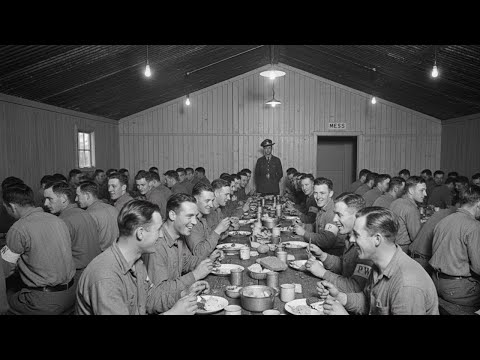
The mess hall opened at six. Australian cooks in white aprons stood behind a serving counter. Veber held out his metal tray. The first cook dropped a piece of beef onto his plate—thick as his palm and still steaming. The second added three large boiled potatoes. The third spooned out carrots and green beans. The fourth placed two slices of white bread on the tray. Real white bread, not the sawdust mixture German bakeries used. The final station offered butter. Actual butter.
Veber sat down with five other sailors. Nobody spoke. They just ate. The beef was tender and seasoned with salt and pepper. The bread tasted like something from before the war—peaceful Sunday mornings when his mother baked in their kitchen in Hamburg. This single meal contained at least a thousand calories. He had just eaten in one sitting what a German civilian got for an entire day.
His hands started shaking. A young sailor named Ernst looked up with tears in his eyes.
“They’re feeding us better than our own army feeds its soldiers,” Ernst whispered.
Veber nodded slowly. He couldn’t find words. Somewhere in his mind, a small voice asked a question he didn’t want to hear: If the enemy treats us this well, what does that say about everything we were told?
The routine at Cowra settled into a pattern that felt increasingly unreal. Every morning at seven, a bell rang for breakfast: porridge with milk and sugar, two eggs each, toast with jam, and real coffee made from beans—not the acorn substitute German families had been drinking since 1940.
Veber learned that the Australian government allocated each prisoner approximately 3,500 calories per day. The number haunted him. His wife’s last letter, smuggled through the Red Cross, mentioned she and their daughter were surviving on watery turnip soup and one slice of bread daily. She had stood in line for four hours to receive a tiny portion of margarine.
Meanwhile, Veber spread real butter on his toast every single morning.
By the third week, the prisoners discovered the camp canteen. Shelves held items that seemed like fantasy: cigarettes for a few pennies, chocolate bars made in Melbourne, hard candies in glass jars. Veber bought a chocolate bar and held it for several minutes before unwrapping it. Australia was making chocolate for prisoners while Germany couldn’t make chocolate for its own children. He ate it slowly, letting each piece melt on his tongue, feeling a strange mixture of gratitude and shame.
In February 1942, work assignments began. Veber volunteered for a nearby wheat farm owned by a man named Robert McKenzie. The farm stretched across 1,200 acres. McKenzie treated the German prisoners exactly like his regular workers—same lunch, same hours, same shade during breaks. His wife brought out sandwiches: thick slices of ham between fresh bread with lettuce and tomato, and a jug of cold lemonade. Veber bit into his sandwich and tasted mustard—real mustard made with vinegar and spices. The flavor exploded in his mouth. He had forgotten food could taste this good.
One of McKenzie’s workers, a young man named Tom, sat down next to Veber and offered him a cigarette. “You blokes getting treated all right at the camp?” Tom asked.
Veber nodded, struggling to find English words. “Very good. More good than home.”
Tom looked confused for a moment, then understanding crossed his face. “Yeah, I suppose Jerry’s having a rough go of it back in Germany, eh?”
Veber didn’t know what to say. He just nodded again. The wheat fields seemed endless. Massive harvesting machines moved through the crops, cutting and bundling grain faster than any equipment Veber had seen in Europe. McKenzie explained through gestures that Australia exported wheat to Britain and other Allied nations. Even during wartime, Australia produced more food than it could eat.
The contrast stabbed at Veber’s mind. Germany was starving while fighting for Lebensraum—living space—supposedly because Germans needed more land to feed themselves. Yet here was Australia, roughly the same size as Europe, feeding itself and half the Allied war effort with room to spare. Something about the Nazi propaganda wasn’t adding up.
Back at camp, the differences continued piling up. Every Wednesday, trucks delivered fresh fruit: oranges from Queensland, apples from Tasmania, sometimes bananas from coastal plantations. Each prisoner received three pieces of fruit per week. Veber saved his oranges for two days, just looking at them before finally eating them. The juice ran down his chin and he almost cried. In Germany, oranges were something rich people ate before the war. Now enemy prisoners in a prison camp ate them weekly.
The absurdity of it pressed down on his chest. And somewhere deep inside, the first seeds of a dangerous question began to grow.
Christmas 1942 arrived with summer heat and clear blue skies. The camp commandant announced a special holiday meal, and Veber expected perhaps slightly larger portions than usual. Instead, the mess hall transformed into something resembling a restaurant.
Australian cooks had prepared roasted turkey for all two hundred prisoners. Each man received a full plate with stuffing, roasted potatoes, carrots, peas, and gravy. For dessert, plum pudding with custard sauce. The guards ate the same meal alongside the prisoners. One guard, a middle-aged man named Bill, sat at Veber’s table and shared stories about his own Christmas traditions. He showed Veber a photograph of his family and asked if Veber had children.
Veber showed Bill a creased photo from before the war—his wife holding their infant daughter, both smiling at the camera. Bill smiled and said she looked like a sweet kid. Then he pulled out two cigarettes, gave one to Veber, and they smoked together like old friends.
That night, Ernst whispered the question others were thinking. “Why do they treat us so well? We’re bombing their allies. We’re killing their soldiers.”
An older prisoner named Friedrich, who had fought in the First World War, had a theory. “They follow rules,” he said. “The Geneva Convention—they actually follow it. And they have so much they don’t need to starve us. Look around. This country hasn’t been touched by war.”
Veber started noticing other details. The guards never screamed or hit prisoners. There were no propaganda sessions, no required lectures about Australian superiority. The camp had a small library where prisoners could borrow books in German. Some were even taking English classes taught by a local schoolteacher who volunteered twice weekly.
The contrast with SS brutality back home was stunning. Veber remembered watching SS officers beat a man unconscious for speaking Polish in occupied territory. Here, Australian guards played cricket with prisoners during recreation time.
Italian prisoners arrived in March 1943, captured in North Africa and shipped to Australia like the Germans. Veber spoke with several who had basic German. They reported the same treatment: good food, fair guards, work opportunities. One Italian named Marco laughed and said, “My family in Sicily is eating grass soup. I’m eating roast beef in prison. The world has gone mad.”
Veber agreed. The world had indeed gone mad—but perhaps not in the way Hitler’s propaganda claimed. Perhaps the madness was believing Germany was superior when the evidence suggested otherwise. That thought scared him more than any Australian guard ever could.
The moment everything changed came on a Saturday afternoon in April 1943. The camp education officer, a former teacher named Lieutenant Harris, posted a notice on the barracks wall. The Australian government was offering correspondence courses to prisoners who wanted to continue their education. University-level courses.
Veber stood in front of that notice for ten minutes, reading it over and over. Mathematics, English literature, agricultural science, mechanical engineering. Prisoners could study and receive credit recognized after the war. In Nazi Germany, higher education was reserved for party members and the wealthy. Now his captors were offering him a university education while he sat in a prison camp.
He signed up for English and basic engineering. The textbooks arrived three weeks later, shipped from a university in Sydney. Real textbooks with clean pages and detailed diagrams. Veber opened the English textbook and saw notes written in the margins by previous students—normal students, free students, Australian young people who took this education for granted. He ran his fingers over the pages and felt something crack open inside his chest.
The propaganda had called these people inferior colonials, weak British servants who would crumble before German strength. Yet these supposedly inferior people had universities, books, resources to spare—even for enemy prisoners.
Veber had believed his entire adult life that Germans were the master race destined to rule Europe. That belief was becoming harder to maintain when the master race was starving while the colonials offered university courses to their prisoners.
The breaking point came in December 1943, when Robert McKenzie invited Veber to Christmas dinner at his family home. The table seated eight, and nobody treated him like an enemy. Mrs. McKenzie served roasted lamb with mint sauce, roasted potatoes, pumpkin, and fresh bread rolls. “To peace and better days ahead for all of us,” McKenzie toasted, and Veber lifted his glass with shaking hands.
Young Tommy McKenzie asked about Germany and studied the worn photograph of Veber’s wife and daughter. Mary Patterson, the elderly neighbor, patted his hand. “This dreadful war. I hope you’ll be reunited with them soon.” These people showed him more compassion than his own officers ever had.
That week, Veber began a diary. “Everything we were told was a lie,” he wrote. Australia had cars, radios, holidays, and full schoolchildren. Germany had chosen conquest and reaped rubble. He hid the notebook under his mattress, terrified even in captivity.
By mid-1944, the transformation was complete. Germany had lost the war morally before it began. When news of the surrender arrived in May 1945, Veber felt only hollow emptiness. Ernst whispered, “I don’t want to go back. There’s nothing left there.”
Five hundred prisoners applied to remain. Veber’s application was stamped pending, and in February 1946 he sailed home carrying McKenzie’s gifts and his textbooks. Hamburg was mountains of rubble. His wife had died in the winter of 1944; his daughter, now ten, studied his face and nodded without tears. McKenzie’s fifty pounds kept her alive that summer.
In 1951, sponsored by McKenzie, Veber and his daughter returned to Australia. He lived to seventy-eight, and when a student asked why he came back, he said: “Propaganda dies when confronted with breakfast. Abundant, daily, real breakfast.”
What would it take for you to unlearn everything you were taught?
Report this article
Select a reason for reporting:






