Tommy Lee Jones looked the writer in the eye and corrected him: “It’s not a tribe. It’s a nation, the Cherokee Nation.” It was May 2000, on his ranch in West Texas, and the actor was speaking about his grandmother. That single sentence would echo for decades, repeated in magazines, news reports, and even his Wikipedia page. But there was a problem. Jones had two grandmothers. He never said which one he meant.
One was Mary Elizabeth, who died when he was three. The other was Lillian, who lived until he was twenty-two. Two women, two very different lives, and one family story that had become part of his public identity. When AMC wanted him to direct a drama about the Carlisle Indian School in 2012, reports cited his Cherokee ancestry as a reason for their choice. The story had legs. But no one had ever named the grandmother or quoted a single record about her.
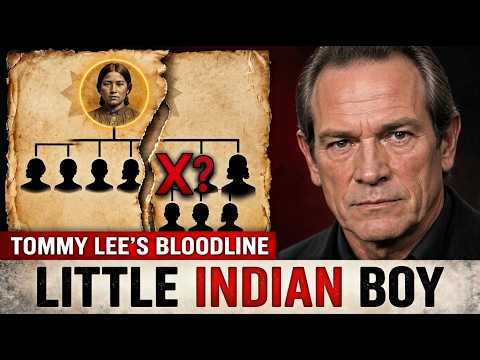
That’s where the paper trail begins. Census sheets. Death records. A draft card. Gravestones. Every census line that records a race for his grandparents and great-grandparents says white. Not one says Indian. Not one says Cherokee. Three generations of documents, and every page agrees.
But paper can be wrong. A census taker wasn’t a scientist. He wrote down what he saw or what the family told him. And family stories have a way of filling in blanks that records leave behind. So the question remains: could there be a Cherokee grandmother hidden somewhere in the branches?
The answer, if it exists, might lie in a single name. Harriet Walls, born in North Carolina around 1837, Tommy’s great-great-grandmother on his father’s side. No record found so far gives her mother’s name. But one celebrity genealogy website, posted in 2017, fills that blank with a name: Nikameha, said to be a Native American woman. No tribe. No date. No source. Just a name and the words “said to be.”
Could that be where the story started? Or is it just another branch of a legend that has grown for generations? The answer isn’t in the records yet. But the search is just beginning.
The Cherokee Nation has its own answer to that question, and it doesn’t come from a website. It comes from law. To enroll today, you must trace your family straight back to a name on the Dawes Rolls, the federal list compiled between 1898 and 1907. A DNA test won’t do it. A family story won’t do it. It has to be a name on that roll.
So the rolls are the next place to look. The Oklahoma Historical Society keeps a free index online. Type in Bradshaw and about forty names come up on Cherokee cards. Type in Scott and you get a longer list still. But when you read the cards closely, something strange happens.
There is a Lenny Scott on the Cherokee rolls. Female, age eighteen, full blood, roll number 20770. For a moment, it looks like the answer. Tommy Lee Jones’s great-grandmother was named Lenny Scott. Could this be her?
Read the rest of the card and the answer falls apart. This Lenny Scott was married to a man named Larkin Forkiller, and she was born Lenny Melinda Martin in Cleburne County, Alabama. The other Lenny Scott, Archie’s mother, was born in Alabama too, but she married John Nathaniel Scott and raised eleven children in Texas. Same name. Two different women. One was a Cherokee citizen. The other was a white Southern girl who never appears on the roll at all.
It’s exactly the kind of match that turns into a family legend when nobody reads the whole card. A name gets remembered. The rest gets lost.
Then there’s the Guion Miller Roll, the list of Eastern Cherokee who applied for a cash settlement between 1906 and 1909. Nearly 46,000 people applied. Only about 30,800 were approved. Two out of every three were turned away. With money on the table, families stepped forward who had never claimed Cherokee before.
Tommy’s great-great-grandparents, Elijah Green and Harriet Walls, came from North Carolina, the heart of Eastern Cherokee country. If any branch of this family had a claim, that was the moment to make it. But no Nash from Texas appears on the list. No Walls from Texas. No Bradshaw from Texas. The door was open, and this family didn’t walk through it.
So what was a white Texas family doing in the Choctaw Nation in 1906? The answer is simpler than it looks. By 1900, most people living in Indian Territory weren’t Indian at all. The census counted about 392,000 people there. The federal Indian agent put the number of Indians at roughly 70,000. Fewer than one in five.
The rest were farmers, railroad men, and miners. In the coal country around McAlester, a quarter of the residents had been born in another country. A baby born there in 1906 was born in Indian Territory. That didn’t make her Indian any more than a baby born in a mining camp was a miner.
And that brings the whole story together. Two grandmothers. Four grandparents. Their parents, and as far back as the census reaches, their parents too. Every line that records a race says white. Not one of them is on the Cherokee rolls.
That doesn’t make Tommy Lee Jones a liar. Family stories get handed down, and most people believe what they were told. But the papers his family left behind don’t back this one up. Nobody wrote down where the Cherokee grandmother came from.
There is one possibility, and it’s only a guess. Lillian may have grown up hearing she was born in the territory. Over two generations, born in Indian Territory could easily soften into Indian. It’s a guess, not a finding. But it’s the kind of guess that explains a great many family legends.
And there’s one name in this family the census can’t reach. Harriet Walls, born in North Carolina around 1837. No record found so far gives her mother’s name. One genealogy page fills that blank with Nikameha. No tribe. No date. No source. Just a name and the words said to be.
So who was Nikameha? And could she be where this whole story started? Before getting to her, there’s a bigger question to answer. Tommy Lee Jones is far from the only American with a Cherokee grandmother story. And how many people tell that same story says a lot about how it begins.
In 2020, the U.S. census asked Americans about race and tribe. More than 1.5 million people wrote in Cherokee, alone or alongside another answer. That made Cherokee the biggest tribal write-in in the country. More people claimed Cherokee on that census than the entire population of Hawaii.
Now count the citizens. The Cherokee Nation enrolls more than 470,000. The Eastern Band in North Carolina has about 16,000. The United Keetoowah Band in Oklahoma, another 14,000. Altogether, roughly half a million enrolled Cherokee citizens. So for every one of them, about three Americans told the census they were Cherokee.
And the number keeps climbing. In 1990, the census counted about 308,000 Cherokee. By 2020, it was nearly five times that. The rules changed in 2000, and people could pick more than one answer. But that’s still a lot of new Cherokee answers in thirty years.
The historian Gregory Smithers has studied exactly this. He found that in the 1840s and 1850s, many white Southerners began claiming a Cherokee great-grandmother. Often she was a princess. The timing matters. The Cherokee had just been forced out of the Southeast on the Trail of Tears. And once they were gone, white Southerners began to romanticize them.
Smithers argues that a Cherokee ancestor made a family feel deeply rooted in the land, as if they had always belonged there. There was one problem with the princess. The Cherokee Nation says the title never existed in Cherokee culture. Outsiders sometimes called a chief’s daughter a princess. But there were no Cherokee princesses.
Look at Tommy Lee Jones’s family again. North Carolina. Tennessee. Alabama. Mississippi. Georgia. Kentucky. Arkansas. Then Texas. That’s exactly the kind of Southern family Smithers was writing about. Families that moved west one generation at a time, through the old Cherokee country and beyond it.
None of that proves where his family story began. It shows how ordinary it is. And it raises the obvious question. Couldn’t a DNA test just settle it?
In October 2018, a United States senator tried exactly that. Elizabeth Warren had grown up with a family story of Native ancestry. She released a DNA analysis done by a Stanford geneticist. His report suggested she likely had a Native American ancestor six to ten generations back.
But there was a catch. The comparison wasn’t Cherokee at all. For his Native American reference, the geneticist used DNA from thirty-seven Indigenous people in Mexico, Peru, and Colombia. The Cherokee Nation answered the same day. Its secretary of state said plainly that a DNA test is useless to determine tribal citizenship. Current tests can’t even tell North American Native ancestry from South American.
A test that can’t tell a continent can’t tell you a tribe. The scholar Kim Tallbear made the same point in a 2013 book. Belonging to a tribe is about law and politics, not just genes. The Cherokee Nation’s own rules say the same thing. DNA results aren’t accepted as proof. Neither are family photos or genealogy websites. It comes back to that list, the Dawes Rolls.
So even if Tommy Lee Jones took a DNA test tomorrow, it couldn’t come back saying Cherokee. At most, it could hint at some Native American ancestry from somewhere a long time back. And there’s one last piece of this story, and it ends in his home county in Texas.
The Cherokee did have a presence in East Texas once, around 1820. A leader named Chief Bowl brought about sixty families into the region. By 1830, there were roughly four hundred Cherokee there. But in July 1839, Texas forces drove them out at the Battle of the Neches. Chief Bowl was killed. The survivors were pushed north across the Red River into Indian Territory.
That was seventeen years before San Saba County was even organized. The Native peoples of the San Saba country were the Comanche, the Apache, the Tonkawa, and the Kadohadacho. Not the Cherokee. There is a little community called Cherokee in San Saba County, named for a stream called Cherokee Creek. The local histories don’t say how the creek got its name. And none of the records for Jones’s grandparents put them there.
The paper keeps pointing one way. But one name in his tree is still open. So Nikameha, here’s everything the record can say about her, and it isn’t much. Start with her daughter, because Harriet is real. She’s right there in the 1860 census in Johnson County, Texas. Harriet Green, age twenty-three, born in North Carolina, married to Elijah, who was thirty and also from North Carolina.
Three small children. John was born in Tennessee. Joseph in Arkansas. And the baby Mary Jane in Texas. Picture that for just a moment. A woman of twenty-three with a toddler, a little boy, and a baby girl just a few months old. In about three years, she’d lived in three different states.
Elijah’s grave memorial adds a little more. Before Texas, it places him in Cannon County, Tennessee, in 1850. That’s just across the mountains from western North Carolina. It also says he served as a private in the Fifth Texas Cavalry during the Civil War. He died in 1898 at Glen Rose and is buried there. Harriet didn’t live that long. Family trees say she died around 1880, when she was only in her early forties.
That’s Harriet. Now her mother. Online family trees, which don’t cite their records, say Harriet was born in Haywood County, up in the mountains of western North Carolina. It’s old Cherokee country. The same trees name her father as John Walls. And for her mother, the free tree site WikiTree simply says unknown.
Then there’s that one celebrity page from 2017. It’s the only place found so far where the name Nikameha turns up. It doesn’t name a tribe. It doesn’t give a source. And it says itself that it’s not clear the claim is true. So here’s the honest part. Nobody can prove Nikameha existed, and nobody can prove she didn’t.
So the story ends where it began: on a West Texas ranch, with a man who knew exactly what a nation was. He was right about the word and wrong about the grandmother. The Cherokee Nation keeps its roll, name by name, and neither Mary Elizabeth nor Lillian is on it. Neither is Nikameha, the ghost on a single unsourced page.
What survives instead is something quieter and just as real. A girl from Ellis County. A girl born two days before her own daughter’s birthday. A bit from 1919, still in a cowboy’s mouth.
That’s a family worth knowing just as it was.
So tell me — what’s the story your family tells, and have you ever gone looking for the paper underneath it?
Report this article
Select a reason for reporting:






