The room was supposed to be a stage for a legend. A defeated SS general, a bulldog’s growl, a revolver slammed onto a desk—the story of Patton’s interrogation has been told a thousand times, each retelling louder and more cinematic than the last. There’s just one problem: none of it happened. Not the gun, not the dog, not the threat. The real version is colder, smaller, and far more unsettling—because it shows a man who didn’t need theatrics to strip another human being of his rights.
But to understand why the myth feels so necessary, you have to understand the man it was built around. George S. Patton wasn’t just a general. He was a performance, a weapon forged on purpose, and a soul convinced he’d already died a dozen times before.
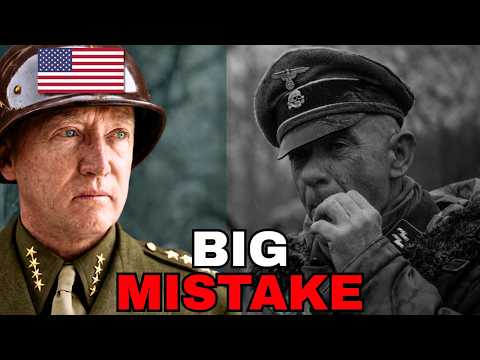
Everything about Patton’s public self was deliberate. The ivory-handled revolvers—never pearl, he’d correct you sharply. The lacquered helmet with stars that caught light from a hundred yards away. The white bull terrier named Willie riding shotgun in the Jeep. He built the image the way an engineer builds a machine, every part chosen to make men look and listen.
Yet beneath that lacquered surface lived a man almost nobody knew. He didn’t learn to read until he was eleven years old. Before that, he assumed he was simply stupid. Classmates mocked him. He memorized long passages by ear because reading them off a page was nearly impossible. At West Point, he failed mathematics and was held back an entire year, watching his classmates graduate ahead of him while he started over from scratch.
Today we’d call it dyslexia. Nobody had that word for him then. So he built a voice—high, thin, almost reedy—and covered it with swearing. A general with a voice like that needed something else to make men listen. The gravel you hear in the movies? Pure Hollywood.
And then there was the other thing. The thing almost nobody puts in the reel. Patton genuinely believed he had already died as a soldier, more than once. He claimed to have fought as a Greek spearman against the Persians, as a Carthaginian under Hannibal, as a knight at Agincourt, as a marshal under Napoleon. When a British general joked that Patton would have made a fine marshal for Napoleon, Patton didn’t laugh. “But I did,” he said flatly.
He wrote ninety-six lines of poetry about it—one soul returning again and again, always a soldier, always dying the same kind of death. He seemed certain he already knew how his story was supposed to end. Hold on to that certainty. It doesn’t end the way he imagined.
November 19th, 1944. Third Army troops are clearing Metz, a fortress city the Germans have held for weeks. Soldiers from the 10th Infantry Regiment find a man hiding inside a brewery. Not a private. Not a corporal. SS Brigadeführer Anton Dunckern—Gestapo and SS Police Chief for the entire Metz sector, a personal friend of Himmler, a man who had marched with Hitler back in 1923. The highest-ranking SS officer Third Army has caught so far.
Word reaches Patton. He decides he wants this one himself. Not for information. For something else entirely.
Here’s what you’d expect from that room. A general, even an SS general, expects to be treated like one. Officer to officer. Maybe a translator. Maybe the basic courtesy the Geneva Convention is supposed to guarantee every man wearing stars on a collar. Patton gives him none of it.
He won’t even speak German to Dunckern, though he could. Refusing him, in Patton’s own words, the honor. Through an interpreter, he says he can’t be bothered to question the man personally because out of every German general he’s captured, this is the first one wholly untrue to everything. A Nazi who betrayed even the Nazis by surviving instead of fighting.
Dunckern tries to explain. He says he couldn’t reach his weapon in time to fight back. That’s the only reason he’s alive.
Patton doesn’t blink. “He is a liar,” he says. Four words. Flat.
Then comes the part every viral version gets wrong. There’s no gun on the table. Patton doesn’t need one. He tells Dunckern exactly what happens if he doesn’t start talking. “I will turn him over to the French. They know how to make people talk.”
And what makes this unusual isn’t a pistol slammed down for effect. It’s what happens after the room clears.
Patton doesn’t send Dunckern to a standard POW camp and let the rules take over. He has him reclassified—not as a prisoner of war, but as a political detainee. Stripped, on the spot, of protections every other captured German officer in Third Army’s custody still had. That’s not a threat shouted across a desk. That’s a man quietly rewriting the rules in real time because he decided this particular prisoner hadn’t earned the ones already written.
So where did the gun on the desk actually come from? Almost certainly Hollywood. The 1970 film Patton leans hard into pistol theatrics that the real transcript—preserved in Patton’s own papers—simply doesn’t contain. No Willie in the room. No I will personally shoot you where you stand. Just contempt, an interpreter, and a piece of paperwork that quietly ended a man’s rights.
It’s a better story precisely because it’s smaller and colder than the fake one. And Metz isn’t the only place Patton’s real story got quietly rewritten into something louder. Some of those rewrites, it turns out, started a lot closer to home than a movie script.
Because while Hollywood was busy inventing a gun on a desk, the people who actually knew Patton were busy inventing something else entirely—a version of the man they could live with. And the loudest of those rewrites didn’t come from a screenwriter. They came from the men who served under him, and from the family who endured him.
Take the necktie. March 1943, Tunisia. American troops have just been mauled at Kasserine Pass, outfought and sent running by an army half of them assumed was already broken. You’d expect the fix to take months—retraining, new equipment, a strategy overhaul from the top down. Patton takes command of Second Corps and does something almost embarrassingly small instead. He makes every officer wear a necktie in combat. He fines soldiers twenty-five dollars—half a private’s monthly pay—for showing up without a helmet strapped on, even near the latrine.
It looks petty. His own deputy, Omar Bradley, said every knotted necktie was a soldier being reminded the sloppy days were over. Three weeks later at El Guettar, Second Corps stops the 10th Panzer Division cold—the first time American troops beat German armor outright in the war. That’s the man the myth is built on. Not the desk-slamming phantom. The pedant with a necktie and a fine book.
But the myth needed a villain’s fury, and it found one in his own household. His wife, Beatrice, was cut from the same cloth. At a formal dinner in Washington not long after the First War, a desk-bound officer sneered within earshot about little boys getting promoted to colonel. The next thing anyone remembers, Beatrice was sitting astride the man’s shoulders, banging his head against the marble floor until Patton and another officer pulled her off him.
Then there’s his son. During the entire Second World War, by most accounts, Patton saw him exactly twice. Their relationship survived almost entirely on paper—weekly letters to a cadet at West Point. When George Jr. was accepted into the Academy, his father’s congratulations read, “We are really proud of you for the first time in your life. See to it that we stay that way.”
Their daughter had her own line about him, muttered once after he’d yelled at her mid-riding lesson: “Dear God, please let that son of a bitch break his neck.” Nobody thought twice about it at the time. It was just the way the Pattons talked to each other—sharp, theatrical, a family performing toughness the way the general performed war.
April 25th, 1944. Six weeks before D-Day. Patton is asked to say a few off-the-record words at the opening of a servicemen’s club in a small English town called Knutsford. Nothing prepared. Nothing official. He tells the crowd it’s the evident destiny of the British and Americans—and of course the Russians—to rule the world.
Off-the-record doesn’t mean off the page. The quote runs in papers worldwide within a day, and early versions leave the Russians out entirely, turning a throwaway line into an international incident six weeks before the most important invasion of the war. Eisenhower doesn’t relieve him, but he puts it in writing. One more incident like this, and Patton is finished. Instantly. No discussion.
So Patton sits in England on June 6th, 1944, while the invasion he’d spent his whole career preparing for happens without him. That night he writes to Beatrice, “It is hell to be on the sidelines and see all the glory eluding me.”
He got another chance. He never fully learned the lesson.
September 22nd, 1945. The war in Europe is over, and Patton is military governor of Bavaria, responsible for denazification—removing former Nazi officials from power. At a press conference, he says he doesn’t see the need for this denazification thing, and compares it to a Democratic and Republican election fight back home.
Walking out afterward, he tells an aide the truth quietly. “Stupid goddamn mistake. I knew better, but I wouldn’t give the son of a bitch the satisfaction of knowing it.”
Knowing better doesn’t save him. Eisenhower summons him to Frankfurt and tells him flatly, “George, you have broken the back of our policy.” Ten days later, Patton is relieved of Third Army—the army he built, the army that broke the siege at Bastogne—and handed a desk job writing history instead of making it. His own summary of the day: “I’ve just been fired by the best friend I ever had.”
Remember the reincarnation? The soldier certain he’d already died a dozen times before, certain he knew exactly how a warrior’s story was supposed to end? He’s quoted endlessly saying there’s only one proper way for a professional soldier to die. The last bullet of the last battle of the last war.
He never said it. It’s a line from the 1970 film, put in his mouth by a screenwriter twenty-five years after he was gone. No letter, no document, no witness places those words in the real Patton’s mouth.
Here’s what actually happened. December 9th, 1945. Eight months after the war in Europe ended. A pheasant hunting trip outside Mannheim, passing the wrecked, burned-out vehicles still littering the road. Patton says, almost to himself, “How awful war is. Think of the waste.”
Minutes later, an army truck turns into his car’s path at a crawling speed. He’s thrown forward and breaks his neck. Paralyzed, but still talking, he tells the man beside him, “This is a hell of a way to die.”
Twelve days later, he’s gone. Sixty years old. Killed not by the enemy, not by the last bullet of the last battle, but by a truck on a wet road and a broken neck. Exactly the way his own daughter once wished on him, without meaning a single word of it.
The myth needed a gun on a desk. The man needed none. He was colder than the legend, smaller than the movie, and more human than either—a soldier who believed he’d died a dozen times, undone by a fender and a wet German road.
If this is the first time you’ve heard the real version instead of the movie one, that’s exactly the gap this channel exists to close. Which legend have you repeated at a dinner table without knowing it was fiction?
Report this article
Select a reason for reporting:






