In October 2003, two SEAL Team Six operators returned from Helmand and requested transfers within 48 hours. They had spent just one night in a compound outside Sangin with four British soldiers from a unit most Americans had never heard of. By dawn, the American lieutenant commanding the operation wrote a two-word line in his after-action report that command quietly classified within the week. Those words never appeared in any briefing slide, joint statement, or congressional testimony for 17 years.
Wait—SEAL Team Six requested transfers? The same unit that took down Bin Laden eight years later? That’s the part that breaks the model. Because what those two operators witnessed four British soldiers do that night wasn’t faster, louder, or more aggressive than their own training. It was something the American military—with its satellites, drones, and $40 billion special operations budget—had never been forced to develop.
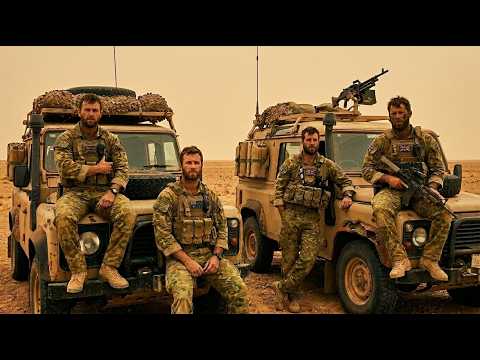
Two years before that night, the British Special Air Service (SAS) had been doing something the Americans hadn’t: they had been in Afghanistan continuously. Not in rotation, not in three-month deployments back to Coronado or Fort Bragg between tours—continuously. By October 2003, the regiment had been working that country for 23 unbroken months. Northern Alliance liaison, interdictions on the Pakistan border, Operation Trent—the largest SAS operation since World War II—reconnaissance into the Helmand Desert. Two years of accumulated institutional knowledge about exactly this ground, this enemy, this province.
The Americans had a 45-kilo kit and the most advanced night vision in the world. The British had two years of memory—and no procurement budget can buy memory.
The October 2003 operation began at a Helmand airstrip with a contrast that in retrospect told the entire story. Eight SEAL Team Six operators stepped onto the ground carrying 45 kg of equipment each: laser designators, suppressors, third-generation night optics, and encrypted radio arrays. Four British soldiers stepped off the same airframe carrying 30 kg. The squadron sergeant—a man we’ll call Briggs to keep the names out of court—was holding a rifle so worn the matte black had rubbed off the receiver, revealing bare aluminum underneath. Lieutenant Mercer, commanding the American element, watched Briggs handle that weapon and made a quiet assumption about reserve units and worn-out kit. He was wrong.
Briggs had been carrying that specific rifle for nine years. He had carried it through Sierra Leone in 2000. He had carried it through three tours in Northern Ireland before that. The wear on the receiver was the receipt for those years—and the rifle was clean. That’s the kind of detail that makes intelligence officers stop talking mid-sentence. The man with the cheapest-looking kit had the most expensive education in the room.
They moved out at 2:00 a.m. Three hours later, Briggs had counted the American radio transmissions and reached a number that worried him. The SEAL Team Six element transmitted every 30 minutes: position checks, waypoint confirmations, equipment status—standard professional procedure under any U.S. doctrine. The four British soldiers transmitted twice in the same period. Both times a single word.
Mercer eventually pulled level with Briggs and asked quietly why his men weren’t checking in. Briggs answered with a sentence the SAS had absorbed through more than two decades of operations against the Provisional IRA: “Every transmission tells someone where you are.” The IRA had spent years inside Northern Ireland building patrol-pattern intelligence out of nothing but radio signatures—frequencies, intervals, electronic fingerprints. Men had died before that lesson fully landed inside the regiment. Once it did, it stayed.
Pay attention to this next bit, because this is the part that should bother you. The Americans had never been put in an environment where an unnecessary radio call came back to them in a body bag. Their radio discipline was professional by Briggs’s standard—but by the standard of an army that had lost friends to it, it was a liability they had never been forced to see.
At 3:52 a.m., 800 meters from the target compound, the patrol hit a problem nobody had planned for. A dry wadi cut across their approach route—4 meters deep, loose limestone, near-vertical sides. The satellite imagery used in the brief was three months old. The erosion that opened that ground had happened after the imagery was taken.
Mercer had three options: reroute, call for updated overheads, or go through quietly. Briggs looked at it for ten seconds and said, “We go through.”
What followed had no training reference in the American playbook. The lead British soldier descended the near wall in eight minutes. Eight minutes for a descent a man moving normally would clear in 90 seconds. Each handhold was tested before weight was transferred. Each boot was placed on the outer edge first, rolling inward only after the rock confirmed it would hold. Weight was distributed across multiple contact points at all times, so no single movement could shift a stone loose.
The American operator who crossed third, 45 kg on his back, said later that every instinct in his body was screaming at him to move faster—because American doctrine had always told him aggression closes the window of risk. The compound 200 meters ahead stayed dark and silent.
The man who led them through that crossing had not learned it in any American facility. He had learned it in jungles, on mountains, and in the streets of Belfast, where moving loudly meant an ambush waiting on the route home. Sixty years of operating without guaranteed air support produces something no procurement budget can replicate: the ability to solve the problem in front of you with exactly what you have right now—not what you wish you had.
You’re going to want to remember this next part, because everyone keeps quiet about it for almost a decade afterward. Two hundred meters from the target, with the assault stack forming up, Briggs looked at the drone feed on the American’s tablet and asked the question that stopped the operation.
The thermal showed seven heat signatures inside the compound and two sentries in the courtyard. Everything accounted for. Everything on the plan. He asked where the dogs were. Every compound in Helmand had dogs. That was not a guess—that was a fact you absorbed in your first week in the province.
The drone operator, 40 kilometers away, had been tasked to surveil the compound and the courtyard—and that is exactly what he had done. The feed showed three dogs sleeping against the north wall, the same wall the assault was planned to breach from. They were outside the frame of the question anyone had thought to ask.
One SAS trooper moved south without being told. He made a wide loop in the dark. He came back inside 15 minutes later with three fingers raised, pointing to the north side. Sleeping.
Mercer reached for his radio to call it in. Briggs put a hand on his arm. “No need. We know what we’re doing.”
What happened over the next 20 minutes was the moment the lieutenant’s after-action report would later try and fail to describe. The whole stack repositioned to the south wall in complete silence. No transmissions. No requests for confirmation from anyone 40 kilometers away with a fuller picture. Twelve men—one of them carrying that worn rifle—adjusted an entire assault plan in the dark on the ground with nothing leaving the patrol. The dogs on the north wall slept through all of it. The target on the south side never knew they were there until the door came in.
The operation was logged in command channels as a clean success: single high-value target acquired, zero casualties, zero compromise. But the institutional memory of what actually happened that night—of what the Americans on the ground had watched—started moving in a different direction.
Mercer’s after-action report contained a two-word sentence about the British element that command read once and routed upward. Two of the eight operators on that ground quietly requested transfers within 48 hours of landing back at Coronado. The senior chief who had been on the patrol gave one interview about the joint deployment years later and said only that he had watched four men do something his unit had been trying to teach for a decade. He did not name them. He did not have to.
The American special operations community spent the next several years quietly studying what the British had been doing. The patient hunters, as one Delta liaison called them in a paper that is still restricted. The fieldcraft that came out of jungles, out of Northern Ireland, out of an empire that ran out of money and was forced to teach its soldiers to win without it.
The two-word line in Mercer’s report, the one command read once and routed upward, eventually got paraphrased into a special operations command lessons-learned document in 2009. The polite version reads: “Partnered force exhibits decision-making advantage attributable to non-replicable institutional experience.” That’s the institutional version. The two words underneath it—the ones the lieutenant actually wrote at 7:00 a.m. on the 3rd of October 2003—were these: They are better.
Two words from a Navy SEAL officer who had just watched four men he outranked, outgunned, and outspent do something his own unit had been trying to teach for a decade.
Briggs went home after that tour. He carried that same worn rifle through two more deployments before he retired. Mercer made captain, then commander, then transferred out of the unit entirely. He never wrote publicly about the night in Helmand.
The real question is not what those two words were. The real question is why an army with every advantage on Earth needed to watch four foreigners in a wadi to remember what its own grandfathers used to know.
But the story doesn’t end with Mercer’s transfer. It ends with what happened to that lessons-learned document—and the man who found it in 2011, in a folder he wasn’t cleared to open, in a vault in Tampa he had no business being in.
The man was a Marine Corps major named Ellsworth, a liaison officer with a habit of reading everything on the shelf. He pulled the folder because the cover sheet was misfiled under a logistics heading. Inside, he found Mercer’s original report—not the paraphrase, the original—with the two words still intact and a handwritten note from a SOCOM colonel: “Do not circulate. Nothing to be gained.”
Ellsworth read it twice. Then he did the math. The 2009 document had been scrubbed of the wadi, the dogs, the radio silence—everything that made the lesson teachable. What remained was a sentence so bloodless it could be filed and forgotten. “They sanitized it,” he told a colleague years later. “They took the only part that could have changed how we train and turned it into a bumper sticker.”
He wrote his own memo. It went nowhere. But a copy of Mercer’s report—photocopied, unauthorized, technically a security violation—ended up in a drawer at Quantico, then in a curriculum working group, then quietly, without attribution, into a fieldcraft module that began teaching small-unit patrols to ask a different question before every mission: what is outside the frame?
Briggs never knew. He was fishing in Wales by then, that worn rifle sold to a collector who had no idea what he was holding. Mercer died in 2019, still silent. The two SEALs who transferred? One retired a master chief. The other left the Navy at fifteen years and became a high school history teacher in Ohio, where he tells his students that the most dangerous thing in any room is the assumption that you already know everything worth knowing.
The lesson survived. Not because the institution wanted it to—but because one major opened a folder he shouldn’t have.
So here’s what I keep circling back to: if the truth only travels when someone breaks the rules to carry it, what does that say about the rules—and how many lessons like this one are still sitting in a vault, waiting for a curious officer who never comes?
Report this article
Select a reason for reporting:






