The first light of dawn on June 22, 1941, brought not the warmth of summer but the thunder of artillery. Along a front stretching nearly 2,000 miles, the German war machine unleashed its fury. Operation Barbarossa had begun. The Soviets, caught off guard, reeled under the massive assault. Stalin himself was said to be in shock, retreating to his dacha for days. The invasion was a gamble of staggering proportions, and the world held its breath.
In the chaos of the initial onslaught, Soviet forces faced a brutal choice: fight or flee. But even in retreat, they were determined to leave nothing behind for the advancing enemy. “Scorched earth” became their desperate mantra. As they pulled back, they torched crops, blew up bridges, and flooded mines. Anything that could aid the Wehrmacht was destroyed. The land itself became a weapon.
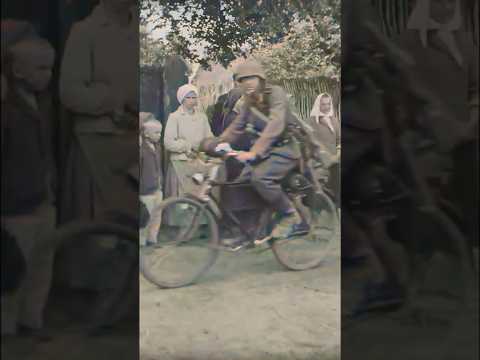
The human cost was staggering. Prisons were emptied—not of criminals, but of political undesirables, shot in haste to prevent their liberation by the Germans. Almost 4 million people were evacuated east of the Urals, a mass migration of industry and humanity. Factories were dismantled, loaded onto trains, and reassembled in the safety of the interior. It was a race against time, a frantic effort to save the Soviet Union’s industrial heart.
But the retreat was not without its horrors. The scorched earth policy left a trail of devastation, a grim prelude to the even greater suffering that would follow. As the German tanks rolled across the steppes, they found little to sustain them—only ashes and emptiness. The stage was set for a war of annihilation, where neither side would show mercy.
Yet, even as the Soviet Union seemed on the brink of collapse, a fierce determination took root. The same ruthlessness that drove the scorched earth policy would soon fuel a relentless counter-offensive. But for now, the Wehrmacht advanced, and the world watched as the largest invasion in history unfolded. The true test of Soviet resilience was only just beginning.
Behind the front lines, the evacuation bordered on pandemonium. Stationmasters worked through the night, coupling freight cars by lantern light while commissars shouted themselves hoarse. Entire factories were loaded onto flatbeds, still warm from the furnaces. Workers rode atop the machinery they had spent days dismantling, clutching tools and family photographs. Trains stretched for miles, creeping eastward under a sky that glowed orange on the horizon.
Not everyone could leave. In villages along the Dnieper, peasants watched the departing columns with hollow eyes, uncertain whether to follow or dig in. “Burn it,” the orders came. “Leave them nothing.” Grain silos erupted in pillars of smoke. Cattle were driven into the woods or shot where they stood. A harvest that had promised plenty was reduced to cinders in a single afternoon.
The political prisoners fared worst of all. In the panic of retreat, NKVD units dragged captives from their cells, lined them against freshly dug pits, and finished the work before the Germans arrived. No one was to fall into enemy hands alive. The executions were hurried, methodical, and largely unrecorded—a silence that would echo for decades.
Far to the east, beyond the Volga and the Ural Mountains, the evacuated trains disgorged their cargo onto empty steppe. In places like Magnitogorsk and Chelyabinsk, construction crews had already broken ground for new plants before the first rail cars arrived. Machines were reassembled in open fields, roofs raised over them as they ran. Workers slept in dugouts and tents, eating black bread and cabbage soup in the freezing rain.
Among them were engineers who had designed the very tanks that would soon roll off these improvised assembly lines. They worked with a fury born of desperation, knowing that every hour saved could mean a division spared. The Urals, once a symbol of remoteness, became the arsenal of survival.
And still the Wehrmacht came. Panzer spearheads punched through the shattered frontier, encircling whole armies at Minsk and Smolensk. The roads east were littered with abandoned equipment, burning trucks, and the bodies of men who had run out of time. Each day brought the enemy closer to Moscow, and each day the Soviet response grew more ruthless—out of necessity, and out of something older and harder: refusal.
By mid-July, the smoke of burning villages could be seen from the Kremlin’s windows. Moscow itself began to prepare for the worst. Trainloads of treasures from the Hermitage and the Lenin Library were spirited away in the dead of night, their crates marked with false labels to confuse any saboteur. The city’s factories were rigged with explosives, ready to vanish should the Germans break through.
In the newly built arsenal towns, however, a different rhythm took hold. At Magnitogorsk, a young engineer named Vera Volkova watched the first blast furnace roar to life—barely three months after the ground had been broken. “We built it in the rain, in the mud, with our bare hands,” she wrote to her brother at the front. “Now let the fascists come and see what we have made.”
The tanks that rolled off those lines were crude by peacetime standards—painted in haste, their welds rough. But they worked. And they came in numbers no one had thought possible. Every third shell fired in the east would soon trace its origin to a factory that had been a field the year before.
Yet the human machinery behind the miracle was fraying. Rations were cut to bread and watery soup. Workers collapsed at their benches, and children as young as twelve were handed files and told to shape metal. In the dormitories, families shared single rooms, hanging blankets for privacy. Grief was a luxury no one could afford. When word arrived that a husband or son had fallen, the news was often met with silence—then a return to the lathe.
At the front, the picture remained grim. The encirclement at Smolensk had swallowed three Soviet armies whole. Prisoners were marched west in columns so long they seemed to have no end. Yet even as the Wehrmacht celebrated, its generals grew uneasy. Supply lines stretched thin. The roads were worse than maps had promised. And the resistance—stubborn, unyielding—was unlike anything they had faced in France or Poland.
In Berlin, Hitler dismissed the warnings. Moscow would fall before winter, he insisted. The Soviet state was a house of cards, ready to collapse at a single push. But in the forests and marshes, partisan bands were already forming—men and women who had refused to flee, melting into the trees with rifles and homemade explosives.
Their war would be fought without rules. Ambushes at dusk. Bridges sabotaged at midnight. German soldiers learned to fear the silence of the woods more than the roar of artillery. Behind the lines, the scorched earth had birthed something new: a war without fronts, where every village might hide a rifle and every shadow a threat.
And still the trains ran east, carrying the bones of a nation toward the mountains. The Urals, it seemed, were not just an arsenal. They were becoming a refuge—and a promise.
The autumn rains turned the roads to rivers of mud, and the German advance slowed to a crawl. General Winter was coming, and with him, the reckoning. In Moscow, Stalin summoned his generals and delivered a speech that would be remembered for generations: “We will defend our capital to the last drop of blood.” The city braced for siege, its streets lined with barricades and its rooftops bristling with anti-aircraft guns.
But the Wehrmacht was already at the gates. From the trenches, Soviet soldiers could see the spires of the Kremlin through the haze. “Not one step back,” the order came, and it was obeyed with a grim fatalism. Divisions were raised from the factories and the collective farms, men and women who had never held a rifle now standing shoulder to shoulder with the regulars.
On December 5, 1941, the counter-offensive began. Fresh Siberian divisions, hardened by years of border skirmishes, struck the frozen German lines like a hammer. The enemy, unprepared for the ferocity of the assault, fell back in disarray. It was the first crack in the myth of invincibility, the first sign that the blitzkrieg could be stopped.
In the Urals, Vera Volkova heard the news over a crackling radio. She wept—not from joy, but from exhaustion. The furnaces had not stopped, and now they would burn brighter than ever. “We are not beaten yet,” she whispered to the empty workshop. The machines roared in agreement.
The war would grind on for years, with millions more sacrifices to come. But the tide had turned. The scorched earth had bought time, and the Urals had forged the weapons of victory. The Soviet Union, against all odds, had survived the first blow.
And as the snows deepened, the partisans in the forests sharpened their knives, waiting for the next patrol. The silence of the woods was broken only by the distant rumble of artillery—and the promise of retribution.
What do you think was the most pivotal moment in the defense of Moscow? Share your thoughts in the comments below.
Report this article
Select a reason for reporting:






