Dr. Michael Harrison had spent three weeks cataloging the Thornton family estate when he first saw the photograph. It was a formal portrait from 1885, remarkably well preserved, showing two young women seated side by side in an elegant Charleston parlor. One was white, Katherine Thornton, the daughter of a wealthy banker. The other was black, unnamed in the caption, simply identified as “a friend.” At first glance, the image seemed to depict a genuine interracial friendship in an era when such a thing was nearly impossible. But as Michael zoomed in on his high-resolution scan, his breath caught in his throat. The black girl’s smile was strained, her knuckles white with tension, and faint marks on her wrists suggested restraints. This was no friendship. It was a carefully constructed illusion.
Michael’s hands trembled as he adjusted the contrast. The girl’s posture was rigid, her eyes unfocused, as if watching someone behind the photographer. The dress she wore was fine but didn’t quite fit, the sleeves too long, the bodice loose. It looked like a hand-me-down, altered for a servant. The note on the back read: “Miss Katherine Thornton and friend, Charleston, South Carolina, 1885.” But Michael knew that “friend” was a lie. He had to find out who this girl was and what had happened to her.
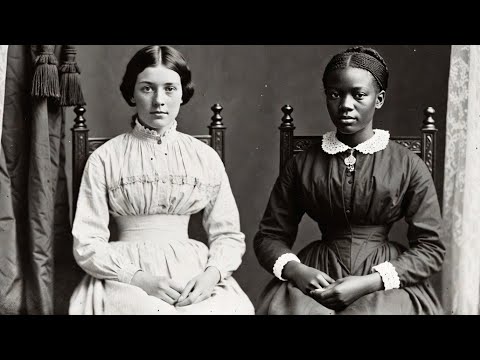
His investigation led him to the Thornton family’s account books, where he found entries for “Rose’s upkeep”—clothing, medical care, books—but never wages. Rose was not an employee. She was property in all but name. A handwritten “informal adoption agreement” from 1870 revealed that Margaret Thornton had taken in a one-year-old orphaned black child, promising food, shelter, and a Christian upbringing in exchange for household labor. “Said child shall remain under the care and authority of the Thornton family,” the document read, with no signature from Rose’s family, no consent, no rights. Michael’s stomach turned. This was slavery by another name, hidden behind a facade of charity.
He delved into Margaret Thornton’s diary, where Rose appeared as a “favored pet”—praised for her needlework, her obedience, her gratitude. “She will be a valuable help to Catherine when Catherine establishes her own household someday,” Margaret wrote in 1881. The diary painted a picture of a girl raised to serve, isolated from other black people, taught to believe she was lucky. But Rose’s own voice emerged from the archives of the Charleston Freedman’s Aid Society, in a handwritten account taken down in 1903. “My name is Rose. I do not have a family name that I know,” she began. “I want someone to know the truth of what happened to me.”
Rose described 33 years of captivity—no wages, no freedom, no choice. She was taught to read only enough for shopping lists, to write only simple instructions. She was forbidden from forming friendships with other black people, told she was “better” than them. “Miss Katherine was kind to me,” Rose wrote, “but it was the kindness of an owner to a favored pet. Friends can leave each other’s company. I could not.” The photograph, taken in April 1885, was staged propaganda. Margaret Thornton had ordered it to show the family’s “progressive views,” forcing Rose to smile and sit beside Katherine as if they were equals. “I smiled because I was afraid,” Rose admitted. “I smiled because I had been told to smile.”
Michael’s research uncovered the broader practice: thousands of black children across the South were taken into white households under the guise of charity, raised as unpaid servants, and denied any legal rights. The photograph was not an anomaly but a window into a hidden system of exploitation that persisted for decades after emancipation. And Rose, against all odds, had escaped.
In 1903, with help from the Freedmen’s Aid Society, she walked out of the Thornton house for the first time in her life. She boarded a train to Philadelphia, where she married, had children, and lived 50 years in freedom. But her story had been silenced—until now.
Michael knew he had to share it. He titled his exhibition The Illusion of Kindness: Slavery’s Legacy in Post-Emancipation America. The photograph would be the centerpiece, but the truth behind it would change everything. As he stood before the enlarged image, studying Rose’s strained smile, he realized that the past was never truly past. It was waiting to be seen.
The museum’s board of directors met on a gray Tuesday in early June to review Michael’s proposal. He had prepared a forty-page dossier: the photograph, the adoption agreement, Margaret Thornton’s diary entries, Rose’s Freedmen’s Aid Society testimony, and the Philadelphia records. He laid it all out on the mahogany table and waited.
Halfway through his presentation, board member Eleanor Rutledge—a descendant of one of Charleston’s oldest families, though not the Thorntons—set down her reading glasses. “Dr. Harrison, are you aware that the Thornton family has been a patron of this museum since 1952?” she asked. Her tone was pleasant. Her eyes were not.
Michael had anticipated this. He had spent two weeks rehearsing his answer. “I am. And I’m also aware that their endowment funded the very wing where we plan to hang this exhibition. Which is precisely why it belongs here.” He let the silence stretch. “If we only tell the stories that flatter our donors, we’re not a museum. We’re a scrapbook.”
The vote was close—six to five. Michael walked out of the boardroom with approval for a modest exhibition, a fraction of the budget he’d requested, tucked into a corner gallery on the second floor. It felt like a victory and a punishment at the same time.
What Michael hadn’t told the board was that he’d already contacted Diana, Rose’s great-granddaughter, before securing approval. He’d broken protocol. He’d risked the whole project on the hope that a descendant would want to be involved. When Diana called him back three days later, her voice was steady but thick with something he couldn’t name.
“My grandmother kept a box,” Diana said. “Under her bed. She said it was for after she was gone. My mother never opened it. Neither did I. But if you’re telling me the truth about all this—I think maybe it’s time.”
Two weeks later, a padded envelope arrived at the museum. Inside was a small tin box, dented at the corners, the paint worn down to bare metal. Michael opened it with gloved hands in the conservation lab, the overhead lights humming.
There were three items inside. A lock of dark hair tied with a faded ribbon. A train ticket stub, Philadelphia, November 1903, punched through. And a photograph—not the formal studio portrait, but a small, creased snapshot taken decades later. An elderly Rose stood on a front porch in Philadelphia, arms around two children, laughing at something outside the frame. Her face was unguarded. Her eyes were bright. She was not performing for anyone.
Michael stared at it for a long time. For weeks he had lived inside the 1885 image, studying its tensions and lies. This was the other side of the story. This was what freedom looked like.
He called Diana that evening. “There’s a photograph in the box,” he said. “I think it needs to be in the exhibition. Not as evidence—as an answer. People will see the 1885 portrait and feel the weight of it. Then they’ll turn a corner and see her laughing. They need to see that she got out.”
Diana was quiet for a moment. “She used to say the Thorntons gave her a trade and a cage. She said the trade kept her family fed, and the cage taught her what freedom was worth.” A pause. “Put it in. She’d want people to know she didn’t just survive. She lived.”
The exhibition opened in September to a line that wrapped around the block. Michael stood near the entrance, watching visitors file past the 1885 portrait, their faces shifting as they read the panels. He noticed a woman in her seventies stop in front of the Philadelphia snapshot. She pressed her fingers to her lips and stood there for a long, long time.
When she finally moved on, Michael stepped closer to the wall and read the caption he had written and rewritten a dozen times: Rose Williams, circa 1940. Freed in 1903. Photograph courtesy of her great-granddaughter, Diana.
Behind him, a school group shuffled in, chaperones shushing. One girl, maybe fourteen, stopped dead in front of the 1885 photograph and squinted. “Her hands,” the girl said to no one in particular. “Look at her hands. She’s holding on so tight.”
Michael smiled for the first time in weeks. The illusion was breaking. One pair of young eyes at a time.
By the following spring, the exhibition had traveled to three cities and the museum had received more than two hundred letters. Some came from descendants of families who recognized the pattern. Others came from people who simply wrote to say they had stood before Rose’s photograph and wept.
One letter arrived without a return address, postmarked Charleston. Inside was a single sheet of stationery, the paper thick and old-fashioned. “I am ninety-one years old,” it read. “My grandmother was a Thornton. I grew up hearing that we were kind to our colored girl. I never asked her name. Now I know it. I am ashamed, and I am grateful she got out.” There was no signature. Michael filed it with the rest.
Diana came back to Charleston that June, on the anniversary of Rose’s escape. She and Michael walked to the old Thornton mansion on Meeting Street—now law offices—and stood on the sidewalk without speaking. “She walked out this door,” Diana said finally. “Thirty-three years, and then one night she just walked out.”
Michael nodded. “And nobody stopped her. That’s the part I keep thinking about. Nobody even noticed until morning.”
They turned and walked back toward the museum, past the market stalls and the church where Rose had once sat alone in her separate section. The city looked the same as it always had—stucco and palmettos, tourists and horse-drawn carriages. But something had shifted, quietly, in the way the past was being told.
That evening, Michael sat at his desk with the 1885 photograph open on his screen. He had looked at it a thousand times. But now he saw something he hadn’t before: behind Rose’s strained smile, behind the white knuckles and the borrowed dress, there was a flicker of something the photographer couldn’t stage. Not fear. Calculation. She was watching the room. She was waiting.
She had waited eighteen more years. Then she had walked out the front door.
Michael closed the file and turned off the lamp. The exhibition would keep traveling. The letters would keep coming. And somewhere in Philadelphia, in a cemetery called Eden, a headstone read beloved wife and mother—the words Rose had chosen for herself, the name she had made her own.
He thought of the girl in the school group, squinting at the photograph. Look at her hands. The next generation was already seeing what his generation had missed.
What would you do if you found a photograph like this in your own family’s attic—and realized the smile you’d always trusted was a lie?
Report this article
Select a reason for reporting:






