Dr. Emily Carson had restored thousands of damaged photographs in her twenty years at the Smithsonian, but the image that arrived on her desk in March 2024 made her hands tremble. Two young women, identical in their severe Victorian beauty, stared out from a cracked and water-stained portrait. Their faces were composed, their dark eyes piercing—but it was their hands that seized Emily’s attention. Between them, their fingers were interlaced in a precise, deliberate pattern. Not a sisterly clasp. A signal.
As Emily leaned closer under her magnifying lamp, a chill crawled up her spine. This was no ordinary gesture—it was a code. And these women, whoever they were, had posed with it deliberately, as if sending a message across time itself.
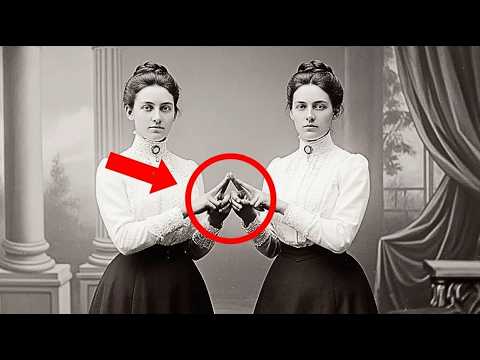
Emily began the painstaking restoration, scanning the photograph at the highest resolution and separating it into layers. Pixel by pixel, she erased the water damage and reconstructed the studio backdrop—painted columns, draped curtains, the standard props of 1890s portraiture. But the hands remained her obsession. The gesture was unmistakable now: a specific sign, purposeful and symbolic.
She had seen similar hand positions in historical photographs before—usually associated with fraternal organizations like the Freemasons. But those were men’s societies, extensively documented. This was different. She had never encountered anything like it in two decades of professional work.
That evening, she called her colleague Professor Margaret Walsh at Georgetown University, a specialist in late 19th-century women’s history. Margaret arrived the next afternoon, her arms loaded with books, her eyes bright with curiosity behind wire-rimmed glasses.
“Show me,” she said without preamble.
Emily handed her the photograph. Margaret studied it in silence, her expression shifting from curiosity to surprise to something approaching excitement. “This isn’t random,” she breathed, pointing with a trembling finger. “This is deliberate communication. These women are making a specific sign.”
Margaret pulled a thick volume from her stack—Women’s Reform Movements in Gilded Age America—and flipped to a chapter on the Women’s Christian Temperance Union. By 1890, the WCTU had over 150,000 members, advocating not only for temperance but for women’s suffrage, prison reform, and workplace protections. They used secret signs and symbols to identify each other, especially in communities where their activism made them targets.
“The alcohol industry was incredibly powerful,” Margaret continued, her voice intense. “Distilleries, breweries, saloon owners—they had politicians in their pockets and didn’t hesitate to use violence against women who threatened their profits. WCTU members needed ways to recognize allies without revealing themselves to enemies.”
Emily felt a chill. “So this gesture is almost certainly a WCTU recognition sign.”
Margaret nodded. “These women weren’t just posing for a family photograph. They were documenting their membership in one of the most radical women’s organizations of their time.” She paused, studying their faces. “In 1890, advocating for temperance and women’s rights could get you ostracized, attacked, or worse.”
The only clue to their identity was the donor’s name: the estate of Helen Pritchard, who had died at 93 in a small town called Milbrook, Pennsylvania. Margaret traveled there, to a town of fewer than 3,000 nestled in the Appalachian Mountains, and found the Milbrook Historical Society in a converted church. The director, an elderly woman named Ruth Coleman, greeted her warmly—until Margaret showed her the photograph.
“Oh my goodness,” Ruth breathed, reaching out to touch the image. “That’s the Hartley sisters, Clara and Rose.”
She pulled out a worn folder labeled “Prominent Families.” The Hartleys had been influential in Milbrook in the 1880s and 1890s—their father, William, owned the general store. But it was a newspaper clipping from November 1891 that made Margaret’s heart race. The headline read: “Local Woman Missing, Sister Distraught.”
Rose Hartley, aged 24, had disappeared without a trace on November 15th, 1891. She had left home the previous evening to attend a meeting and never returned. “What kind of meeting?” Margaret asked. Ruth shook her head. “The article doesn’t say, but there were rumors. My grandmother knew the Hartleys well. She said Rose was involved in something the town didn’t approve of—something that made powerful people very angry.”
Margaret returned to Washington with copies of everything, her mind racing. Back at Georgetown, she cross-referenced the Hartley names with national WCTU records at the Library of Congress. After three days of searching through archived membership rolls, she found a ledger from 1890 listing both Clara and Rose Hartley as members of the Milbrook chapter.
But there was more. Correspondence between the Milbrook chapter and the Pennsylvania State WCTU office revealed increasing hostility from local business owners—particularly the Kernney family, who owned three saloons and a brewery. One letter, dated October 1891 and marked confidential, was written by chapter president Elizabeth Morrison to WCTU leader Frances Willard herself.
Dear Miss Willard, it began, I write with grave concern for the safety of our members. The Kernney family has escalated their campaign of intimidation. Last week, rocks were thrown through windows. Yesterday, my husband received a letter threatening violence. Most troubling, several of our younger members, including Miss Rose Hartley, have received anonymous notes suggesting they cease their activities or face consequences.
Rose Hartley had disappeared exactly one month after this letter was written.
Margaret requested police records from the Pennsylvania State Archives. What arrived was disappointingly thin: Sheriff Thomas Burke’s official report, just three pages, clearly designed to close the case quickly. Burke had interviewed Clara, who stated her sister left at 7 p.m. to attend a meeting. He had interviewed the father, who described Rose as “headstrong” and suggested she might have run away with a suitor. Most tellingly, Burke had interviewed Patrick Kernney, owner of the largest saloon, who claimed he had been home all evening.
The investigation was closed on November 18th—just three days after Rose vanished—with Burke concluding there was no evidence of foul play. Margaret dug deeper into Burke’s background and discovered he had taken out a substantial loan from Patrick Kernney’s brother in 1889. The conflict of interest was obvious.
Meanwhile, Emily had been examining other photographs from the Pritchard estate. Among them was a group portrait of about twenty women, all wearing white ribbons—the symbol of the WCTU. Both Clara and Rose Hartley stood in the back row. But several of the women’s faces had been deliberately scratched out, the emulsion scraped away to obliterate their features. Four women had been erased.
Someone had wanted to remove these women from history.
Margaret counted the remaining faces—sixteen women whose features survived the vandal’s blade. If the chapter had begun with twelve members in 1887, then the group had grown, or some faces belonged to women who had replaced the missing. The thought settled in her stomach like a stone.
She turned her attention to the Kernney family, whose opposition to the WCTU threaded through every document she had found. Property records and business directories painted a portrait of a dynasty built on liquor and leverage. Patrick Kernney owned the Silver Dollar Saloon. His brother James ran the Milbrook Brewery, which supplied beer across the region. A third brother, Michael, had been elected to the town council in 1888.
The Kernneys were not subtle. In an 1890 editorial for the Milbrook Gazette, Patrick was quoted calling the WCTU “interfering busybodies who should mind their own households instead of other people’s business.” He warned that temperance women would destroy the local economy and impose their narrow morality on everyone.
But the most disturbing discovery came from court records. In 1889, a woman named Sarah Bennett had filed assault charges against Patrick Kernney, claiming he attacked her outside her home after she signed a temperance petition. The case was dismissed by Judge Harold Morrison—Elizabeth Morrison’s husband, the very man whose wife led the local WCTU chapter.
Margaret dug further. Judge Morrison had significant debts, and Patrick Kernney had purchased those debts from the bank in 1888, effectively gaining financial control over the judge. The corruption ran deeper than she had suspected. The Kernneys didn’t just influence the town’s legal system—they owned it.
Two more assault cases against women in the temperance movement had been dismissed by Morrison. Sheriff Burke’s loan from the Kernney family, she learned, had been interest-free—an arrangement that suggested either friendship or obligation. The pattern was clear: the Kernneys had systematically neutralized anyone in authority who might have protected the WCTU women.
Then Margaret found something that made her blood run cold. A property deed from January 1892 showed that William Hartley had sold his general store to Patrick Kernney for a sum far below market value. Just two months after Rose’s disappearance, the Hartley family’s livelihood had been surrendered. Why would a successful businessman sell for a fraction of his worth, unless he was under extreme pressure?
She traced Clara Hartley through census records. Clara never married—unusual for a woman of her class and era. She lived with her father until his death in 1903, then alone in the family house until 1920, when she moved to Philadelphia. She died in 1952 at eighty-five and was buried there, not in Milbrook where her family had been prominent for generations. The choice to be buried away from her hometown felt like a final rejection of the place where her sister had vanished.
Before her death, Clara had donated papers to the Historical Society of Pennsylvania. Margaret traveled to Philadelphia with growing excitement. The collection was small—three boxes of letters, a diary, and some photographs—but what she found there was explosive.
Clara’s diary, kept meticulously from 1889 to 1920, contained detailed accounts of the chapter’s activities and the escalating conflict with the Kernneys. The entries from October and November 1891 were particularly revealing. On October 20th, Clara wrote: Rose received another threatening note today, the third this month. This one was pushed under our door during the night. It said, ‘Stop your temperance activities or you will regret it. This is your final warning.’ Rose wanted to show it to Sheriff Burke, but I convinced her it would be useless. Burke dines at Patrick Kernney’s saloon every Friday.
On November 10th, just four days before Rose disappeared, Clara wrote: Rose has been meeting with a man who claims to have evidence of corruption in the Kernney family’s business dealings. Watered-down liquor sold at full price, bribes to local officials, threats against competitors. She says this evidence could shut down their operations and break their power in Milbrook. I begged her to be careful, but Rose is fearless.
Then came the entry from November 14th—the night Rose vanished. Rose left at 7 p.m. to meet her informant. He had promised to give her documents proving the Kernneys have been systematically bribing officials. She said if she didn’t return by midnight, I should assume something had gone wrong and should go to Mrs. Morrison. It is now past midnight. Rose has not returned. I am terrified.
Margaret read on with mounting horror. Clara had gone to Sheriff Burke the next morning, as required by law. Burke was dismissive, suggesting Rose had probably run off with the informant. When Clara insisted something terrible had happened, Burke told her to stop making wild accusations or she would face charges of slander. Clara went to Mrs. Morrison, who promised to contact the state WCTU office—but before any outside help could arrive, Burke had closed the case.
The final box contained something Margaret hadn’t expected: a sealed envelope marked To be opened only in the event of my death, by someone investigating Rose’s disappearance. Inside was a letter written in Clara’s elderly hand, dated 1951—one year before her death.
Margaret’s hands shook as she unfolded it.
To whoever finds this letter, Clara had written. I have carried the truth about my sister’s death for sixty years, too afraid to speak while those responsible or their descendants might retaliate. But I am old now, and soon I will join Rose. The truth must be known.
On November 14th, 1891, Rose went to meet a man named Thomas Sullivan, who worked at the Milbrook Brewery. Sullivan had been skimming documents proving the Kernneys were defrauding customers and bribing officials. But someone warned the Kernneys about the meeting. Rose never arrived at the abandoned mill. Two days later, Sullivan was found dead in the river.
Clara’s letter named the corrupt: Judge Morrison, drowning in debt, had betrayed the meeting. Sheriff Burke had ruled Sullivan’s death an accidental drowning, though his widow swore her husband couldn’t swim. Three other WCTU members vanished between 1889 and 1893—Sarah Bennett, Mary O’Connor, and Elizabeth Morrison’s own daughter, Catherine.
Margaret verified every detail. The pattern was unmistakable: women who opposed the Kernneys disappeared, and no one investigated. Clara had preserved it all—Kernney’s letters to the judge, pages from Sullivan’s account book, and an anonymous witness’s account of Rose being forced into a carriage near the old mill.
Eight months later, Emily and Margaret stood in the Smithsonian’s exhibition hall for the opening of Courage and Consequence: The Untold Story of the Milbrook WCTU. The restored photograph of Clara and Rose hung at its center, their hands still locked in that secret sign. Helen Pritchard’s great-granddaughter wept as she learned the truth her family had buried for generations.
Before the photograph, Emily studied the sisters one last time. Their message had finally crossed 133 years to be received.
But as visitors filed past, Margaret wondered aloud: how many other erased women still wait in silent photographs for someone to ask what their hands are saying?
Report this article
Select a reason for reporting:






