Dr. Marcus Webb had examined hundreds of portraits from the early 1900s, but something about this one made him pause. The photograph showed two siblings, Robert and Grace Thompson, posed in the formal style of 1903. At first glance, it was a sweet family portrait. But then he saw it—the brother’s hand on his sister’s shoulder, fingers positioned with deliberate precision. This was no casual touch. It was a message.
Marcus had spent months curating an exhibition on African-American communication methods during and after slavery. He recognized intention when he saw it. This wasn’t the casual touch of a protective brother. This was a code.
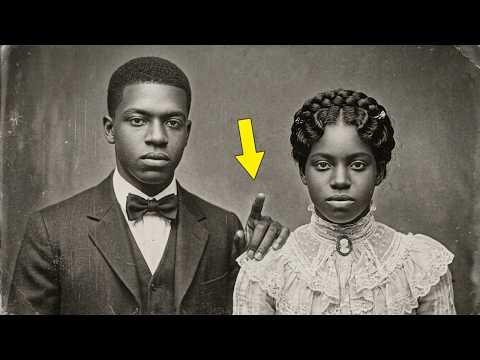
He pulled up reference photos of hand signals used by conductors on the Underground Railroad and gestures employed by freed people seeking lost family members. Nothing matched exactly, but there were similarities. The index and middle fingers extended fully, the ring finger bent at the second knuckle, the pinky slightly curved, the thumb pressed firmly against her shoulder. Each finger position seemed purposeful.
Marcus turned to the accompanying index card: Robert and Grace Thompson, Atlanta, Georgia, June 1903. The photographer was JB Harrison Studio, and the source was a Florence Thompson Henderson. He opened his laptop and began searching census records. Robert, age 18, a laborer. Grace, age 15, a student. Parents: Samuel and Ruth Thompson. Address: 1027 Auburn Avenue, Atlanta.
Auburn Avenue in 1903 was the heart of black Atlanta, a thriving commercial district where African-American businesses and churches flourished despite oppressive racial laws. Why would two teenagers from this community pose with their hands in what Marcus was increasingly certain was a code? What message were they trying to send?
He spent the morning digging into the history of Auburn Avenue. By 1903, the brief promise of Reconstruction had collapsed. Georgia had implemented poll taxes and literacy tests to disenfranchise black voters. Segregation laws governed every public space. Violence terrorized black communities. Yet Auburn Avenue was a beacon of resilience, home to doctors, lawyers, teachers, and business owners who refused to be broken.
The Thompson family address led Marcus to property records: Samuel Thompson owned a small grocery store on Auburn Avenue. Tax records indicated modest but steady income. This was a family that had achieved stability and a measure of independence in a world designed to deny them both. But what connected them to the coded communication networks Marcus had been studying?
Grocery stores, he knew, had often served as more than places to buy food. They were gathering spots, information hubs, places where news traveled and communities organized. During slavery, certain shops had been known stops on the Underground Railroad. After emancipation, they continued to serve covert purposes—passing messages, hiding people in danger, coordinating mutual aid.
Marcus drafted an email to Dr. Patricia Lawrence, a colleague at Spelman College who specialized in post-Reconstruction black communities in Atlanta. He attached the photograph and described the unusual hand positioning, asking if she had encountered anything similar. Then he turned to finding descendants of the Thompson family.
The estate sale listing mentioned Florence Thompson Henderson as the source of the photograph. A quick search revealed an obituary from six months earlier: Florence Henderson, age 89, died peacefully at her home in Decatur, Georgia, survived by her daughter, Linda Henderson Carter, and two grandchildren. Marcus found Linda’s contact information and composed a careful email introducing himself and explaining his research. He expressed his belief that Robert and Grace may have been involved in something historically significant.
He hit send and leaned back. His phone buzzed almost immediately. Patricia had responded: “Marcus, this is fascinating. I don’t recognize the specific hand code, but I can tell you that 1903 was a critical year in Atlanta. There was significant activism around family reunification. Many people were still searching for relatives separated during slavery. There were also growing concerns about orphan trains and indenture systems that were essentially re-enslaving black children. If Robert and Grace were involved in that work, they would have needed ways to identify themselves without drawing attention. Can you meet tomorrow?”
Marcus replied immediately, confirming the meeting. As he gathered his materials, his email pinged again. Linda Henderson Carter had responded: “Dr. Webb, I’m so glad you reached out. My grandmother told me stories about Robert and Grace when I was young. She always said they were bridgekeepers who helped broken families find their way home. She left me a box of old letters and documents. Would you like to see them?”
Marcus’s hands trembled as he typed his response. This was more than he had hoped for. The photograph was just the beginning.
Linda Henderson Carter’s home was a modest brick ranch in Stone Mountain, its front yard meticulously maintained with azaleas just beginning to bloom. Marcus arrived exactly on time, carrying his leather portfolio and a digital recorder. He had barely pressed the doorbell when the door opened, revealing a woman in her early sixties with silver-streaked hair and warm, intelligent eyes that reminded him immediately of Grace Thompson in the photograph.
“Dr. Webb, please come in. I’ve been looking forward to this all morning.” Linda’s handshake was firm and her smile genuine. She led him through a living room decorated with family photographs spanning generations to a dining room where a large cardboard box sat on the polished table beside a tea service.
“I pulled this down from the attic last night,” Linda said, gesturing to the box. “I haven’t looked at most of this since my grandmother passed in 1994. She made me promise to keep it safe. Said it was important history, but she died before she could explain everything properly.”
Marcus sat down carefully, accepting the tea Linda poured. “What did your grandmother tell you about Robert and Grace?”
Linda settled into her chair, her hands wrapping around her teacup. “Grandma Florence was Robert’s granddaughter. She said he and Grace were teenagers when they started what she called ‘the finding work.’ She said it wasn’t safe to talk about it openly, even decades later, because some families still carried shame about what had happened to them.”
“Shame about what?” Marcus asked gently.
“About losing their children,” Linda’s voice dropped. “Grandma said that after slavery ended, people scattered—looking for work, for safety, for family members who’d been sold away. And in all that chaos, children got lost. Some were taken by former enslavers claiming legal guardianship. Others were placed in orphanages or sent on trains to work as indentured labor in other states. Parents would search for years, but the system was designed to make them disappear.”
Marcus felt a chill despite the warm room. He’d read about these practices—the apprenticeship laws that essentially continued slavery under a different name, the orphan trains that shipped poor children to work on distant farms, the legal machinations that separated families and made reunification nearly impossible.
“Robert and Grace helped find these children?” he asked.
“That’s what Grandma said. They were part of a network. People who could travel without drawing suspicion. Teenagers who could pose as servants or laborers, who could move between communities gathering information. They’d find out where children had been taken and work with others to get word back to families.”
Linda reached for the box and began removing items: yellowed letters tied with ribbon, a small leather journal, newspaper clippings brittle with age, and more photographs. “This is the journal Grace kept,” she said, sliding it across to Marcus. “Grandma said it was written in code, but she never figured out how to read it.”
Marcus opened the journal carefully. The pages were filled with neat handwriting, but the entries were cryptic—dates, initials, numbers. June 15th, 1903. R.M.T. to visit. Three packages. Auburn delivery successful. Hands remember.
“Hands remember,” Marcus murmured, looking up at Linda. “The photograph. The way Robert’s touching Grace’s shoulder.”
Linda shook her head. “She just said they had their own language.”
Patricia Lawrence’s office at Spelman College was cramped but organized—every surface covered with books, papers, and artifacts from her decades of research. When Marcus arrived the next morning with his laptop full of photographed journal pages, she had already cleared space on her desk and pulled several reference books from her shelves.
“I’ve been thinking about this all night,” Patricia said, barely greeting him before diving in. “Show me everything you found.”
Marcus opened his laptop and displayed the photographs of Grace’s journal alongside the portrait of the siblings. Patricia leaned in close, her reading glasses perched on her nose, studying the hand position with intense concentration.
“Okay,” she said slowly. “Let me show you something.” She pulled out a leather-bound notebook filled with her own handwriting and sketches. “About fifteen years ago, I interviewed a woman named Mrs. Henrietta James. She was ninety-seven years old, and her grandmother had been involved in what she called the ‘locator network’ around the turn of the century. Mrs. James showed me hand signals her grandmother had taught her. Said they were ways that network members identified each other.”
Patricia flipped through her notebook until she found a page filled with hand-drawn diagrams. “Look at this one. She called it the bridgekeeper sign. Index and middle fingers extended—that meant safe passage.” She demonstrated it by placing her hand on someone’s shoulder just like in your photograph.
Marcus felt electricity run through him. “What about the other fingers? The bent ring finger, the curved pinky.”
“I didn’t get all the details,” Patricia admitted. “Mrs. James was very old and some information had been lost over generations. But she said different finger combinations added meaning. A bent ring finger might indicate covenant or sworn promise. A curved pinky could mean protection or guardianship.”
“So Robert’s hand position in the photograph,” Marcus said, “could be saying something like ‘safe passage, sworn promise, and protection.'”
“Exactly. It would tell anyone in the network that he and Grace were committed to the work, that they could be trusted with the most vulnerable people—children being reunified with their families.”
Patricia turned her attention to the journal pages on Marcus’s screen. “Now, let’s see if we can decode these entries.”
They worked through the morning, Patricia’s expertise in the period and Marcus’s fresh perspective combining to unlock the cryptic language of Grace’s journal. Patterns emerged. Initials represented families. Numbers indicated children’s ages. Locations were disguised with seemingly innocent references. Auburn delivery meant a child had been successfully returned to their family on Auburn Avenue.
One entry from July 1903 made them both pause: July 18th, three packages, ages 6, 8, 10. Charleston origin. Father searching four years. Conductor M.B. confirmed. Route through Augusta. Hands remember. Risk high.
“Three children,” Patricia said softly. “Lost or taken from their father in Charleston four years earlier, probably around 1899. Robert and Grace were coordinating their return.”
Marcus scrolled to entries from late July and early August. “Look—August 2nd. Packages arrived. Auburn father reunion. Tears of joy. Hands blessed.” He looked up. “They did it. They brought those children home.”
But not all entries ended happily. September 1903. St. family package lost. Trail ended. Virginia. Hearts broken. Some children, it seemed, could never be found. Some families would never be whole again.
Patricia sat back, removing her glasses to wipe her eyes. “They were so young, Marcus. Teenagers doing this dangerous work.”
Marcus nodded, his gaze drifting back to the photograph on the screen. Robert and Grace stared out at him across 121 years, their expressions solemn but their hands speaking volumes. “They were children themselves,” he said quietly, “and they were saving other children.”
Patricia closed her notebook. “So what now? We have the journal, the letters, the photograph. We have a story that needs to be told.”
Marcus thought of the exhibition he’d been building, the empty gallery waiting for its centerpiece. “We tell it. We show the world what these hands meant—safe passage, sworn promise, protection.” He looked at Linda, who was watching them both with tears in her eyes. “With your permission, of course.”
Linda smiled, her grandmother’s warmth shining through. “That’s exactly what she would have wanted.”
Six months later, the exhibition opened. Visitors stood before the portrait, leaning in to trace the position of Robert’s fingers with their own hands, understanding dawning in their eyes. The story of the bridgekeepers was finally being remembered.
But Marcus knew this was only the beginning. How many other photographs were waiting in attics and archives, their silent promises still unheard? Would you know a secret code if it were hiding in plain sight?
Report this article
Select a reason for reporting:






