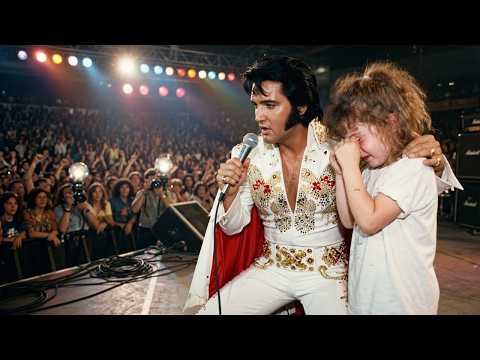
Las Vegas, August 1972. The air inside the Convention Center was electric, charged with the roar of 40,000 fans who had come from across the country to witness the King of Rock and Roll. Hotels were booked solid. Tickets were the hottest in America. Some had sold their most precious belongings just to be there. For millions, seeing Elvis Presley wasn’t entertainment—it was a dream.
Backstage, the hallway buzzed with activity. Stage managers checked clipboards. Lighting technicians adjusted giant spotlights. The TCB band tuned their instruments. Every minute brought the audience closer to the moment they’d see their idol.
Behind a closed dressing room door, Elvis sat quietly, alone. He stared at an old family photograph—his mother, Gladys, smiling as she always had. He gently touched the edge of the picture and whispered, “I wish you could have seen tonight.” A soft knock interrupted the silence. His manager, Colonel Tom Parker, entered. “Elvis, it’s time.” Elvis carefully placed the photograph back inside his jacket and smiled politely. “You nervous?” the Colonel asked. Elvis laughed softly. “I’ve sung in front of hundreds of thousands. I still get nervous.” Colonel smiled. “That’s why they love you.”
Elvis stood and adjusted his famous white jumpsuit, covered with brilliant rhinestones. The enormous eagle spread proudly across his chest. His white boots shined perfectly. His black hair had been carefully styled. Everything looked perfect—everything except his eyes. There was always a quiet sadness behind them.
Outside, the announcer’s voice echoed across the arena. “Ladies and gentlemen, please welcome the one, the only Elvis Presley.” The building exploded. 40,000 voices became one. People stood instantly. Some screamed, some cried, others simply stared, unable to believe they were finally seeing the man whose music had changed their lives.
The curtains slowly opened. Bright white spotlights swept across the stage. Then he appeared—Elvis Presley. The roar was unlike anything the arena had ever heard. It felt as though the building itself was shaking. Elvis smiled warmly, raised one hand, thanking the crowd before singing a single note.
The band counted in. The first guitar chord filled the arena. The audience erupted again. Elvis walked confidently across the enormous stage, his voice powerful, smooth, effortless. Every lyric was sung by 40,000 people. Flash bulbs exploded like lightning. Security guards smiled. Camera operators struggled to keep up with the energy.
One hour passed like minutes. Song after song, the audience refused to sit down. Elvis laughed. “You folks trying to wear me out?” The crowd screamed louder. He pointed toward one section, then another, greeting fans as if he knew every one of them.
Backstage, Colonel Parker smiled proudly. “I’ve never seen a crowd like this.” One producer nodded. “This might become his greatest concert.” Nobody realized they were right. But not for the reason they imagined.
As another song began, Elvis slowly walked toward the front of the stage. Thousands of hands reached toward him. Everyone hoped he would throw one of his famous white scarves. Instead, something caught his attention. Not cameras, not photographers, not cheering fans. One tiny figure standing against the front barrier.
A little girl, no older than seven. She wasn’t cheering. She wasn’t singing. She wasn’t smiling. She clutched a worn teddy bear so tightly her little hands had turned white. Tears rolled silently down her cheeks. Around her, thousands of people celebrated. She stood completely alone.
Elvis continued singing, but something inside him changed. He looked again. The little girl never once looked at the stage. She simply stared at the floor. Still crying.
Elvis missed the next lyric. The band looked toward him. He quietly nodded, trying to continue, but he couldn’t. His eyes never left the little girl. Halfway through the chorus, he slowly lowered the microphone. The band kept playing. Elvis raised one hand. Immediately, every musician stopped. The music disappeared. 40,000 voices fell silent. The entire arena became still.
Backstage, panic erupted. “What’s happening? Did the sound fail? Is Elvis all right? Call the stage manager.” Security immediately moved toward the stage. Colonel Parker stepped forward, confused. Elvis ignored everyone. His attention remained fixed on one little girl.
Elvis slowly walked toward the edge of the stage. 40,000 people watched without making a sound. Security rushed forward. He gently lifted one hand. No. They immediately stopped. Elvis carefully stepped down from the stage. Only a few feet separated him from the crying child. He slowly knelt until his eyes were level with hers. Then, in the softest voice anyone nearby had ever heard, he quietly asked, “My little angel, who broke your heart?”
The little girl tried to answer, but no words came—only tears, more tears. She hugged her old teddy bear even tighter. Elvis looked gently toward the woman standing beside her. The woman, already crying herself, took a trembling step forward. “I’m so sorry,” she whispered. “We never wanted to stop your concert.” Elvis slowly shook his head. His voice was almost a whisper. “You didn’t stop my concert.” He looked back at the little girl. “You became the most important person in this entire arena.”
The mother closed her eyes, trying desperately to control her emotions. Then, with tears running freely down her face, she finally whispered, “Her father.”
Mother could barely speak. Her hands trembled. Tears rolled down her face faster than she could wipe them away. Elvis remained kneeling, patient, quiet. The entire arena waited. More than 40,000 people completely silent. No music, no applause, no shouting—only one mother’s voice, barely louder than a whisper.
“Her father,” she struggled to continue. “He promised he would bring her to see you.” The little girl held her teddy bear tighter. The mother looked toward Elvis. “He saved for almost an entire year—every extra dollar, every overtime shift, every birthday gift he put aside—just so she could finally meet her hero.”
The audience lowered their heads. Many already knew this wasn’t going to be an ordinary story. The mother continued. “Three days ago—” her voice broke. “He was driving home from work. There was a terrible accident.”
The arena became so quiet people could hear someone crying several rows away. The mother closed her eyes. “He never made it home.”
The little girl finally looked up at Elvis. Her tiny voice almost disappeared inside the enormous arena. “He promised he’d bring me.” Another tear rolled down her cheek. “But Daddy didn’t come.”
Those four words broke something inside everyone listening. Several musicians quietly removed their headphones. One guitarist turned away, unable to stop crying. Backstage, Colonel Tom Parker lowered his head. One security guard wiped his eyes. Even photographers forgot to take pictures.
Elvis closed his eyes. His breathing slowed—because suddenly he wasn’t standing inside the Las Vegas Convention Center. He wasn’t the king of rock and roll. He was simply a son remembering the day he lost his own mother. For one brief moment, he remembered the empty house, the silence, the feeling that the world had suddenly become too big, too cold, too lonely.
He slowly opened his eyes, looked at the little girl, then quietly asked, “What is your daddy’s name?” The little girl whispered, “Thomas.” Elvis smiled softly. “Thomas.” He repeated the name as though he wanted the entire building to remember it.
He slowly stood, walked toward the center of the stage, picked up the microphone, and looked across 40,000 people. His voice was calm, gentle. “My friends,” he paused, “tonight we came here to enjoy music.” Another pause. “But sometimes life changes the concert.”
The audience remained silent. “There is a little girl standing right here whose father spent an entire year trying to bring her to this concert.” Elvis looked toward the little girl. “He made a promise.” His voice became quieter. “He passed away only three days ago.”
Gasps echoed throughout the arena. Many people covered their mouths. Others quietly embraced the person beside them. Elvis continued, “So tonight, this isn’t my concert.” He smiled sadly. “This concert belongs to Thomas.”
Without anyone asking, 40,000 people slowly stood. One row, then another, then another. Within seconds, every single person inside the arena was standing. Nobody clapped. Nobody cheered. They simply stood in complete silence, honoring a man they had never met.
The little girl looked around in complete disbelief. She couldn’t understand why everyone had stood up. Elvis walked back toward her. He slowly removed the famous white scarf from around his neck—the same scarf thousands of fans had hoped he would throw into the crowd. Instead, he gently placed it around the little girl’s shoulders.
She looked down at the scarf, then back at Elvis. “I can’t take this.” Elvis smiled. “Oh, yes, you can.” He gently adjusted it around her shoulders. “Because tonight, you are the guest of honor.”
The little girl’s lips trembled. “But Daddy was supposed to stand next to me.” Elvis gently took her tiny hand, then quietly looked toward the ceiling, his own eyes filled with tears. “No,” he whispered, “he still is.”
The little girl looked upward, as if for just one second she truly believed her father could hear every word. Elvis slowly reached toward his guitar. The arena held its breath. He looked toward the band and quietly smiled. No drums, no piano, no orchestra—just one guitar. The musicians nodded without hesitation. Every instrument was lowered. The stage fell completely silent.
Elvis carefully lifted the old acoustic guitar and rested it across his lap. His fingers touched the strings only once. A single note echoed across the arena. 40,000 people didn’t move, didn’t breathe, because everyone knew the next song would never be remembered as another Elvis performance. It would become something far greater.
Elvis looked gently at the little girl, then whispered, “This one’s for Thomas.” His fingers slowly moved across the strings, and the first note of the most emotional song of his entire career filled the silent arena.
The song was You’ll Never Walk Alone. Elvis sang it slowly, like a prayer whispered into the dark. His voice cracked on the second verse, and he didn’t hide it. 40,000 people heard the King of Rock and Roll break—and love him more for it.
When the final chord faded, the little girl looked up and said, “Daddy would’ve clapped.” Elvis smiled through his tears. “Then let’s give him a reason to.”
He lifted her gently onto the stage, and together they faced the crowd. The ovation that followed lasted nearly ten minutes. Nobody wanted to leave. Nobody wanted the night to end.
As the lights dimmed, Elvis knelt one last time. “What’s your name, little angel?” She whispered, “Emily.” He nodded. “Emily, your daddy kept his promise. And tonight, so did I.”
Years later, Emily returned to that same arena—a grown woman, a gold ring still on her finger. She never forgot the night the King stopped the music to notice one crying child.
Because sometimes the greatest performance isn’t the one heard by millions—it’s the one felt by a single broken heart.
Have you ever been the person nobody noticed—or the one who finally did? Tell us your story in the comments.
Report this article
Select a reason for reporting:






