The August heat pressed against the attic windows like a living thing, and Daniel Foster could feel sweat trickling down his spine as he climbed the narrow stairs of his late grandmother’s Victorian house. Dust motes swirled in the shafts of afternoon light, illuminating decades of forgotten belongings stacked in careful disorder. His grandmother had passed three months ago, and the house—standing since 1875—now belonged to him and his sister Rebecca.
“There’s so much up here,” Rebecca said, wiping her forehead with the back of her hand. “We’ll be sorting through this for months.” She opened a trunk filled with yellowed linens and moth-eaten quilts, the smell of age rising like a ghost.
Daniel moved toward the far corner where leather cases and wooden boxes leaned against the wall. Something about their careful arrangement suggested intention—as if someone had placed them there with purpose rather than simply storing them away. He knelt before a flat leather portfolio, its surface cracked with age but still intact.
He unbuckled the brass clasps and lifted the cover. Inside, wrapped in cloth that might once have been white, lay a large photograph mounted on thick cardboard. The sepia tones had faded but remained clear enough to distinguish faces. A family of seven stood before a modest wooden house, their expressions solemn in the way of nineteenth-century portraits.
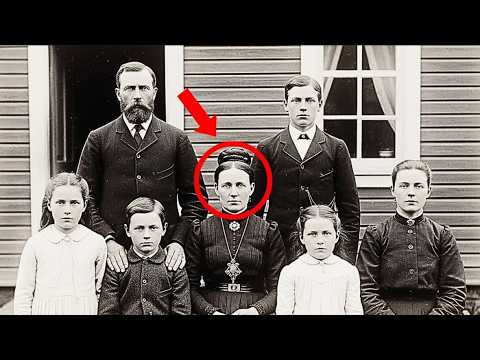
“It’s dated 1890,” Daniel said, pointing to faint pencil marks on the back. “Philip and Catherine Foster family—those are our ancestors.” Rebecca leaned in, studying the faces. The man stood tall with a thick beard, his hand resting on the shoulder of a boy. Three other children ranged in age from perhaps six to fifteen, but it was the woman, Catherine, who drew their attention.
She stood slightly apart, her dark dress formal and high-necked, her hair pulled back severely. Her eyes seemed to hold something beyond the typical stoicism of old photographs—a depth, a weight of experience. Around her neck hung an ornate necklace, clearly visible even in the aged photograph. The piece seemed elaborate for what appeared to be a modest household.
“That’s beautiful,” Rebecca said. “I wonder if it still exists somewhere.”
Daniel pulled out his phone and activated the camera, zooming in on Catherine’s face. The modern technology brought the image into sharper focus. He moved the frame slowly across her features, then down to the necklace. He froze.
“Rebecca, look at this.”
She leaned over his shoulder as he zoomed further into the pendant. What had seemed like simple ornamentation revealed something impossible. Inside the pendant’s center was another photograph—a face, a child’s face, an African-American girl. But this child appeared nowhere in the family portrait.
Rebecca grabbed the phone from Daniel’s hand, her fingers trembling as she adjusted the zoom. The image remained clear: a young African-American girl, perhaps eight or nine years old, her expression serious, her hair braided close to her scalp. The photograph within the photograph measured no more than a quarter inch in diameter, yet the detail was extraordinary.
“How is this even possible?” Rebecca whispered. “Photography in 1890 couldn’t capture something this small, could it?”
Daniel took the phone back, capturing a screenshot. “Actually, it could. I remember reading about microphotography. It was a Victorian technique—incredibly rare and expensive. They used specialized lenses to photograph tiny portraits that could fit inside jewelry. But why would Catherine have a picture of this child hidden in her necklace?”
They sat in silence, the attic’s heat suddenly oppressive. Daniel looked again at Catherine’s face in the larger portrait—at the subtle set of her jaw, the way her eyes seemed to carry secrets.
“The child isn’t part of the family,” Rebecca said slowly. “At least not officially. So who was she?”
Daniel stood and began searching through nearby boxes with renewed urgency. Their grandmother had been meticulous about family history, keeping documents and letters organized by generation. If there was an explanation, it would be here.
Rebecca pulled out a wooden box marked with Catherine’s name. Inside lay a collection of papers—receipts, letters, a small leather-bound journal. She opened the journal carefully, its pages brittle with age. The handwriting was elegant but hurried, as if written in stolen moments.
“Listen to this,” Rebecca said, reading aloud. “March 15th, 1888. Another soul passed through last night. I gave her bread and the warmest blanket we could spare. She wept when she saw her freedom papers. Philip says I must be more careful. But how can I turn away from this work?”
Daniel’s breath caught. “Passed through. Freedom papers. Rebecca, Catherine was part of the Underground Railroad.”
“But the Civil War ended in 1865,” Rebecca said, confusion crossing her face. “The Underground Railroad stopped operating after emancipation.”
“Not entirely,” Daniel replied. “Even after the war, there were cases—people still enslaved in remote areas, children separated from families during slavery who needed help reuniting. The network didn’t completely disappear.”
Rebecca turned more pages, finding entries that spoke of packages delivered, of stations and conductors—the coded language of the Underground Railroad. Catherine’s words painted a picture of a woman who had risked everything to help others find safety. But nowhere did Catherine mention the child in the photograph.
Two days later, Daniel and Rebecca sat across from Dr. Helen Okonkwo in the climate-controlled archive room of the Historical Society of Pennsylvania. The original photograph lay between them on a padded examination table. Dr. Okonkwo, a specialist in nineteenth-century photography and African-American history, studied the image through a jeweler’s loupe.
“This is remarkable,” she said, adjusting the magnification. “The microphotograph is exceptionally well preserved. The technique was called Stanhope photography, named after the optical devices used to view them. But finding one embedded in a necklace documenting an African-American child in this context—this is genuinely extraordinary.”
She set down the loupe and pulled her laptop closer. “You said Catherine’s journal referenced Underground Railroad activity in the late 1880s.”
“Yes,” Daniel confirmed. “The entries span from 1885 to 1891.”
Dr. Okonkwo nodded, typing rapidly. “That aligns with what we know about post-war rescue efforts. Many formerly enslaved children were separated from their parents during the war. Some were held illegally, others trapped in exploitative labor. There were organized efforts—often led by women like Catherine—to locate these children and reunite them with family.”
She pulled up a database of historical records. “Without a name, we’re searching through thousands of possibilities. Did you find anything else?”
Rebecca scrolled through photos on her phone. “There was this—” She stopped at an image of a folded paper. “We didn’t open it fully because it seemed fragile, but you can see names on the outside.”
Dr. Okonkwo enlarged the image. The writing was faded but legible: Sarah, Delaware, 1889, delivered to freedom.
“Sarah,” the archivist repeated softly. “Delaware in 1889 would fit the timeline. If Catherine helped this girl escape and kept her photograph in her necklace, there was something deeply significant about this case.”
Daniel leaned forward. “How do we find out more about Sarah?”
Dr. Okonkwo smiled, though her expression carried weight. “We’ll need to search Freedmen’s Bureau records, Quaker Society documents, church registries, county records from Delaware. Many of these children’s stories were deliberately hidden to protect them.” She looked again at Catherine’s face in the photograph. “But your ancestor clearly thought this story was worth preserving. She wore this child’s face next to her heart. That tells me Sarah’s story matters.”
Three weeks of research had transformed Daniel’s dining room into a makeshift archive. Papers covered every surface—photocopies of census records, printed emails from historical societies, timelines scrolled on poster board. Rebecca visited most evenings after work, and tonight she brought news.
“I found something,” she said, laying her laptop on the table. “Dr. Okonkwo connected me with a researcher in Delaware who specializes in post-Civil War African-American communities. Look at this.”
The screen displayed a scanned document from the Dover Quaker Meeting House, dated September 1889. The entry read: Received into our care one child, Sarah, aged approximately nine years, delivered from unlawful bondage by friends working in coordination with Philadelphia contacts. Child shows signs of previous ill treatment but is in fair health. Placed temporarily with the household of Thomas and Mary Pritchard.
Daniel read the entry three times. “This has to be her. The timing matches exactly. Philadelphia contacts—that’s Catherine.”
“There’s more,” Rebecca said, scrolling down. “Listen: Young Sarah has made remarkable progress. After extensive inquiries, we have located her mother, Eliza, who was sold away from Delaware in 1882 and has obtained her freedom in Maryland. Reunion arranged for April 1890. The joy of mother and child upon seeing each other after eight years is beyond description.“
Silence filled the room. Daniel looked at the family photograph propped against the wall. “She reunited them,” he said quietly. “Aunt Catherine helped save Sarah and reunite her with her mother.”
Rebecca wiped her eyes. “Eight years old when they were separated.”
Daniel zoomed in again on Sarah’s serious young face. What courage had it taken? What had it meant to Catherine that she succeeded in this rescue?
“Why this child?” Rebecca asked. “Catherine helped dozens of people. Why was Sarah the one whose photograph she kept?”
Daniel clicked through files, stopping at a Quaker meeting record. The entry about Sarah’s arrival included: Child bears a scar upon her left forearm, result of a burn, and shows considerable distress when approached suddenly. His stomach tightened. The clinical language couldn’t hide the implications.
“Maybe Catherine couldn’t forget what had been done to this little girl,” he said softly. “Wearing her photograph was a promise that she wouldn’t be forgotten.”
Daniel returned to his grandmother’s attic on a cool Saturday morning, convinced they had missed something. He worked methodically through boxes, checking inside books for loose papers, examining drawer undersides, looking for hiding places a careful woman might use.
In a wooden secretary desk, he found a drawer that seemed shallower than it should be. He removed it completely and felt along the interior space. His fingers touched paper. A package of letters tied with faded ribbon had been concealed in the false bottom. The top letter was addressed to My dearest Catherine in careful, newly literate handwriting.
He read: “My dearest Catherine, I hope this letter finds you well. I write to tell you that Sarah and I are settled now in Baltimore. She’s growing so tall and strong. You would not recognize the frightened child you delivered to Dover. She speaks of you often and asks me to send her love. She says you promised she would see her mama again and because of you, she did. I cannot ever repay what you’ve done for us. Your friend always, Eliza.”
The letter was dated June 1890. Daniel photographed it and continued reading. Seven more letters spanned three years, documenting Sarah’s progress, her education, her health—small details Eliza thought Catherine would want to know.
In December 1891, Eliza wrote: Sarah asks me to tell you she’s learning to read very good now. The teacher says she has a gift. She made me promise to tell you special that she is not afraid anymore when it gets dark. She says remembering you told her she was brave helps her feel safe.
Daniel sat back, overwhelmed. These weren’t just reports. They showed continued relationship. Catherine hadn’t simply rescued Sarah—she had become someone whose words carried comfort long after they parted.
The final letter, dated March 1893: Dear Catherine, I must tell you Sarah and I are moving to Philadelphia. I have found work at a textile factory. Sarah made me promise to ask—could we visit you? She would very much like to thank you herself. With deepest gratitude, Eliza.
Daniel immediately called Rebecca. “They came to Philadelphia. They might have met Catherine again.”
On the envelope’s back, he noticed Catherine’s handwriting: Answered April 2nd, 1893. They will come to tea on Sunday.
They had met again.
Dr. Okonkwo laid a final folder on the table—Sarah’s 1952 estate records. Among them, a single line in her will: “To my students, I leave what was given to me: the belief that you are worth everything.”
Daniel closed the folder. “She never stopped passing it on.”
Rebecca looked at the family portrait one last time. “Catherine wore a stranger’s child over her heart. Sarah spent her life proving that child mattered.”
Outside, autumn leaves drifted past the window. Daniel understood now—the portrait wasn’t a secret to protect, but a promise to keep.
“What would you do,” he asked quietly, “if you found a face hidden in your family’s past?”
What would you do—keep it close, or set it free?
Report this article
Select a reason for reporting:






