In the summer of 2012, beneath a municipal car park in Leicester, England, a team of archaeologists cracked open the earth and found a skeleton. It was curled into a shallow grave, spine twisted into an unmistakable scoliotic curve, hands still crossed at the wrists. The bones were old—very old. And the moment the team saw that spine, one name surfaced: Richard III, the last Plantagenet king, dead since 1485, missing for five centuries.
The discovery seemed to close a very old case. Carbon dating, battle injuries, age at death—everything lined up. But there was another round of testing still to come, and this one wasn’t about the spine. It was about the blood.
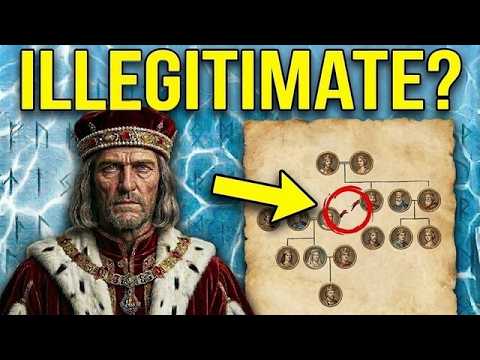
The moment the DNA results arrived, something broke. Not in the skeleton, but in the dynasty. The Y chromosome—the genetic signature that should have run clean and unbroken through the male Plantagenet line—did not match the living male-line descendants at all. And the DNA doesn’t tell us where the break happened. It just tells us it did.
To understand why that result matters, you have to understand who Richard III was supposed to be, and how completely history thought it already knew him.
Richard III is one of the most infamous figures in English history, and almost everything people know about him comes from one source: Tudor propaganda, crystallized by Shakespeare. The hunchback, the child murderer, the scheming usurper who killed his nephews in the Tower of London and seized the throne through treachery.
This image was deliberately constructed by the regime that replaced him. Henry VII, who defeated Richard at Bosworth Field in 1485, needed Richard to be a monster. The Tudors needed the Plantagenets to be illegitimate, corrupt, unworthy. So that’s what the chronicles said. And that’s what stuck.
The physical deformity was part of the story. Medieval and Tudor writers used bodily abnormality as a kind of moral shorthand—a twisted body as evidence of a twisted soul. Scholars largely accepted that the scoliosis had been real, but exaggerated.
The location of the burial was also treated as settled, at least theoretically. Richard had been interred at Greyfriars Church in Leicester. The church was later demolished. The site was built over, but the general location was known. Nobody had seriously gone to look.
And the lineage? That was simply not in question. Richard III was a Plantagenet. Edward III was his great-great-grandfather. The line ran through John of Gaunt, through the Dukes of York, and finally to Richard himself. This was genealogy. It was documented. It was drawn in careful heraldic trees and confirmed by royal record. It had been settled for centuries.
The bones matched. The history matched. But one test remained, and it didn’t.
Here is the thing about genealogical records. They track names. They track titles, marriages, children, successions. What they do not, cannot do, is verify biology. A genealogical record says that a certain child was born to a certain father. It records what was believed or claimed at the time. It says nothing about what actually happened in the bedroom.
DNA does not make that assumption.
And remarkably, until 2012, nobody had ever tested the Plantagenet male line against genetic evidence. No one had extracted a Y chromosome from any known Plantagenet remains and compared it to living male-line descendants. The idea simply had not been done.
Royal genealogy was a paper science—documents, chronicles, heraldry. The genetic dimension did not exist yet. And even once it became possible, the question was not asked. That was the blind spot. Not stupidity, not negligence, just a gap that nobody had thought to fill, sitting quietly inside one of the most studied dynasties in history.
The Leicester team set out to fill it. But this is where the difficulty of the science becomes its own kind of story.
Ancient DNA from medieval bone is not a clean sample. It degrades, it fragments, it gets contaminated by the soil, by bacteria, by the DNA of every person who handled the remains across centuries. Extracting anything usable from a skeleton buried since 1485 requires careful, painstaking laboratory work. And even then, success is not guaranteed.
But the bigger challenge wasn’t the skeleton. It was finding the right comparison. To test the Y chromosome, you need living male-line descendants—men who carry the same unbroken paternal lineage from a known common ancestor. Finding those men required a completely separate research track, genealogical detective work running across five centuries, tracing male lines forward through dozens of generations, eliminating branches that died out, following the ones that survived.
Eventually, two male-line descendants were identified. One in Canada, one in Australia. Both tracing their direct paternal ancestry back to a common Plantagenet root.
So now you have two tracks: a degraded medieval skeleton and two living men on opposite sides of the world. Both tracks have to work. If the DNA from the bones is too damaged to read, the test fails. If the genealogical research has a flaw, the comparison is worthless. Either one collapses the whole thing.
The first results came back on the maternal line—mitochondrial DNA, passed through mothers. The team compared Richard’s remains to living female-line descendants traced through the same genealogical method. The match was clean. The maternal line confirmed. The skeleton was Richard III. Everything was working.
Then the Y chromosome results came back. The maternal line held. The paternal line did not. And those are not the same kind of problem.
Here is the result, stated plainly: Richard III’s Y chromosome does not match the Y chromosomes of the living male-line Plantagenet descendants. Somewhere in the line between Edward III, who died in 1377, and Richard III, who died in 1485, a son in the official record was not biologically fathered by the man history says was his father. One break. One non-parental event. Clean and unambiguous in the data.
The researchers were careful with their language, as they should be. They used the term false paternity event. They did not say fraud. They did not name anyone. The break could have been the result of an affair, a secret the family never knew about, a child quietly accepted without question. These things happened. They happen still. What the DNA tells you is simply that somewhere in that 140-year window, the biological and the documented diverged.
Now, here is what makes this impossible to dismiss. The mismatch is not a borderline result. It’s not a statistical maybe. The Y chromosomes are clearly non-matching, not weakly similar. And the mitochondrial confirmation on the other side means this cannot be explained by contamination, sample mix-up, or laboratory error. If the sample were contaminated or misidentified, both tests would be wrong. Only one is.
The result was peer-reviewed and published in Nature Communications in 2014. It holds.
What it rules out is significant. It rules out an unbroken legitimate biological male line from Edward III through to Richard III. It rules out the assumption, held uncritically for centuries, that genealogical documentation equals biological reality in royal succession. And it reopens, without resolving, a question that nobody in 1485 could have asked: which ancestors in this line were actually whose sons?
The researchers identified five generations in which the break could have occurred. Five generations of Plantagenet men, any one of whom might be the point where the biological line quietly departed from the written one.
Some of those figures carry more historical shadow than others. John of Gaunt, Edward III’s formidable son, has attracted attention. His mother, Philippa of Hainault, was the subject of some contemporary whispers, though the evidence is thin. Others have pointed to later in the line, toward Richard, Duke of York, and his own recorded parentage. But the DNA cannot target any specific individual. It can only define the window.
And the window contains kings. If the break occurred early enough in that span—before certain rulers rather than after—then the claim those men held to the English throne rested on a lineage that was already, biologically speaking, severed.
The Wars of the Roses, the most violent succession crisis in medieval English history, was fought by factions both claiming legitimate descent from Edward III. Both sides were prepared to go to war over the purity of their blood. And beneath it all, invisible to every person fighting and dying over that question, there may have been a fracture that made the entire argument moot. History’s most devastating legitimacy war, possibly built on an illegitimacy nobody knew existed.
This is not a story unique to England or to Richard III. The Leicester case was striking because of how famous the subject was, but the pattern it revealed is not unusual. Studies of other European aristocratic lineages have found similar results. Gaps between the documented record and the biological reality. Non-paternity events quietly lodged inside dynasties that staked their entire authority on the cleanliness of their blood.
The estimated rate of false paternity in pre-modern populations runs at roughly 1 to 3% per generation under normal conditions—and possibly higher in contexts where political pressure shaped whose name appeared on a birth record. Across enough generations, in a line long enough, a single break becomes statistically unremarkable. What is remarkable is that nobody thought to look. That the tools existed for years before anyone used them on the Plantagenet line. That a car park in Leicester had to give up a skeleton before the question was finally asked.
To be clear about what remains uncertain: the study cannot tell us who. It cannot name the man whose father was not who the record says he was. Speculation about specific figures is not supported by the DNA alone and should be held lightly. What the DNA does is fix the boundaries of the problem. It confirms the fracture. It narrows the window to five generations. And it permanently ends the assumption that the Plantagenet male line ran in clean biological continuity from Edward III to the last king who bore that name.
What no one can say—and what may never be resolved—is whether knowing this, had anyone been able to know it at the time, would have changed anything at all. Whether the armies that met at Bosworth Field would have laid down their weapons if they understood that the bloodline they were fighting over had already silently ceased to exist in the biological sense.
That question has no answer.
The bones are in Leicester Cathedral now, reinterred with ceremony, with a stone tomb and an effigy, and the full weight of royal acknowledgement. The name on the tomb is Richard III. That part isn’t in dispute. The skeleton is his.
But the line—the blood, the dynastic claim, the thing that made a Plantagenet a Plantagenet—that is now a question with no clean answer. The Y chromosome result hasn’t changed. It will not change. It sits in the published record, quiet and permanent.
Think about what the skeleton actually survived. Five hundred years under a parking lot, the demolition of the church above it, the complete reorganization of the city around it. It outlasted the dynasty it belonged to. It outlasted the Tudors who destroyed that dynasty. It outlasted every version of the story that was told about it.
And when it was finally found, finally tested, the first thing it did was crack open the one part of the story everyone thought was settled.
The spine was real. Shakespeare got that much right, buried beneath all the slander. The curvature was there, in the bone. But the blood—the pure royal blood, the unbroken chain, the legitimacy that kings killed for—that part turned out to be a story. Not a lie anyone told consciously. Not a conspiracy. Just a gap between what was written and what was true, passed forward through generations until it reached a man in a shallow grave who had no idea it existed.
Somewhere in the Plantagenet line, a child was born and given a father’s name, and nobody questioned it. And the whole machinery of dynastic succession moved forward as if the record were real. And for five and a half centuries, it was—because nobody checked.
So here is what we are left with: a king in a cathedral, a chromosome that refuses to lie, and a question that history never thought to ask. If the blood was never pure, was the war ever worth fighting—and would you have wanted to know?
Report this article
Select a reason for reporting:






