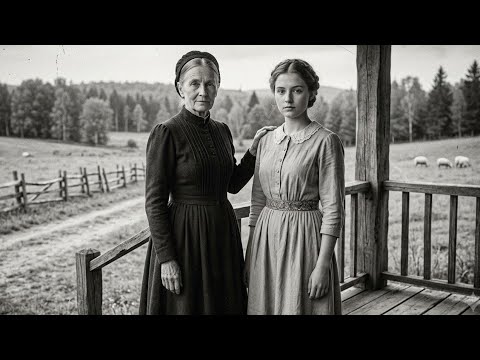
Dr. Sarah Chen had examined thousands of historical photographs in her career as a medical historian at Boston University, but on that Tuesday morning in March 2024, a worn cardboard box smelling of attic dust and old paper made her pause before she even removed the protective sleeve. The image inside showed two women standing outside a modest wooden house, their expressions serious in the way people posed for cameras in 1887. The older woman, perhaps in her 40s, wore a simple dark dress with a white apron, her rough, capable hands resting on the shoulders of a younger woman barely 20. Both had dark hair pulled back severely, and both stared directly at the camera with an intensity that seemed to reach across more than a century.
But it was the necklace that caught Sarah’s attention. Both women wore identical pieces—delicate chains holding small pendants carved from wood or bone, inscribed with botanical symbols: leaves, flowers, and something that might have been a root system. Sarah leaned closer, her breath fogging the protective glass of her examination lamp. “Michael,” she called to her assistant, “did they include any documentation? Letters, journals, anything?”
Michael appeared in the doorway carrying two cups of coffee. “There’s a small leather notebook. Looks handwritten, but it’s in pretty rough shape. And there’s this.” He held up a small cloth pouch. Inside, wrapped in yellow tissue paper, was a necklace identical to the ones in the photograph. Sarah’s hands trembled slightly as she unwrapped it. The pendant was carved from dark wood, smooth from years of wear. The botanical symbols were even clearer in person: chamomile, raspberry leaf, and something she recognized from her research into traditional medicine—blue cohosh, an herb midwives once used during childbirth.
She turned the pendant over in her palm, noticing for the first time tiny initials carved into the back: CM and AK. The letters were barely visible, worn almost smooth by time and touch. Someone had worn this necklace for years, perhaps decades. Someone had valued it enough to keep it safe, to pass it down. Sarah looked back at the photograph at the two women with their matching necklaces and their determined faces. They weren’t just posing for a picture. They were documenting something, preserving something, making sure that someone someday would see them and understand.
“Well, let’s start with the notebook,” Sarah said, setting down her coffee. “Whatever these women wanted us to know, I think they left us the evidence to find it.” The leather notebook sat on Sarah’s desk like a challenge. Its pages were brittle, the ink faded to brown, and the handwriting—cramped and urgent—was almost illegible in places. Sarah had spent three days just preparing to open it properly, consulting with the university’s conservation department to ensure she wouldn’t damage it further. Now, wearing cotton gloves and using a wooden spatula to gently separate the pages, she began to read.
March 14th, 1887, delivered Mrs. Kowalski’s fourth child at dawn. Boy, healthy, 8 lb. She had no money, but gave me eggs and bread. Her husband works at the mill, and they cannot afford the hospital fees. I did not ask for payment.
The entries continued in the same matter-of-fact tone, each one recording a birth, the mother’s name, the baby’s condition, and sometimes a note about payment or lack thereof. But between these clinical observations, another story emerged. The hospital on Beacon Street turned away Mrs. O’Brien today. They said her kind wasn’t welcome. Her kind? She’s Irish and poor and her husband died in a factory accident last month. I will attend her when her time comes. Sarah’s chest tightened as she read. The writer, presumably the older woman in the photograph, wasn’t just documenting births. She was documenting a system of exclusion—of deliberate medical neglect based on ethnicity, poverty, and social status.
May 2nd, 1887. Mrs. Washington came to me in secret. She is a Negro woman whose mistress does not know she is with child. The white doctors will not see her. I promised her I would be there and I will keep my promise. The notebook spanned five years, from 1885 to 1890, and contained records of more than 200 births. Sarah cross-referenced the names with city birth records and found something remarkable: many of these births had no official documentation. No hospital records, no physician signatures, nothing. These children had been born in the shadows of official society, delivered by hands that left no trace in the archives. But the midwife had kept her own records. She had borne witness.
As Sarah continued reading, she noticed something else. Every few pages, there was a small symbol drawn in the margin—the same botanical designs from the necklace—and next to some entries, there were additional initials: AK, the same letters carved into the back of the pendant. “Michael,” Sarah called out, her voice tight with excitement. “I need you to search birth records for anyone with the initials AK, who was born or lived in Boston between 1865 and 1875, and cross-reference it with immigration records from Ireland.”
This wasn’t just one woman’s story. It was two women’s story, and Sarah was determined to uncover both of them. She found the first real clue to the midwife’s identity in an unexpected place: a property deed from 1884. The address matched the house in the photograph—a small dwelling on what was then the outskirts of Boston, now absorbed into the city’s sprawl. The deed was registered to a woman named Katherine Morrison.
Armed with this name, Sarah dove into census records, immigration documents, and church registries. Katherine Morrison, born Katherine O’Sullivan in County Cork, Ireland, had arrived in Boston in 1868 at age 19. She married Thomas Morrison, a dock worker, in 1869. Thomas died in 1876 of tuberculosis, leaving Katherine a widow at 27 with no children of her own. But the trail went cold after Thomas’s death. There were no property transactions, no legal documents, nothing until the 1884 deed—when Katherine suddenly had enough money to purchase the house outright.
“How does a widowed immigrant woman with no recorded employment buy property?” Sarah wondered aloud. Michael, who had become increasingly invested in the mystery, looked up from his laptop. “Maybe she inherited it.” “From whom? Her husband was a dock worker. His estate inventory listed furniture worth $12.” Sarah tapped her pen against her notebook. “No, she earned this money. The question is, how?”
The answer came from an unlikely source: a medical journal from 1883. Sarah had been searching through archives of the Boston Medical Society when she found a heated editorial titled “The Problem of Unregulated Birth Attendance.” The author, a prominent physician, railed against “ignorant women” who practiced midwifery without formal training, calling them a danger to public health and a threat to legitimate medical practice. But buried in his diatribe was a detail that made Sarah’s pulse quicken: “These women charge fees far below what any qualified physician can afford to offer, creating an unfair marketplace that drives patients away from proper medical care.”
Katherine Morrison wasn’t just delivering babies out of charity. She was running a business—one that served patients the hospitals refused to treat. And she was successful enough to buy property. Sarah pulled out the photograph again, studying Katherine’s face with new understanding. This wasn’t a simple portrait of a midwife and her helper. This was a portrait of a businesswoman and her partner, two women who had built something significant in a world that didn’t want to acknowledge their work. The necklaces suddenly made more sense. They weren’t just decorative. They were a symbol of partnership, of shared purpose, of a legacy being deliberately passed from one generation to the next.
But who was AK? And why had her identity been so carefully hidden from the official record? The young woman in the photograph, the one wearing the matching necklace, proved harder to identify. The notebook made occasional references to “my apprentice” or “the girl who helps me,” but never used a full name. Sarah spent weeks searching for any connection between Katherine Morrison and young women in the 1880s census data, checking domestic servants, boarders, and distant relatives. The breakthrough came from an unexpected source: a letter tucked into the back of the notebook that Sarah had initially overlooked.
The paper was different from the notebook pages—finer quality, with a watermark. The handwriting was different, too: younger, more confident, with carefully formed letters. Dear Katherine, I’m writing to tell you that I successfully delivered Mrs. Brennan’s twins last night. Both girls, both healthy, though it was a difficult birth. I used the technique you taught me with the raspberry leaf tea, and it helped considerably. Mrs. Brennan’s husband is a cooper and has little money, but he made me a beautiful wooden box as payment. I will treasure it always. Your grateful student, Anna.
There was no last name, no date, no return address. But it was a start. Sarah now had a first name: Anna. And the initials AK suggested her last name began with K. Michael spent three days combing through immigration records, census data, and church baptismal records. Finally, late on a Friday afternoon, he burst into Sarah’s office with a triumphant expression. “Anna Kelly,” he announced, dropping a printout on her desk. “Born in Cork, Ireland, in 1867. Immigrated to Boston in 1883 at age 16, orphaned. Both parents died of fever before she left Ireland. She was sponsored by a Women’s Aid Society and placed in domestic service.”
Sarah scanned the document, her heart racing. “Does it say where she was placed? With a widow named Katherine Morrison?” Michael grinned. “Listed as a household servant in the 1885 census. But here’s the interesting part: by the 1890 census, she’s listed as Katherine’s ward, not her servant. And her occupation is listed as ‘medical assistant.'” Sarah sat back in her chair, pieces falling into place. Katherine had taken in a young orphan, given her a home, and trained her in a profession. The relationship had evolved from employer and servant to mentor and student—and eventually to something like mother and daughter.
“They built this together,” Sarah murmured, touching the photograph gently. “Katherine taught Anna everything she knew, and Anna carried it forward.” The real scope of Katherine and Anna’s work began to reveal itself when Sarah started cross-referencing the names in the notebook with city records. She created a database, painstakingly entering each birth recorded in Katherine’s handwriting, then searching for any corresponding documentation in official archives. The pattern was stark and disturbing. Of the 247 births recorded in the notebook between 1885 and 1890, only 89 appeared in hospital records. The rest—158 births—existed only in Katherine’s careful documentation. These were children born to women the medical establishment had refused to serve.
Sarah mapped the addresses. They clustered in specific neighborhoods: the North End, where Italian immigrants crowded into tenements; the West End, home to Irish and Jewish families; and scattered addresses in the South End, where Black families lived in boarding houses and cramped apartments. “Look at this,” Sarah told Michael, pointing to her map. “Katherine wasn’t just serving her own neighborhood. She was traveling all over the city, going wherever she was needed.” The notebook revealed the logistics. Katherine charged on a sliding scale. Wealthy families paid $5, working families paid $2, and the poorest paid nothing at all—or paid in goods and services: a loaf of bread, a repaired shoe, a bundle of firewood. Katherine accepted it all and recorded it meticulously.
But there was something else in the records, something Sarah almost missed at first. Every few months, there were entries marked with a small star in the margin. These births had no names attached—just initials and a location. And they were always attended by both Katherine and Anna together. March 17th, 1888. Difficult birth. Mother survived, but barely. CM and AK both attended. No complications with the child. Mother asked us to find her a safe place. We obliged. Sarah’s breath caught. These weren’t just difficult births. These were women in crisis—women who needed more than medical care. They needed protection, secrecy, and help that went far beyond delivering a baby.
Katherine and Anna weren’t just midwives. They were operating something like an underground network, helping women whose circumstances made them vulnerable: women escaping abusive situations, women whose pregnancies had to be hidden, women who had nowhere else to turn. The necklaces took on yet another meaning. They were a signal—a way for women in need to identify Katherine and Anna as people who could be trusted, people who would help without judgment, without questions, without involving authorities who might make things worse. Sarah held the pendant in her hand, understanding now why it had been worn smooth. It hadn’t just been worn for years. It had been shown to dozens, maybe hundreds of desperate women who needed to know they were safe.
Sarah’s research took an unexpected turn when a woman named Eleanor Rodriguez answered her genealogy forum query. Eleanor’s great-great-grandmother, Rosa Martinez, had been delivered by a midwife in Boston in 1889—and family stories mentioned a necklace with botanical symbols. They met at a Cambridge coffee shop on a rainy April morning. “Rosa kept this her whole life,” Eleanor said, opening a small wooden box. “She told my great-grandmother that two women with necklaces like this saved her life.”
Inside were letters in Spanish and a scrap of fabric embroidered with the same symbols. Rosa had written that the midwives asked no payment—only that she pass on the kindness. She became a midwife herself, serving Boston’s Mexican community, and passed the tradition to her daughter. “I’m a retired nurse,” Eleanor said. “I like to think I carried on what they started.”
More stories flooded in—Providence, Worcester, a Chinese immigrant family with a faded drawing of the symbols. The network was larger than Sarah had imagined, spanning cities, communities, generations. The symbols were a shared language of trust.
The final piece came from Anna Kelly herself. Sarah found her 1947 obituary and, through the Cambridge Historical Society, her donated papers—including a continuation of Katherine’s notebook. Tucked in front was a letter from Katherine, dated 1889: “I give you this notebook to continue the work we have built together. You came to me as a frightened orphan, and you have grown into a skilled and compassionate healer. I am proud to call you my daughter in all but blood.”
Anna had added her own note: “I received this letter on the day Katherine passed away. I was 22 and terrified I could not continue without her. But I remembered her words. We are witnesses. So I witnessed, I recorded, I served, and I taught others just as she taught me.”
Sarah presented her findings at a conference in October 2024. Eleanor was in the audience with her daughter and granddaughter. “I wanted them to hear this,” she said. “To know that our family has always been about helping others.”
Months later, a Vermont midwife wrote to Sarah. Her grandmother had left her a wooden pendant carved with botanical symbols, trained by a woman who claimed to be part of a long tradition. “I wear the pendant when I attend births,” she wrote. “I didn’t understand what it meant until I read your research. Now I do. The work continues.”
Sarah kept that letter beside the photograph of Katherine and Anna. Two women who wore their necklaces as a promise—kept across generations, passed from hand to hand, teacher to student. They were no longer invisible. They had been seen, understood, and their legacy carried forward into a new century.
What forgotten story in your own family might be waiting to be uncovered?
Report this article
Select a reason for reporting:






